Dennis Wheatley - Vendetta in Spain
Здесь есть возможность читать онлайн «Dennis Wheatley - Vendetta in Spain» весь текст электронной книги совершенно бесплатно (целиком полную версию без сокращений). В некоторых случаях можно слушать аудио, скачать через торрент в формате fb2 и присутствует краткое содержание. Жанр: Старинная литература, на английском языке. Описание произведения, (предисловие) а так же отзывы посетителей доступны на портале библиотеки ЛибКат.
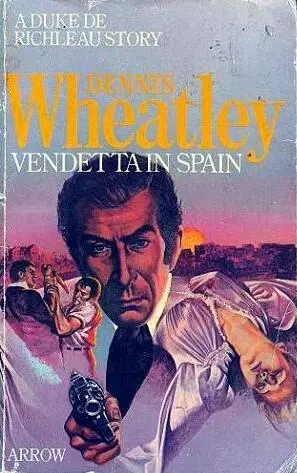
- Название:Vendetta in Spain
- Автор:
- Жанр:
- Год:неизвестен
- ISBN:нет данных
- Рейтинг книги:4 / 5. Голосов: 1
-
Избранное:Добавить в избранное
- Отзывы:
-
Ваша оценка:
Vendetta in Spain: краткое содержание, описание и аннотация
Предлагаем к чтению аннотацию, описание, краткое содержание или предисловие (зависит от того, что написал сам автор книги «Vendetta in Spain»). Если вы не нашли необходимую информацию о книге — напишите в комментариях, мы постараемся отыскать её.
Readers of
and other books in which the glamorous Lucretia-Jose appears with the Duke de Richleau may recall that her parentage was surrounded by mystery. Over the years many people have written, asking for an account of the great romance that led to her birth.
The story takes us back to Spain, in 1906, when the Duke had not yet succeeded his father, and was still the Count de Quesnoy. In these days it is not easy for us to realize that, less than fifty years ago, there was hardly a Monarch or President who could leave his bed in the morning with any certainty that he would live through the day. Anarchism permeated every country in Europe. Not a night passed without groups of fanatics meeting in cellars to plan attempts with knives, pistols or bombs against the representatives of law and order; not a month passed without some royalty or high official falling a victim to their plots.
In Spain, an historic bomb outrage that led to scores of innocent people being killed or injured, gave de Quesnoy ample cause to vow vengeance on the assassins. His attempt to penetrate anarchist circles in Barcelona nearly cost him his life. In San Sebastian, Granada and Cadiz he hunted and was hunted by them in a ruthless vendetta. Only after two years did it end in a final desperate gamble with death.
It is against this background of true history, subtle intrigue, sudden violence, terrorism, blackmail and suspense that there develops the bitter-sweet romance between the gallant young de Quesnoy and the beautiful Condesa Gulia, the wife of a friend he loves and honours. Their frustrated passion leads to a denouement that rivals in surprise and breath-taking effect the outcome of his vendetta against the anarchists.
Vendetta in Spain — читать онлайн бесплатно полную книгу (весь текст) целиком
Ниже представлен текст книги, разбитый по страницам. Система сохранения места последней прочитанной страницы, позволяет с удобством читать онлайн бесплатно книгу «Vendetta in Spain», без необходимости каждый раз заново искать на чём Вы остановились. Поставьте закладку, и сможете в любой момент перейти на страницу, на которой закончили чтение.
Интервал:
Закладка:
In France Clemenceau was still Premier, but he was now having great trouble in holding together his coalition of Radicals and Socialists, and there were growing indications that the latter might split off and defeat him at the next election. The suppression of the Paris Commune, and all it stood for, in 1871 was now ancient history; but for a quarter of a century the memory of its threat to property, small as well as large, had made the majority of Frenchmen regard all workers' movements with the gravest suspicion. Since the 'nineties, however, they had gained ground by leaps and bounds. Recently the Marxists had fomented a great wave of militant strikes which, by the sabotaging of plant, had cost the country a vast sum, and had been put down only by adopting emergency measures. The anarchists, too, continued to be equally active and, following an attempt to assassinate President Fallieres, were jeopardizing the effectiveness of the army by a great campaign encouraging desertion and denouncing military service.
In Germany Kaiser Wilhelm II continued to give his Chancellor, Prince von Biilow, sleepless nights wondering what new tactless and bellicose utterance he might learn in the morning that his Royal master had given out - generally to some foreign correspondent who had played upon his vanity during a private interview. There had been serious trouble in Germany's Polish provinces and also in Alsace-Lorraine, but a combination of efficient administration backed by the Prussian jack-boot had kept both minorities under control. Commercially, Germany was enjoying an era of great prosperity and there could be no doubt at all that the Kaiser's policies of Colonial expansion and building a High Seas Fleet that could challenge the British Navy had the full support of his people.
Italy was still labouring under a vast burden of debt and the backwardness and superstition of her agricultural population. In the south and m Sicily, the government, the priests and the Mafia competed to rob the peasantry of their last centissimi, and the appalling earthquake that had a few months earlier annihilated the great port of Messina had added greatly to the general distress.
From Vienna the aged Franz-Joseph still ruled his vast multiracial Empire. It was said that he worked stolidly for longer hours per day than the most conscientious of his civil servants, endeavouring to reconcile Hungarians with Czechs, Poles with Ruthenians, Austrians with Italians and Croats with Serbs; yet none of his subject races was content and, many people thought, they were waiting only for his death to proclaim their independence.
Portugal had for a long while been bankrupt, and in a final attempt to restore his country's finances King Carlos had allowed his Prime Minister to assume the powers of a dictator. This had led, fifteen months earlier, to an attack by a band of assassins on the Royal carriage. The King and Crown Prince had been shot dead; the Queen had miraculously escaped a hail of bullets and her younger son Manuel had been only slightly wounded. Now, aged nineteen, he wore the Crown, but was no more than a puppet in the hands of a coalition government which was desperately endeavouring to stave off revolution.
In Spain no event of outstanding importance had taken place, and since de Richleau was not going there he only glanced through the back numbers of such Spanish periodicals as were available. Whatever countries he might decide to visit later he was going first to Russia, to take up his inheritance; so it was to the state of things in Russia that he gave the lion's share of his interest.
Only a year before he had been shipped off to South America the Tsar had at last given way to popular pressure and consented to elections being held for the purpose of creating a National Assembly. This first Duma - as it was called - was convened only as a consultative body. But as soon as it assembled it became apparent that its members were not going to be content to act merely as advisers to the government. The two largest parties - the Liberal Democrats and the Socialists - had both demanded that the Duma should control the executive. The Tsar had refused to yield and dissolved his first 'parliament'.
Thereupon the leaders of the Opposition had crossed the frontier into Finland and issued a violent protest known as the 'Viborg Manifesto'. It called on the Russian people to refuse to pay taxes or supply recruits to the Army and Navy until the Duma was restored. The government had then counter-attacked by establishing special courts to punish terrorists and agitators. A great purge of Socialists had been carried out and thousands of people sent into exile.
Early in 1907, by which time things seemed to have quietened down, elections for a second Duma were held; but, in spite of the purge, a Liberal-Socialist majority was again returned. The Tsar's Minister, Count Stolypin, had accused the Socialist members of conspiracy and demanded their expulsion. A Committee had been appointed to examine the evidence, but the public outcry was so great that, without even waiting for the findings of the Committee, the Tsar had again dissolved the Duma.
There had followed a period of what almost amounted to civil war. On the one hand the Government used its Secret Police, and a vast spy system, with the utmost ruthlessness in an attempt to stamp out all opposition - even executing scores of people for political offences committed two or three years earlier - on the other a great part of the normally law-abiding masses now helped to finance, hide and abet the Nihilists, who succeeded in murdering scores of police and officials.
The Government won, at least to the extent that, when a third Duma was summoned in the autumn of 1907, Stolypin had at last secured the tame assembly he desired. This enabled him to introduce such reforms as he could persuade the Tsar to agree to, and to prepare the way for the measures on which his heart was set. These were designed to substitute private for communal ownership, so that the peasants might own the land on which they worked; for it was his very sensible belief that the possession of private property would prove the best bulwark against revolution.
But matters were not moving swiftly enough for the Socialists and Marxists. They continued their underground warfare with unabated vigour. Not a day passed but shots were fired or a bomb thrown at some relative of the Tsar, one of his Ministers, a General, a Police Chief, or some high official and innumerable police agents were knifed or slugged on the head. And it was in a bomb outrage that de Richleau's father had lost his life.
The old Duke had held no official position of any kind, and had never taken Russian nationality; so he was still technically a Frenchman. He had left his estate only to attend a centenary celebration in Kiev, the capital of the Ukraine, as the guest of the Governor, Count Boris Plackoff, a cousin of his dead wife. As so often happened, the bomb had been badly aimed. None of its splinters even grazed the Governor, but they killed or wounded a dozen soldiers and spectators standing a few yards away from him, the Duke among them.
That both de Quesnoy's wife and father should have met their deaths in the same way was not, in fact, a particularly strange coincidence. Anyone in the vicinity of royalty or a Governor making a public appearance at that time was liable to fall a victim to an assassin; so it was no more surprising than if two people, both of whom at times climbed mountains, should both die as a result of mountaineering accidents. Yet the murder of his father re-aroused in the new Duke all the emotions to which he had been subject two and a half years earlier.
The facts that he had never regarded his father with more than respectful affection, that he had seen very little of him during the past fifteen years, and that he had benefited through his death by coming into a considerable fortune, hardly entered his mind. They were submerged under the salient fact that his parent, while an innocent bystander, had been violently and painfully done to death by a small criminal minority which sought to impose its will by acts of terror upon a vast law-abiding majority.
Читать дальшеИнтервал:
Закладка:
Похожие книги на «Vendetta in Spain»
Представляем Вашему вниманию похожие книги на «Vendetta in Spain» списком для выбора. Мы отобрали схожую по названию и смыслу литературу в надежде предоставить читателям больше вариантов отыскать новые, интересные, ещё непрочитанные произведения.


Обсуждение, отзывы о книге «Vendetta in Spain» и просто собственные мнения читателей. Оставьте ваши комментарии, напишите, что Вы думаете о произведении, его смысле или главных героях. Укажите что конкретно понравилось, а что нет, и почему Вы так считаете.