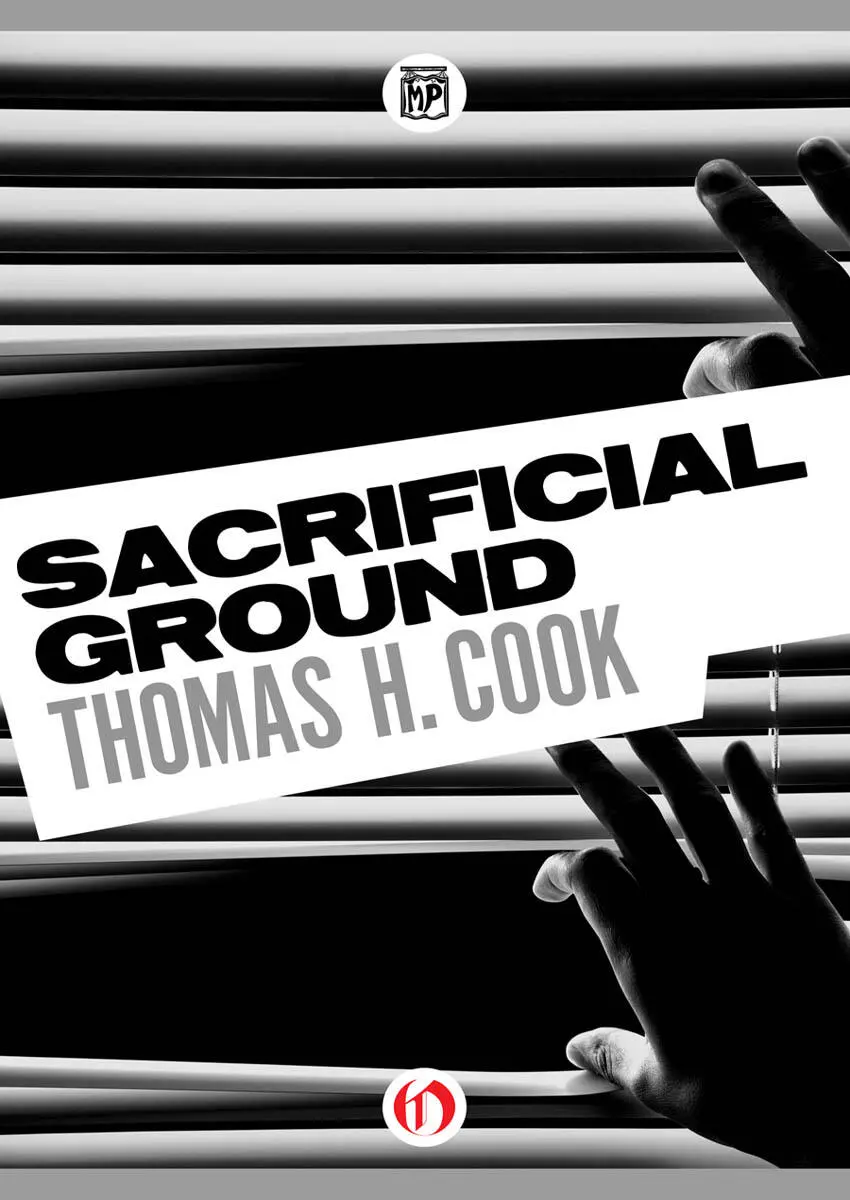
Thomas Cook - Sacrificial Ground
Здесь есть возможность читать онлайн «Thomas Cook - Sacrificial Ground» весь текст электронной книги совершенно бесплатно (целиком полную версию без сокращений). В некоторых случаях можно слушать аудио, скачать через торрент в формате fb2 и присутствует краткое содержание. Жанр: Старинная литература, на английском языке. Описание произведения, (предисловие) а так же отзывы посетителей доступны на портале библиотеки ЛибКат.
- Название:Sacrificial Ground
- Автор:
- Жанр:
- Год:неизвестен
- ISBN:нет данных
- Рейтинг книги:5 / 5. Голосов: 1
-
Избранное:Добавить в избранное
- Отзывы:
-
Ваша оценка:
Sacrificial Ground: краткое содержание, описание и аннотация
Предлагаем к чтению аннотацию, описание, краткое содержание или предисловие (зависит от того, что написал сам автор книги «Sacrificial Ground»). Если вы не нашли необходимую информацию о книге — напишите в комментариях, мы постараемся отыскать её.
Sacrificial Ground — читать онлайн бесплатно полную книгу (весь текст) целиком
Ниже представлен текст книги, разбитый по страницам. Система сохранения места последней прочитанной страницы, позволяет с удобством читать онлайн бесплатно книгу «Sacrificial Ground», без необходимости каждый раз заново искать на чём Вы остановились. Поставьте закладку, и сможете в любой момент перейти на страницу, на которой закончили чтение.
Интервал:
Закладка:
But suddenly the front door opened, and Karen walked out onto the grounds. She was dressed in a white blouse and long white skirt, as if she had decided to embrace the opposite of mourning. There was a single white ribbon in her hair, and the wind lifted it gently as he stepped out of the shadows and walked toward her.
She saw him instantly, and there was enough light for him to tell that her face did not change when she saw him. She stood very still, her arms at her sides, and waited as he neared her.
“The gate was open,” he said.
“Yes,” Karen said. She moved a few paces to the right, toward an enormous spray of summer roses. Their red petals had curled tightly for the night. She took one of them in her hand. “My father planted these for Angelica,” she said. She pointed toward another bush of white roses. “And he planted that one for me.” She looked at him closely. “Why are you here?”
“I’m not sure,” Frank said. “I went for a drive. I ended up here.”
“And the gate was open, as you said.”
“Yes.”
“I have a telephone, Mr. Clemons.”
“I know I should have called.”
“Why didn’t you?”
“I didn’t want to,” Frank said.
He waited for her to answer back, perhaps insult him. But she didn’t. Instead there was just silence, without so much as a whisper of wind.
“I went to see Arthur Cummings today,” Frank said finally.
“About the trust fund?”
“About that, and about Angelica.”
“You won’t learn anything from him,” Karen said dryly. She released the flower and it sprang from her hand. “Why did you come here?” she asked again.
For a moment, Frank tried to come up with an answer that would satisfy her, something that would make sense either to her or to Brickman when she complained about him the next day.
“The portrait,” he said at last, “the one you painted of your sister.”
“The one in Cummings’ office?”
“Yes,” Frank said. “When did you paint it?”
“When she was eight years old.”
“And so you were …”
“Twenty-two,” Karen said immediately. She took a slow, hesitant step into the darkness, like one testing the water of a pool. “Twenty-two,” she repeated. She moved again, this time slightly backward, and fixed her gaze on the lush summer grounds. “We used to play here,” she said, “the two of us.” She looked at him. “All those childhood games. I can look over there and remember tying her up, Indian-style.” She nodded to the right. “And under that tree was where they set up the buffet at her third birthday party.” She laughed quietly. “My father loved to do that sort of thing, throw a grand party.” She shook her head. “Some people look for money, and some people look for ways to spend it. My father loved to see money flow away from him, rivers of money into the arts, schools, all sorts of things.” She drew in a long, slow breath. “I think it was his way of being good. It was probably the only way he knew to be good.”
“Was he good to Angelica?” Frank asked.
“Yes, he was. And he was good to me, and to Mother.”
Frank resisted the impulse to pull out his notebook. “Angelica’s face, the one in the portrait.” He stopped, waited, then let it drop. “The eyes.”
He could see a little shiver of emotion run through her body, then gather in her face.
“You noticed them?” she asked.
“Yes.”
She smiled. “You’re the first.”
“I don’t believe that.”
She looked at him as if he had insulted her. “I don’t lie, Mr. Clemons.” Her eyes settled on him thoughtfully. “And to tell you the truth, I’m surprised you noticed.” She shrugged. “Some people have commented that the painting seems a little odd. But no one has ever realized that it’s all in the eyes.”
“They’re dead,” Frank said.
“Yes, they are.”
“Why?”
“I don’t know,” Karen replied. Her eyes swept over him. “The most I can say is that somehow I expected something terrible to happen to Angelica. When our parents died, I thought that that was it, the terrible thing. Then, later on, I knew that it wasn’t.”
“So you weren’t surprised by her death.”
“No,” Karen said.
“But if you—”
“We have a garden in the back,” Karen interrupted. “Do you like gardens?”
“I don’t know much about them.”
“You don’t have to,” Karen said. She smiled delicately. “I’m glad you came tonight. I guess you can understand that. I never thought it would feel this odd.”
“What?”
“To be absolutely alone.”
Frank nodded. “I’d like to see the garden,” he said.
“Good,” Karen said. “Come with me.”
He followed her around the side of the house to where the garden swept out before them, wet and gleaming in the evening dew. It was softly illuminated by small, bluish floodlights. There was a circular marble fountain, and here and there assorted pieces of statuary rose from flowerbeds or peeped over slender walls of carefully manicured hedge. It was beautiful, and for a moment Frank found himself oddly moved by it, as if the garden were a beguiling vision of an order and a contentment that were beyond his own grasp.
“We don’t cultivate anything that’s really exotic,” Karen explained. “The demanding ones just require too much.” She glanced at Frank. “Only the really hearty ones can make it on their own.”
“Do you have a greenhouse?” Frank asked.
“No. Only the garden.”
“Did Angelica like the garden?”
Karen’s eyes narrowed. “You don’t ever forget where you are or what you’re doing, do you?”
Frank felt himself bristle slightly. “There aren’t too many things worth doing,” he said.
She turned away from him. “Well, do you like the garden?”
“It’s all right.”
“So you don’t like it?”
“It’s nice,” Frank said.
“What do you like, Mr. Clemons?”
“The streets.”
“Why?”
“They’re not like this,” Frank said, nodding toward the garden. “They’re not controlled.” He shrugged. “I don’t know, maybe I think that once in a while everybody ought to have to put everything on the line. Maybe that’s why I like the streets.”
“Violence, you mean?”
“If it comes to that.”
“But violence doesn’t solve things, does it?”
“I’ve seen it solve a few.”
She waited a moment, as if considering her next question.
“Was Angelica murdered?” she asked finally.
“I think so,” Frank told her.
“Yes,” Karen whispered. She shivered slightly, despite the warm, musty air that surrounded them. “I think I’d better go in, now.”
Together, they walked back around the house.
“That’s Angelica’s room,” Karen said. She pointed to a single dark rectangle. “She always kept the shade drawn.”
“I’ll have to go through it sometime,” Frank told her. “Is tomorrow all right?”
“Yes.”
“What time?”
“It doesn’t matter. I’ll be here all day.”
Karen walked up the steps, then turned back toward him. “Go ahead,” she told him. “I’ll wait until you’re gone.”
It seemed an odd request, but Frank did not hesitate to honor it. As he walked toward his car, he knew that she was watching him, but he did not know why. And yet, he believed that he had somehow managed to break through to her. He could feel her eyes upon him as he walked away, and he knew that there was no hostility in them. He could feel some sort of line uniting them, one that stretched beyond the approaching gate, and farther still, to the other side of the city where the streets still clung to their anger, and his room waited for him like a lonely child.
Читать дальшеИнтервал:
Закладка:
Похожие книги на «Sacrificial Ground»
Представляем Вашему вниманию похожие книги на «Sacrificial Ground» списком для выбора. Мы отобрали схожую по названию и смыслу литературу в надежде предоставить читателям больше вариантов отыскать новые, интересные, ещё непрочитанные произведения.





Обсуждение, отзывы о книге «Sacrificial Ground» и просто собственные мнения читателей. Оставьте ваши комментарии, напишите, что Вы думаете о произведении, его смысле или главных героях. Укажите что конкретно понравилось, а что нет, и почему Вы так считаете.