Philippa Gregory - The Constant Princess
Здесь есть возможность читать онлайн «Philippa Gregory - The Constant Princess» — ознакомительный отрывок электронной книги совершенно бесплатно, а после прочтения отрывка купить полную версию. В некоторых случаях можно слушать аудио, скачать через торрент в формате fb2 и присутствует краткое содержание. Жанр: Старинная литература, на английском языке. Описание произведения, (предисловие) а так же отзывы посетителей доступны на портале библиотеки ЛибКат.
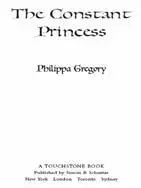
- Название:The Constant Princess
- Автор:
- Жанр:
- Год:неизвестен
- ISBN:нет данных
- Рейтинг книги:4 / 5. Голосов: 1
-
Избранное:Добавить в избранное
- Отзывы:
-
Ваша оценка:
The Constant Princess: краткое содержание, описание и аннотация
Предлагаем к чтению аннотацию, описание, краткое содержание или предисловие (зависит от того, что написал сам автор книги «The Constant Princess»). Если вы не нашли необходимую информацию о книге — напишите в комментариях, мы постараемся отыскать её.
Thus, bestselling author Philippa Gregory introduces one of her most unforgettable heroines: Katherine of Aragon. Known to history as the Queen who was pushed off her throne by Anne Boleyn, here is a Katherine the world has forgotten: the enchanting princess that all England loved. First married to Henry VIII's older brother, Arthur, Katherine's passion turns their arranged marriage into a love match; but when Arthur dies, the merciless English court and her ambitious parents -- the crusading King and Queen of Spain -- have to find a new role for the widow. Ultimately, it is Katherine herself who takes control of her own life by telling the most audacious lie in English history, leading her to the very pinnacle of power in England.
Set in the rich beauty of Moorish Spain and the glamour of the Tudor court, The Constant Princess presents a woman whose constancy helps her endure betrayal, poverty, and despair, until the inevitable moment when she steps into the role she has prepared for all her life: Henry VIII's Queen, Regent, and commander of the English army in their greatest victory against Scotland.
From Publishers Weekly
As youngest daughter to the Spanish monarchs and crusaders King Ferdinand and Queen Isabella, Catalina, princess of Wales and of Spain, was promised to the English Prince Arthur when she was three. She leaves Spain at 15 to fulfill her destiny as queen of England, where she finds true love with Arthur (after some initial sourness) as they plot the future of their kingdom together. Arthur dies young, however, leaving Catalina a widow and ineligible for the throne. Before his death, he extracts a promise from his wife to marry his younger brother Henry in order to become queen anyway, have children and rule as they had planned, a situation that can only be if Catalina denies that Arthur was ever her lover. Gregory's latest (after Earthly Joys) compellingly dramatizes how Catalina uses her faith, her cunning and her utter belief in destiny to reclaim her rightful title. By alternating tight third-person narration with Catalina's unguarded thoughts and gripping dialogue, the author presents a thorough, sympathetic portrait of her heroine and her transformation into Queen Katherine. Gregory's skill for creating suspense pulls the reader along despite the historical novel's foregone conclusion.
The Constant Princess — читать онлайн ознакомительный отрывок
Ниже представлен текст книги, разбитый по страницам. Система сохранения места последней прочитанной страницы, позволяет с удобством читать онлайн бесплатно книгу «The Constant Princess», без необходимости каждый раз заново искать на чём Вы остановились. Поставьте закладку, и сможете в любой момент перейти на страницу, на которой закончили чтение.
Интервал:
Закладка:
Westminster Palace,
January 1510
I WAKE IN THE NIGHT TO PAIN and a strange sensation. I dreamed that a tide was rising in the river Thames and that a fleet of black-sailed ships were coming upriver. I think that it must be the Moors, coming for me, and then I think it is a Spanish fleet—an armada, but strangely, disturbingly, my enemy, and the enemy of England. In my distress I toss and turn in bed and I wake with a sense of dread and find that it is worse than any dream, my sheets are wet with blood, and there is a real pain in my belly.
I call out in terror, and my cry wakes María de Salinas, who is sleeping with me.
“What is it?” she asks. Then she sees my face and calls out sharply to the maid at the foot of the bed and sends her running for my ladies and for the midwives, but somewhere in the back of my mind I know already that there is nothing that they can do. I clamber into my chair in my bloodstained nightdress and feel the pain twist and turn in my belly.
By the time they arrive, struggling from their beds, all stupid with sleep, I am on my knees on the floor like a sick dog, praying for the pain to pass and to leave me whole. I know that there is no point in praying for the safety of my child. I know that my child is lost. I can feel the tearing sensation in my belly as he slowly comes away.
After a long, bitter day, when Henry comes to the door again and again, and I send him away, calling out to him in a bright voice of reassurance, biting the palm of my hand so that I do not cry out, the baby is born, dead. The midwife shows her to me, a little girl, a white, limp little thing: poor baby, my poor baby. My only comfort is that it is not the boy I had promised Arthur I would bear for him. It is a girl, a dead girl, and then I twist my face in grief when I remember that he wanted a girl first, and she was to be called Mary.
I cannot speak for grief, I cannot face Henry and tell him myself. I cannot bear the thought of anyone telling the court. I cannot bring myself to write to my father and tell him that I have failed England, I have failed Henry, I have failed Spain, and worst of all—and this I could never tell anyone—I have failed Arthur.
I stay in my room. I close the door on all the anxious faces, on the midwives wanting me to drink strawberry-leaf tisanes, on the ladies wanting to tell me about their stillbirths, and their mothers’ stillbirths and their happy endings, I shut them away from me and I kneel at the foot of my bed, and press my hot face against the covers. I whisper through my sobs, muffled so that no one but him can hear me. “I am sorry, so sorry, my love. I am so sorry not to have had your son. I don’t know why, I don’t know why our gentle God should send me this great sorrow. I am so sorry, my love. If I ever have another chance I will do my best, the very best that I can, to have our son, to keep him safe till birth and beyond. I will, I swear I will. I tried this time, God knows, I would have given anything to have your son and named him Arthur for you, my love.” I steady myself as I can feel the words tumbling out too quickly, I can feel myself losing control, I feel the sobs starting to choke me.
“Wait for me,” I say quietly. “Wait for me still. Wait for me by the quiet waters in the garden where the white and the red rose petals fall. Wait for me and when I have given birth to your son Arthur and your daughter Mary and done my duty here, I will come to you. Wait for me in the garden and I will never fail you. I will come to you, love. My love.”
The king’s physician went to the king directly from the queen’s apartments. “Your Grace, I have good news for you.”
Henry turned a face to him that was as sour as a child’s whose joy has been stolen. “You have?”
“I have indeed.”
“The queen is better? In less pain? She will be well?”
“Even better than well,” the physician said. “Although she lost one child, she has kept another. She was carrying twins, Your Grace. She has lost one child but her belly is still large and she is still with child.”
For a moment the young man could not understand the words. “She still has a child?”
The physician smiled. “Yes, Your Grace.”
It was like a stay of execution. Henry felt his heart turn over with hope. “How can it be?”
The physician was confident. “By various ways I can tell. Her belly is still firm, the bleeding has stopped. I am certain she is still with child.”
Henry crossed himself. “God is with us,” he said positively. “This is the sign of His favor.” He paused. “Can I see her?”
“Yes, she is as happy at this news as you.”
Henry bounded up the stairs to Katherine’s rooms. Her presence chamber was empty of anyone but the least-informed sightseers, the court and half the City knew that she had taken to her bed and would not be seen. Henry brushed through the crowd who whispered hushed blessings for him and the queen, strode through her privy chamber, where her women were sewing, and tapped on her bedroom door.
María de Salinas opened it and stepped back for the king. The queen was out of her bed, seated in the window seat, her book of prayers held up to the light.
“My love!” he exclaimed. “Here is Dr. Fielding come to me with the best of news.”
Her face was radiant. “I told him to tell you privately.”
“He did. No one else knows. My love, I am so glad!”
Her eyes were wet with tears. “It is like a redemption,” she said. “I feel as if a cross has been lifted from my shoulders.”
“I shall go to Walsingham the moment our baby is born and thank Our Lady for her favor,” he promised. “I shall endow the shrine with a fortune, if it is a boy.”
“Please God that He grants it,” she murmured.
“Why should He not?” Henry demanded. “When it is our desire, and right for England, and we ask it as holy children of the church?”
“Amen,” she said quickly. “If it is God’s will.”
He flicked his hand. “Of course it must be His will,” he said. “Now you must take care and rest.”
Katherine smiled at him. “As you see.”
“Well, you must. And anything you want, you shall have.”
“I shall tell the cooks if I want anything.”
“And the midwives shall attend you night and morning to make sure that you are well.”
“Yes,” she agreed. “And if God is willing, we shall have a son.”
It was María de Salinas, my true friend who had come with me from Spain, and stayed with me through our good months and our hard years, who found the Moor. He was attending on a wealthy merchant, traveling from Genoa to Paris. They had called in at London to value some gold and María heard of him from a woman who had given a hundred pounds to Our Lady of Walsingham, hoping to have a son.
“They say he can make barren women give birth,” she whispers to me, watching that none of my other ladies have come close enough to overhear.
I cross myself as if to avoid temptation. “Then he must use black arts.”
“Princess, he is supposed to be a great physician. Trained by masters who were at the University of Toledo.”
“I will not see him.”
“Because you think he must use black arts?”
“Because he is my enemy and my mother’s enemy. She knew that the Moors’ knowledge was unlawfully gained, drawn from the devil, not from the revealed truth of God. She drove the Moors from Spain and their magical arts with them.”
“Your Grace, he may be the only doctor in England who knows anything about women.”
“I will not see him.”
Читать дальшеИнтервал:
Закладка:
Похожие книги на «The Constant Princess»
Представляем Вашему вниманию похожие книги на «The Constant Princess» списком для выбора. Мы отобрали схожую по названию и смыслу литературу в надежде предоставить читателям больше вариантов отыскать новые, интересные, ещё непрочитанные произведения.










Обсуждение, отзывы о книге «The Constant Princess» и просто собственные мнения читателей. Оставьте ваши комментарии, напишите, что Вы думаете о произведении, его смысле или главных героях. Укажите что конкретно понравилось, а что нет, и почему Вы так считаете.