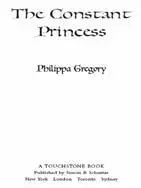
Philippa Gregory - The Constant Princess
Здесь есть возможность читать онлайн «Philippa Gregory - The Constant Princess» — ознакомительный отрывок электронной книги совершенно бесплатно, а после прочтения отрывка купить полную версию. В некоторых случаях можно слушать аудио, скачать через торрент в формате fb2 и присутствует краткое содержание. Жанр: Старинная литература, на английском языке. Описание произведения, (предисловие) а так же отзывы посетителей доступны на портале библиотеки ЛибКат.
- Название:The Constant Princess
- Автор:
- Жанр:
- Год:неизвестен
- ISBN:нет данных
- Рейтинг книги:4 / 5. Голосов: 1
-
Избранное:Добавить в избранное
- Отзывы:
-
Ваша оценка:
The Constant Princess: краткое содержание, описание и аннотация
Предлагаем к чтению аннотацию, описание, краткое содержание или предисловие (зависит от того, что написал сам автор книги «The Constant Princess»). Если вы не нашли необходимую информацию о книге — напишите в комментариях, мы постараемся отыскать её.
Thus, bestselling author Philippa Gregory introduces one of her most unforgettable heroines: Katherine of Aragon. Known to history as the Queen who was pushed off her throne by Anne Boleyn, here is a Katherine the world has forgotten: the enchanting princess that all England loved. First married to Henry VIII's older brother, Arthur, Katherine's passion turns their arranged marriage into a love match; but when Arthur dies, the merciless English court and her ambitious parents -- the crusading King and Queen of Spain -- have to find a new role for the widow. Ultimately, it is Katherine herself who takes control of her own life by telling the most audacious lie in English history, leading her to the very pinnacle of power in England.
Set in the rich beauty of Moorish Spain and the glamour of the Tudor court, The Constant Princess presents a woman whose constancy helps her endure betrayal, poverty, and despair, until the inevitable moment when she steps into the role she has prepared for all her life: Henry VIII's Queen, Regent, and commander of the English army in their greatest victory against Scotland.
From Publishers Weekly
As youngest daughter to the Spanish monarchs and crusaders King Ferdinand and Queen Isabella, Catalina, princess of Wales and of Spain, was promised to the English Prince Arthur when she was three. She leaves Spain at 15 to fulfill her destiny as queen of England, where she finds true love with Arthur (after some initial sourness) as they plot the future of their kingdom together. Arthur dies young, however, leaving Catalina a widow and ineligible for the throne. Before his death, he extracts a promise from his wife to marry his younger brother Henry in order to become queen anyway, have children and rule as they had planned, a situation that can only be if Catalina denies that Arthur was ever her lover. Gregory's latest (after Earthly Joys) compellingly dramatizes how Catalina uses her faith, her cunning and her utter belief in destiny to reclaim her rightful title. By alternating tight third-person narration with Catalina's unguarded thoughts and gripping dialogue, the author presents a thorough, sympathetic portrait of her heroine and her transformation into Queen Katherine. Gregory's skill for creating suspense pulls the reader along despite the historical novel's foregone conclusion.
The Constant Princess — читать онлайн ознакомительный отрывок
Ниже представлен текст книги, разбитый по страницам. Система сохранения места последней прочитанной страницы, позволяет с удобством читать онлайн бесплатно книгу «The Constant Princess», без необходимости каждый раз заново искать на чём Вы остановились. Поставьте закладку, и сможете в любой момент перейти на страницу, на которой закончили чтение.
Интервал:
Закладка:
When Lady Margaret tried to claim precedence by arriving at the dining hall door a few footsteps before Catalina, a Princess of the Blood, an Infanta of Spain and now Queen of England, Catalina stepped back at once and gave way to her with such an air of generosity that everyone remarked on the pretty behavior of the new queen. Catalina had a way of ushering the older woman before her that absolutely denied all rules of precedence and instead somehow emphasized Lady Margaret’s ungainly gallop to beat her granddaughter-in-law to the high table. They also saw Catalina pointedly step back, and everyone remarked on the grace and generosity of the younger woman.
The death of Lady Margaret’s son, King Henry, had hit the old lady hard. It was not so much that she had lost a beloved child; it was more that she had lost a cause. In his absence she could hardly summon the energy to force the Privy Councilors to report to her before going to the king’s rooms. Harry’s joyful excusing of his father’s debts and freeing of his father’s prisoners she took as an insult to his father’s memory and to her own rule. The sudden leap of the court into youth and freedom and playfulness made her feel old and bad-tempered. She, who had once been the commander of the court and the maker of the rules, was left to one side. Her opinion no longer mattered. The great book by which all court events must be governed had been written by her; but suddenly, they were celebrating events that were not in her book, they invented pastimes and activities, and she was not consulted.
She blamed Catalina for all the changes she most disliked, and Catalina smiled very sweetly and continued to encourage the young king to hunt and to dance and to stay up late at night. The old lady grumbled to her ladies that the queen was a giddy, vain thing and would lead the prince to disaster. Insultingly, she even remarked that it was no wonder Arthur had died, if this was the way that the Spanish girl thought a royal household should be run.
Lady Margaret Pole remonstrated with her old acquaintance as tactfully as she could. “My lady, the queen has a merry court but she never does anything against the dignity of the throne. Indeed, without her, the court would be far wilder. It is the king who insists on one pleasure after another. It is the queen who gives this court its manners. The young men adore her and nobody drinks or misbehaves before her.”
“It is the queen whom I blame,” the old woman said crossly. “Princess Eleanor would never have behaved like this. Princess Eleanor would have been housed in my rooms, and the place would have run by my rules.”
Tactfully, Catalina heard nothing, not even when people came to her and repeated the slanders. Catalina simply ignored her grandmother-inlaw and the constant stream of her criticism. She could have done nothing that would irritate her more.
It was the late hours that the court now kept that were the old lady’s greatest complaint. Increasingly, she had to wait and wait for dinner to be served. She would complain that it was so late at night that the servants would not be finished before dawn, and then she would retire before the court had even finished their dinner.
“You keep late hours,” she told Harry. “It is foolish. You need your sleep. You are only a boy; you should not be roistering all night. I cannot keep hours like this, and it is a waste of candles.”
“Yes, but my lady grandmother, you are nearly seventy years old,” he said patiently. “Of course you should have your rest. You shall retire whenever you wish. Catalina and I are only young. It is natural for us to want to stay up late. We like amusement.”
“She should be resting. She has to conceive an heir,” Lady Margaret said irritably. “She’s not going to do that bobbing about in a dance with a bunch of featherheads. Masking every night. Whoever heard of such a thing? And who is to pay for all this?”
“We’ve been married less than a month!” he exclaimed, a little irritated. “These are our wedding celebrations. I think we can enjoy good pastimes and keep a merry court. I like to dance.”
“You act as if there was no end to money,” she snapped. “How much has this dinner cost you? And last night’s? The strewing herbs alone must cost a fortune. And the musicians? This is a country that has to hoard its wealth, it cannot afford a spendthrift king. It is not the English way to have a popinjay on the throne, a court of mummers.”
Harry flushed. He was about to make a sharp retort.
“The king is no spendthrift,” Catalina intervened quickly. “This is just part of the wedding festivities. Your son, the late king, always thought that there should be a merry court. He thought that people should know that the court was wealthy and gay. King Harry is only following in the footsteps of his wise father.”
“His father was not a young fool under the thumb of his foreign wife!” the old lady said spitefully.
Catalina’s eyes widened slightly and she put her hand on Harry’s sleeve to keep him silent. “I am his partner and his helpmeet, as God has bidden me,” she said gently. “As I am sure you would want me to be.”
The old lady grunted. “I hear you claim to be more than that,” she began.
The two young people waited. Catalina could feel Harry shift restlessly under the gentle pressure of her hand.
“I hear that your father is to recall his ambassador. Am I right?” She glared at them both. “Presumably he does not need an ambassador now. The King of England’s own wife is in the pay and train of Spain. The King of England’s own wife is to be the Spanish ambassador. How can that be?”
“My lady grandmother—” Harry burst out; but Catalina was sweetly calm.
“I am a princess of Spain. Of course I would represent the country of my birth to my country by marriage. I am proud to be able to do such a thing. Of course I will tell my father that his beloved son, my husband, is well, that our kingdom is prosperous. Of course I will tell my husband that my loving father wants to support him in war and peace.”
“When we go to war—” Harry began.
“War?” the old lady demanded, her face darkening. “Why should we go to war? We have no quarrel with France. It is only her father who wants war with France, no one else. Tell me that not even you will be such a fool as to take us into war to fight for the Spanish! What are you now? Their errand boy? Their vassal?”
“The King of France is a danger to us all!” Harry stormed. “And the glory of England has always been—”
“I am sure My Lady the King’s Grandmother did not mean to disagree with you, sire,” Catalina said sweetly. “These are changing times. We cannot expect older people always to understand when things change so quickly.”
“I’m not quite in my dotage yet!” the old woman flared. “And I know danger when I see it. And I know divided loyalties when I see them. And I know a Spanish spy—”
“You are a most treasured advisor,” Catalina assured her. “And my lord the king and I are always glad of your advice. Aren’t we, Harry?”
He was still angry. “Agincourt was—”
“I’m tired,” the old woman said. “And you twist and twist things about. I’m going to my room.”
Catalina swept her a deep, respectful curtsey, Harry ducked his head with scant politeness. When Catalina came up the old woman had gone.
“How can she say such things?” Harry demanded. “How can you bear to listen to her when she says such things? She makes me want to roar like a baited bear! She understands nothing, and she insults you! And you just stand and listen!”
Catalina laughed, took his cross face in her hands, and kissed him on the lips. “Oh, Harry, who cares what she thinks as long as she can do nothing? Nobody cares what she says now.”
Читать дальшеИнтервал:
Закладка:
Похожие книги на «The Constant Princess»
Представляем Вашему вниманию похожие книги на «The Constant Princess» списком для выбора. Мы отобрали схожую по названию и смыслу литературу в надежде предоставить читателям больше вариантов отыскать новые, интересные, ещё непрочитанные произведения.


Обсуждение, отзывы о книге «The Constant Princess» и просто собственные мнения читателей. Оставьте ваши комментарии, напишите, что Вы думаете о произведении, его смысле или главных героях. Укажите что конкретно понравилось, а что нет, и почему Вы так считаете.