Philippa Gregory - The Constant Princess
Здесь есть возможность читать онлайн «Philippa Gregory - The Constant Princess» — ознакомительный отрывок электронной книги совершенно бесплатно, а после прочтения отрывка купить полную версию. В некоторых случаях можно слушать аудио, скачать через торрент в формате fb2 и присутствует краткое содержание. Жанр: Старинная литература, на английском языке. Описание произведения, (предисловие) а так же отзывы посетителей доступны на портале библиотеки ЛибКат.
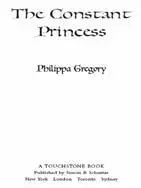
- Название:The Constant Princess
- Автор:
- Жанр:
- Год:неизвестен
- ISBN:нет данных
- Рейтинг книги:4 / 5. Голосов: 1
-
Избранное:Добавить в избранное
- Отзывы:
-
Ваша оценка:
The Constant Princess: краткое содержание, описание и аннотация
Предлагаем к чтению аннотацию, описание, краткое содержание или предисловие (зависит от того, что написал сам автор книги «The Constant Princess»). Если вы не нашли необходимую информацию о книге — напишите в комментариях, мы постараемся отыскать её.
Thus, bestselling author Philippa Gregory introduces one of her most unforgettable heroines: Katherine of Aragon. Known to history as the Queen who was pushed off her throne by Anne Boleyn, here is a Katherine the world has forgotten: the enchanting princess that all England loved. First married to Henry VIII's older brother, Arthur, Katherine's passion turns their arranged marriage into a love match; but when Arthur dies, the merciless English court and her ambitious parents -- the crusading King and Queen of Spain -- have to find a new role for the widow. Ultimately, it is Katherine herself who takes control of her own life by telling the most audacious lie in English history, leading her to the very pinnacle of power in England.
Set in the rich beauty of Moorish Spain and the glamour of the Tudor court, The Constant Princess presents a woman whose constancy helps her endure betrayal, poverty, and despair, until the inevitable moment when she steps into the role she has prepared for all her life: Henry VIII's Queen, Regent, and commander of the English army in their greatest victory against Scotland.
From Publishers Weekly
As youngest daughter to the Spanish monarchs and crusaders King Ferdinand and Queen Isabella, Catalina, princess of Wales and of Spain, was promised to the English Prince Arthur when she was three. She leaves Spain at 15 to fulfill her destiny as queen of England, where she finds true love with Arthur (after some initial sourness) as they plot the future of their kingdom together. Arthur dies young, however, leaving Catalina a widow and ineligible for the throne. Before his death, he extracts a promise from his wife to marry his younger brother Henry in order to become queen anyway, have children and rule as they had planned, a situation that can only be if Catalina denies that Arthur was ever her lover. Gregory's latest (after Earthly Joys) compellingly dramatizes how Catalina uses her faith, her cunning and her utter belief in destiny to reclaim her rightful title. By alternating tight third-person narration with Catalina's unguarded thoughts and gripping dialogue, the author presents a thorough, sympathetic portrait of her heroine and her transformation into Queen Katherine. Gregory's skill for creating suspense pulls the reader along despite the historical novel's foregone conclusion.
The Constant Princess — читать онлайн ознакомительный отрывок
Ниже представлен текст книги, разбитый по страницам. Система сохранения места последней прочитанной страницы, позволяет с удобством читать онлайн бесплатно книгу «The Constant Princess», без необходимости каждый раз заново искать на чём Вы остановились. Поставьте закладку, и сможете в любой момент перейти на страницу, на которой закончили чтение.
Интервал:
Закладка:
Catalina, her hand in the warm, firm grasp, felt wonderfully reassured. “I am afraid I am not always very obedient,” she confessed.
The older woman laughed. “Oh yes, for one would be a fool not to think for oneself,” she allowed. “True obedience can only happen when you secretly think you know better, and you choose to bow your head. Anything short of that is just agreement, and any ninny-in-waiting can agree. Don’t you think?”
And Catalina, giggling with an Englishwoman for the first time, laughed aloud and said: “I never wanted to be a ninny-in-waiting.”
“Neither did I,” gleamed Margaret Pole, who had been a Plantagenet, a princess royal and was now a mere wife buried in the fastness of the Tudor Borders. “I always know that I am myself, in my heart, whatever title I am given.”
I am so surprised to find that the woman whose presence I have dreaded is making the castle at Ludlow feel like a home for me. Lady Margaret Pole is a companion and friend to comfort me for the loss of my mother and sisters. I realize now that I have always lived in a world dominated by women: the queen my mother, my sisters, our ladies- and maids-in-waiting, and all the women servants of the seraglio. In the Alhambra we lived almost withdrawn from men, in rooms built for the pleasure and comfort of women. We lived almost in seclusion, in the privacy of the cool rooms, and ran through the courtyards and leaned on the balconies secure in the knowledge that half the palace was exclusively in the ownership of us women.
We would attend the court with my father—we were not hidden from sight—but the natural desire of women for privacy was served and emphasized by the design of the Alhambra where the prettiest rooms and the best gardens were reserved for us.
It is strange to come to England and find the world dominated by men. Of course I have my rooms and my ladies, but any man can come and ask for admittance at any time. Sir Richard Pole or any other of Arthur’s gentlemen can come to my rooms without notice and think that they are paying me a compliment. The English seem to think it right and normal that men and women should mix. I have not yet seen a house with rooms that are exclusive to women, and no woman goes veiled as we sometimes did in Spain, not even when traveling, not even among strangers.
Even the royal family is open to all. Men, even strangers, can stroll through the royal palaces as long as they are smart enough for the guards to admit them. They can wait around in the queen’s presence chamber and see her anytime she walks by, staring at her as if they were family. The great hall, the chapel, the queen’s public rooms are open to anyone who can find a good hat and a cape and pass as gentry. The English treat women as if they are boys or servants, they can go anywhere, they can be looked at by anyone. For a while I thought this was a great freedom, and for a while I reveled in it; then I realized the Englishwomen may show their faces but they are not bold like men, they are not free like boys; they still have to remain silent and obey.
Now with Lady Margaret Pole returned to the warden’s rooms it feels as if this castle has come under the rule of women. The evenings in the hall are less hearty, even the food at dinner has changed. The troubadours sing of love and less of battles, there is more French spoken and less Welsh.
My rooms are above, and hers are on the floor below, and we go up and down stairs all day to see each other. When Arthur and Sir Richard are out hunting, the castle’s mistress is still at home and the place does not feel empty anymore. Somehow, she makes it a lady’s castle, just by being here. When Arthur is away, the life of the castle is not silent, waiting for his return. It is a warm, happy place, busy in its own day’s work.
I have missed having an older woman to be my friend. María de Salinas is a girl as young and silly as I am, she is a companion, not a mentor. Doña Elvira was nominated by my mother the queen to stand in a mother’s place for me; but she is not a woman I can warm to, though I have tried to love her. She is strict with me, jealous of her influence over me, ambitious to run the whole court. She and her husband, who commands my household, want to dominate my life. Since that first evening at Dogmersfield when she contradicted the king himself, I have doubted her judgment. Even now she continually cautions me against becoming too close with Arthur, as if it were wrong to love a husband, as if I could resist him! She wants to make a little Spain in England, she wants me to still be the Infanta. But I am certain that my way ahead in England is to become English.
Doña Elvira will not learn English. She affects not to be able to understand French when it is spoken with an English accent. The Welsh she treats with absolute contempt as barbarians on the very edge of civilization, which is not very comfortable when we are visiting the townspeople of Ludlow. To be honest, sometimes she behaves more grandly than any woman I have ever known, she is prouder than my mother herself. She is certainly grander than me. I have to admire her, but I cannot truly love her.
But Margaret Pole was educated as the niece of a king and is as fluent in Latin as I am. We speak French easily together, she is teaching me English, and when we come across a word we don’t know in any of our shared languages, we compose great mimes that set us wailing with giggles. I made her cry with laughing when I tried to demonstrate indigestion, and the guards came running, thinking we were under attack when she used all the ladies of the court and their maidservants to demonstrate to me the correct protocol for an English hunt in the field.
With Margaret, Catalina thought she could raise the question of her future, and her father-in-law of whom she was frankly nervous.
“He was displeased before we came away,” she said. “It is the question of the dowry.”
“Oh, yes?” Margaret replied. The two women were seated in a window, waiting for the men to come back from hunting. It was bitterly cold and damp outside, neither of them had wanted to go out. Margaret thought it better to volunteer nothing about the vexed question of Catalina’s dowry; she had already heard from her husband that the Spanish king had perfected the art of double-dealing. He had agreed a substantial dowry for the Infanta, but then sent her to England with only half the money. The rest, he suggested, could be made up with the plate and treasure that she brought as her household goods. Outraged, King Henry had demanded the full amount. Sweetly Ferdinand of Spain replied that the Infanta’s household had been supplied with the very best, Henry could take his pick.
It was a bad way to start a marriage that was, in any case, founded only on greed and ambition, and a shared fear of France. Catalina was caught between the determination of two coldhearted men. Margaret guessed that one of the reasons that Catalina had been sent to Ludlow Castle with her husband was to force her to use her own household goods and so diminish their value. If King Henry had kept her at court in Windsor or Greenwich or Westminster, she would have eaten off his plates and her father could have argued that the Spanish plate was as good as new, and must be taken as the dowry. But now, every night they ate from Catalina’s gold plates and every scrape of a careless knife knocked a little off the value. When it was time to pay the second half of the dowry, the King of Spain would find he would have to pay cash. King Ferdinand might be a hard man and a cunning negotiator but he had met his match in Henry Tudor of England.
“He said that I should be a daughter to him,” Catalina started carefully. “But I cannot obey him as a daughter should, if I am to obey my own father. My father tells me not to use my plate and to give it to the king. But he won’t accept it. And since the dowry is unpaid, the king sends me away with no provision; he doesn’t even pay my allowance.”
Читать дальшеИнтервал:
Закладка:
Похожие книги на «The Constant Princess»
Представляем Вашему вниманию похожие книги на «The Constant Princess» списком для выбора. Мы отобрали схожую по названию и смыслу литературу в надежде предоставить читателям больше вариантов отыскать новые, интересные, ещё непрочитанные произведения.


Обсуждение, отзывы о книге «The Constant Princess» и просто собственные мнения читателей. Оставьте ваши комментарии, напишите, что Вы думаете о произведении, его смысле или главных героях. Укажите что конкретно понравилось, а что нет, и почему Вы так считаете.