Philippa Gregory - The Constant Princess
Здесь есть возможность читать онлайн «Philippa Gregory - The Constant Princess» — ознакомительный отрывок электронной книги совершенно бесплатно, а после прочтения отрывка купить полную версию. В некоторых случаях можно слушать аудио, скачать через торрент в формате fb2 и присутствует краткое содержание. Жанр: Старинная литература, на английском языке. Описание произведения, (предисловие) а так же отзывы посетителей доступны на портале библиотеки ЛибКат.
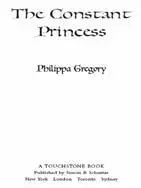
- Название:The Constant Princess
- Автор:
- Жанр:
- Год:неизвестен
- ISBN:нет данных
- Рейтинг книги:4 / 5. Голосов: 1
-
Избранное:Добавить в избранное
- Отзывы:
-
Ваша оценка:
The Constant Princess: краткое содержание, описание и аннотация
Предлагаем к чтению аннотацию, описание, краткое содержание или предисловие (зависит от того, что написал сам автор книги «The Constant Princess»). Если вы не нашли необходимую информацию о книге — напишите в комментариях, мы постараемся отыскать её.
Thus, bestselling author Philippa Gregory introduces one of her most unforgettable heroines: Katherine of Aragon. Known to history as the Queen who was pushed off her throne by Anne Boleyn, here is a Katherine the world has forgotten: the enchanting princess that all England loved. First married to Henry VIII's older brother, Arthur, Katherine's passion turns their arranged marriage into a love match; but when Arthur dies, the merciless English court and her ambitious parents -- the crusading King and Queen of Spain -- have to find a new role for the widow. Ultimately, it is Katherine herself who takes control of her own life by telling the most audacious lie in English history, leading her to the very pinnacle of power in England.
Set in the rich beauty of Moorish Spain and the glamour of the Tudor court, The Constant Princess presents a woman whose constancy helps her endure betrayal, poverty, and despair, until the inevitable moment when she steps into the role she has prepared for all her life: Henry VIII's Queen, Regent, and commander of the English army in their greatest victory against Scotland.
From Publishers Weekly
As youngest daughter to the Spanish monarchs and crusaders King Ferdinand and Queen Isabella, Catalina, princess of Wales and of Spain, was promised to the English Prince Arthur when she was three. She leaves Spain at 15 to fulfill her destiny as queen of England, where she finds true love with Arthur (after some initial sourness) as they plot the future of their kingdom together. Arthur dies young, however, leaving Catalina a widow and ineligible for the throne. Before his death, he extracts a promise from his wife to marry his younger brother Henry in order to become queen anyway, have children and rule as they had planned, a situation that can only be if Catalina denies that Arthur was ever her lover. Gregory's latest (after Earthly Joys) compellingly dramatizes how Catalina uses her faith, her cunning and her utter belief in destiny to reclaim her rightful title. By alternating tight third-person narration with Catalina's unguarded thoughts and gripping dialogue, the author presents a thorough, sympathetic portrait of her heroine and her transformation into Queen Katherine. Gregory's skill for creating suspense pulls the reader along despite the historical novel's foregone conclusion.
The Constant Princess — читать онлайн ознакомительный отрывок
Ниже представлен текст книги, разбитый по страницам. Система сохранения места последней прочитанной страницы, позволяет с удобством читать онлайн бесплатно книгу «The Constant Princess», без необходимости каждый раз заново искать на чём Вы остановились. Поставьте закладку, и сможете в любой момент перейти на страницу, на которой закончили чтение.
Интервал:
Закладка:
“She has resignation,” he said simply. “She is a most spiritual woman and if she looked for reward, she has one in that she is married to Sir Richard Pole, a man most trusted by my father, and she lives here in the highest regard and she is my friend and I hope will be yours.”
He took her hand and felt it tremble. “Come, Catalina. This isn’t like you. Be brave, my love. She won’t blame you.”
“She must blame me,” she said in an anguished whisper. “My parents insisted that there should be no doubt over your inheritance. I know they did. Your own father promised that there would be no rival princes. They knew what he meant to do. They did not tell him to leave an innocent man with his life. They let him do it. They wanted him to do it. Edward Plantagenet’s blood is on my head. Our marriage is under the curse of his death.”
Arthur recoiled; he had never before seen her so distressed. “My God, Catalina, you cannot call us accursed.”
She nodded miserably.
“You have never spoken of this.”
“I could not bear to say it.”
“But you have thought it?”
“From the moment they told me that he was put to death for my sake.”
“My love, you cannot really think that we are accursed?”
“In this one thing.”
He tried to laugh off her intensity. “No. You must know we are blessed.” He drew closer and said very quietly, so that no one else could hear, “Every morning when you wake in my arms, do you feel accursed then?”
“No,” she said unwillingly. “No, I don’t.”
“Every night when I come to your rooms, do you feel the shadow of sin upon you?”
“No,” she conceded.
“We are not cursed,” he said firmly. “We are blessed with God’s favor. Catalina, my love, trust me. She has forgiven my father, she certainly would never blame you. I swear to you, she is a woman with a heart as big as a cathedral. She wants to meet you. Come with me and let me present her to you.”
“Alone, then,” she said, still fearing some terrible scene.
“Alone. She is in the castle warden’s rooms now. If you come at once, we can leave them all here and go quietly by ourselves and see her.”
She rose from her seat and put her hand on the crook of his arm. “I am walking alone with the princess,” Arthur said to her ladies. “You can all stay here.”
They looked surprised to be excluded, and some of them were openly disappointed. Catalina went past them without looking up.
Once out of the door he preceded her down the tight spiral staircase, one hand on the central stone post, one on the wall. Catalina followed him, lingering at every deep-set arrow-slit window, looking down into the valley where the Teme had burst its banks and was like a silver lake over the water meadows. It was cold, even for March in the Borders, and Catalina shivered as if a stranger were walking on her grave.
“My love,” he said, looking back up the narrow stairs towards her. “Courage. Your mother would have courage.”
“She ordered this thing,” she said crossly. “She thought it was for my benefit. But a man died for her ambition, and now I have to face his sister.”
“She did it for you,” he reminded her. “And nobody blames you.” They came to the floor below the princess’s suite of rooms, and without hesitation Arthur tapped on the thick wooden door of the warden’s apartments and went in.
The square room overlooking the valley was the match of Catalina’s presence chamber upstairs, paneled with wood and hung with bright tapestries. There was a lady waiting for them, seated by the fireside, and when the door opened she rose. She was dressed in a pale gray gown with a gray hood on her hair. She was about thirty years of age; she looked at Catalina with friendly interest, and then she sank into a deep, respectful curtsey.
Disobeying the nip of his bride’s fingers, Arthur withdrew his arm and stepped back as far as the doorway. Catalina looked back at him reproachfully and then bobbed a small curtsey to the older woman. They rose up together.
“I am so pleased to meet you,” Lady Pole said sweetly. “And I am sorry not to have been here to greet you. But one of my children was ill and I went to make sure that he was well nursed.”
“Your husband has been very kind,” Catalina managed to say.
“I hope so, for I left him a long list of commandments; I so wanted your rooms to be warm and comfortable. You must tell me if there is anything you would like. I don’t know Spain, so I didn’t know what things would give you pleasure.”
“No! It is all…absolutely.”
The older woman looked at the princess. “Then I hope you will be very happy here with us,” she said.
“I hope to…” Catalina breathed. “But I…I…”
“Yes?”
“I was very sorry to hear of the death of your brother.” Catalina dived in. Her face, which had been white with discomfort, now flushed scarlet. She could feel her ears burning, and to her horror she heard her voice tremble. “Indeed, I was very sorry. Very…”
“It was a great loss to me, and to mine,” the woman said steadily. “But it is the way of the world.”
“I am afraid that my coming…”
“I never thought that it was any choice or any fault of yours, Princess. When our dear Prince Arthur was to be married his father was bound to make sure that his inheritance was secured. I know that my brother would never have threatened the peace of the Tudors, but they were not to know that. And he was ill-advised by a mischievous young man, drawn into some foolish plot…” She broke off as her voice shook; but rapidly she recovered herself. “Forgive me. It still grieves me. He was an innocent, my brother. His silly plotting was proof of his innocence, not of his guilt. There is no doubt in my mind that he is in God’s keeping now, with all innocents.”
She smiled at the princess. “In this world, we women often find that we have no power over what men do. I am sure you would have wished my brother no harm, and indeed, I am sure that he would not have stood against you or against our dearest prince here—but it is the way of the world that harsh measures are sometimes taken. My father made some bad choices in his life, and God knows he paid for them in full. His son, though innocent, went the way of his father. A turn of the coin and it could all have been different. I think a woman has to learn to live with the turn of the coin even when it falls against her.”
Catalina was listening intently. “I know my mother and father wanted to be sure that the Tudor line was without challenge,” she breathed. “I know that they told the king.” She felt as if she had to make sure that this woman knew the depth of her guilt.
“As I might have done if I had been them,” Lady Margaret said simply. “Princess, I do not blame you, nor your mother or father. I do not blame our great king. Were I any one of them, I might have behaved just as they have done, and explained myself only to God. All I have to do, since I am not one of these great people but merely the humble wife to a fine man, is to take care how I behave and how I will explain myself to God.”
“I felt that I came to this country with his death on my conscience,” Catalina admitted in a sudden rush.
The older woman shook her head. “His death is not on your conscience,” she said firmly. “And it is wrong to blame yourself for another’s doing. Indeed, I would think your confessor would tell you: it is a form of pride. Let that be the sin that you confess, you need not take the blame for the sins of others.”
Catalina looked up for the first time and met the steady eyes of Lady Pole and saw her smile. Cautiously she smiled back, and the older woman stretched out her hand, as a man would offer to shake on a bargain. “You see,” she said pleasantly. “I was a princess royal myself once. I was the last Plantagenet princess, raised by King Richard in his nursery with his son. Of all the women in the world, I should know that there is more to life than a woman can ever control. There is the will of your husband, and of your parents, and of your king, and of your God. Nobody could blame a princess for the doings of a king. How could one ever challenge it? Or make any difference? Our way has to be obedience.”
Читать дальшеИнтервал:
Закладка:
Похожие книги на «The Constant Princess»
Представляем Вашему вниманию похожие книги на «The Constant Princess» списком для выбора. Мы отобрали схожую по названию и смыслу литературу в надежде предоставить читателям больше вариантов отыскать новые, интересные, ещё непрочитанные произведения.




Обсуждение, отзывы о книге «The Constant Princess» и просто собственные мнения читателей. Оставьте ваши комментарии, напишите, что Вы думаете о произведении, его смысле или главных героях. Укажите что конкретно понравилось, а что нет, и почему Вы так считаете.