Jack Whyte - The Eagles' Brood
Здесь есть возможность читать онлайн «Jack Whyte - The Eagles' Brood» весь текст электронной книги совершенно бесплатно (целиком полную версию без сокращений). В некоторых случаях можно слушать аудио, скачать через торрент в формате fb2 и присутствует краткое содержание. Жанр: Старинная литература, на английском языке. Описание произведения, (предисловие) а так же отзывы посетителей доступны на портале библиотеки ЛибКат.
- Название:The Eagles' Brood
- Автор:
- Жанр:
- Год:неизвестен
- ISBN:нет данных
- Рейтинг книги:4 / 5. Голосов: 1
-
Избранное:Добавить в избранное
- Отзывы:
-
Ваша оценка:
The Eagles' Brood: краткое содержание, описание и аннотация
Предлагаем к чтению аннотацию, описание, краткое содержание или предисловие (зависит от того, что написал сам автор книги «The Eagles' Brood»). Если вы не нашли необходимую информацию о книге — напишите в комментариях, мы постараемся отыскать её.
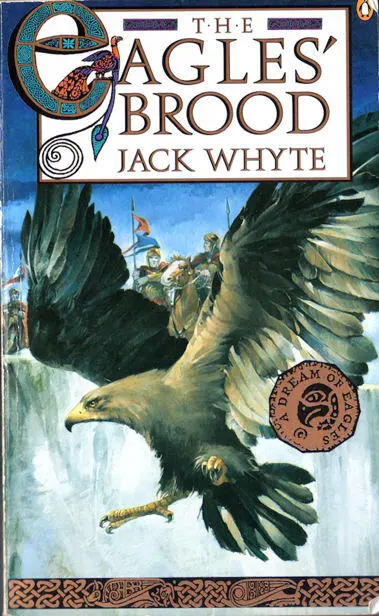
In the author's The Skystone (1996), set in the last years of the Roman occupation of fifth-century Britain, the sword Excalibur was forged, presaging the reign of King Arthur years later. This time, the narrator, grand-nephew of the forger of the sword, is none other than that (traditionally) eerie being, Merlin the sorcerer--sanitized here to the most high-minded of soldiers who survives wars, betrayal, and a tragic love affair. Caius Merlyn Britannicus, born in a.d. 401, is the son of the Commander in Chief of the forces of the fortress/town of Camulod, a community of Romans and Britons. Merlyn's best friend from boyhood is his cousin Uther Pendragon, a mighty warrior and the son of a Celtic king, though with a terrible temper that can show itself off the fields of war. Torturing Merlyn is the suspicion that it might have been Uther who brutally beat the waif whom Merlyn will name Cassandra after she violently resists Uther's sexual games. The deaf and dumb Cassandra (her real identity will be a surprise) is healed and then secluded, eventually becoming Merlyn's wife until her savage death. There are wars and invasions, waged principally by King Lot of Cornwall, wars that bring awful innovations like poisoned arrows. There are also theological conflicts, since the free-will doctrines of Pelagius are condemned as heretical by the Church. Merlyn's trek to a seminal debate of theologians is marked by skirmishes--he rescues the warrior/bishop Germanus at one point--and by the discovery of a half-brother. All ends with the deaths of those fierce antagonists Lot and Uther, and with Merlyn holding up Uther's baby son by Lot's dead queen, a baby who hasthe deep golden eyes of . . . a mighty bird of prey . . . a King perhaps, to wield Excalibur.'' With plenty of hacking and stabbing, pontifications, dogged sex, and a few anachronistic mind-sets: another dipperful from the fertile Arthurian well, sans magic but brimful of action.
The Eagles' Brood — читать онлайн бесплатно полную книгу (весь текст) целиком
Ниже представлен текст книги, разбитый по страницам. Система сохранения места последней прочитанной страницы, позволяет с удобством читать онлайн бесплатно книгу «The Eagles' Brood», без необходимости каждый раз заново искать на чём Вы остановились. Поставьте закладку, и сможете в любой момент перейти на страницу, на которой закончили чтение.
Интервал:
Закладка:
"Good. I thought you might." She smiled. "As soon, of course, as your male mind came around to it. Now, tomorrow, we will ride out together to your Avalon, just the two of us. The weather is beautiful, and I have need of fresh, spring air. And it's high time I had the chance to evaluate this little priestess of yours."
BOOK FOUR - Kings
XXIX
'The Senior Surgeon, Commander."
I followed Donuil's pointing finger with my eyes, to where Lucanus was climbing the hill towards us. He rode bent forward uncomfortably, his downcast eyes watching his horse's hooves as the beast picked its way cautiously among the stones and boulders littering the sloping hillside. He was still no more than half-way up, making hard going of it, and I smiled at the picture he made, recalling a comment written by Publius Varrus many years before describing his own discomfort on a horse's back. I turned back to Donuil.
"The good Lucanus is a brilliant surgeon and a fine physician, Donuil, but he's no cavalryman. He and you together must be the worst example of our military strength an enemy could see."
Donuil grinned at me, completely unabashed. "Ah, but then, Commander, we are not your military strength. The Surgeon will never have to execute his surgery from the back of a horse, so his skills won't suffer from his lack of comfort when perched on an animal's rump. I, on the other hand, being the naturally spirited creature that I am, am improving daily in spite of—and you yourself will admit this—the direst of circumstances. My very race dictates I have a natural law to overcome. If the gods had meant us Ersemen to ride horses, they would have filled Eire with the things."
I did not answer him. I was too busy scanning the meadow that lay below us. We were about to make our first road camp, and I had climbed this hill to survey the site I had selected, hoping to find it as ideal as it seemed from below.
I was more than satisfied. "It's perfect," I said. "Now, I want the camp laid out down there as though we were on the plain in front of Camulod. Four equal areas oriented north and south, one for each squadron, the commissary and supply wagons in the middle, and the extra mounts there in the front, closest to the road. You follow me?" He nodded, and I raised my eyebrow, my only response. He flushed and nodded again, saluting me with his clenched fist.
"Your pardon. Aye, Commander. Four separate areas, as in Camulod, one to each squadron, the commissariat in the middle and the extra horses in front, at the south, between the camp and the road for safety."
"That's better. Please inform the squadron commanders."
He saluted again and rode off cautiously down the hill, although not quite so awkwardly as Lucanus, whom he passed on his way with a quick, distracted nod. I smiled as I watched him go, pleased with the way he was learning. It was against all his Hibernian training and background to submit to the kind of discipline I was exerting on him, but he was coping and coming to terms with it willingly.
Lucanus came up alongside me and reined in his animal, a placid beast specially chosen for him. He loosened his helmet, pulled it off and wiped the sweat from his brow with his bent elbow.
"On my oath, Britannicus, I will never understand why you people insist on wearing armour in weather like this. It's hot enough to melt flesh!"
I smiled, but didn't even bother to answer him. As Senior Surgeon, he, above all others, understood the military requirement for preparedness at all times. He watched me closely, waiting in vain for me to rise to his bait, and then swung his horse around to look down into the valley.
"They look good, don't they?"
"Aye, Lucanus, they do. And so they should. They are good. They're the best. Camulod's best, and that means the world's best, for my money."
On the road below us, our entire contingent was now in view, and they presented a pleasing picture of military correctness. The First Squadron, made up of our most experienced veterans, bore my great black and silver bear standard at their head—where the Roman Eagle would have been in bygone days—along with their own regalia: a crimson standard featuring a white stag and surmounted by a spread of antlers. They rode in a tight-formation column, with their squadron and troop commanders in the lead, followed immediately by the two standard-bearers, and then the remainder of the squadron, four ranks abreast in files of ten. Fifty paces behind their rear rank came the Second Squadron, in similar formation, followed in turn by the water wagon—a large, pitch-sealed, cylindrical oaken tank, laid on its side and mounted on a wheeled platform, drawn by two horses. After that came the six great commissary wagons—huge, double-axled things with enormous, spoked wheels of hand-carved oak, rimmed with iron tires—each drawn by a team of six massive draft horses. Behind the wagons came the extra mounts, tight-herded by the young men whose only work was with the horses, until the time they earned promotion and began training as troopers. Behind the extra horses, far back from their dust, and protecting them from attack from the rear, came the Third and Fourth Squadrons, equal in size to the First and Second, but made up of less seasoned troops and leavened by older, well-hardened men. One hundred and seventy-five fighting men in all, including officers, and exclusive of the commissary staff and herd boys, who brought the total number to just over two hundred.
We watched in silence as they halted to await Donuil's approach, the commanders of the rearward squadrons riding to the head of die column to meet him. A series of shouted commands rose through the late afternoon air, and the First Squadron wheeled to the left and made their way from the road into the wooded meadow I had chosen as a campsite, crossing directly to the area designated for them. It took some time for the entire train to regroup in their allotted places, but then, at a shouted command, they all dismounted as one, and the open meadow was transformed as they set about making camp on this, the first night of the journey to Verulamium.
"Quite a difference from the old, walled infantry camp, isn't it?" Lucanus murmured. »
"No, not really, not when you think about it, Luke," I responded, using the name he had asked me to call him once we became friends. "It's still the same basic design they used in ancient times—four divisions and two cross streets. The only real difference is that walls are unnecessary, and unwanted. The horses are the walls, all by themselves. We simply split the horses up into four or more groups and have their riders stay close by them. And we increase the areas between the squadrons to leave enough room to manoeuvre in the event of an attack. It merely looks different. The new format works the same way as the old one did, and for exactly the same old reason—the one that's seldom recognized, but always honoured."
Lucanus looked at me sidewise, sensing a trap. "Oh really? And what reason is that?"
"Mess call, Luke." I was smiling, but serious nonetheless. "Think about it. It's more than simply Roman discipline. Digging the ditch and building the walls each day on the march was originally a very real precaution against attack, but the routine continued centuries after peace had been established throughout the Empire. There came a time—and it lasted for centuries—when the odds against a Roman camp being attacked must have exceeded ten thousand to one, and yet the discipline persisted."
"Fine," he grunted eventually, when he realized I was waiting for him to ask. "I'll risk it. Why did it persist?"
"Because it had another purpose, rooted in certainty." I could see that he was bracing himself to be the butt of some joke of mine, eyeing me warily and prepared to come up with some quick and witty rejoinder. "No, I'm serious. Bear in mind that the only time a legionary had to himself was at the end of the day. A very large part of the punctilious tradition of Roman camps came from the simple fact that, after a hard day's march, the commissary people needed time to prepare dinner without being harassed by hungry men with nothing to do. So to get around that, the Army made it a rule that the soldiers had to dig a ditch and build a rampart every day, then pitch their tents, before they were released to eat and relax. Gave the cooks time to get dinner ready. Now our troopers have to unsaddle, groom, feed and water their mounts, clean and tend to their harness, pitch their own tents and build their own fires before they can eat. Still gives the cooks time to make dinner. And dinner on the march is the most important part of a soldier's life— infantry or cavalry."
Читать дальшеИнтервал:
Закладка:
Похожие книги на «The Eagles' Brood»
Представляем Вашему вниманию похожие книги на «The Eagles' Brood» списком для выбора. Мы отобрали схожую по названию и смыслу литературу в надежде предоставить читателям больше вариантов отыскать новые, интересные, ещё непрочитанные произведения.







Обсуждение, отзывы о книге «The Eagles' Brood» и просто собственные мнения читателей. Оставьте ваши комментарии, напишите, что Вы думаете о произведении, его смысле или главных героях. Укажите что конкретно понравилось, а что нет, и почему Вы так считаете.