Jack Whyte - The Lance Thrower
Здесь есть возможность читать онлайн «Jack Whyte - The Lance Thrower» весь текст электронной книги совершенно бесплатно (целиком полную версию без сокращений). В некоторых случаях можно слушать аудио, скачать через торрент в формате fb2 и присутствует краткое содержание. Жанр: Старинная литература, на английском языке. Описание произведения, (предисловие) а так же отзывы посетителей доступны на портале библиотеки ЛибКат.
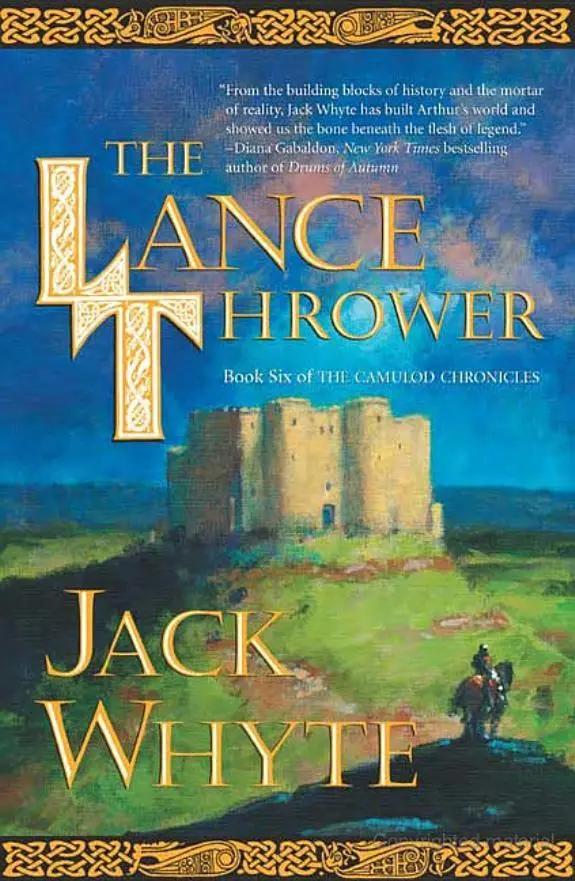
- Название:The Lance Thrower
- Автор:
- Жанр:
- Год:неизвестен
- ISBN:нет данных
- Рейтинг книги:5 / 5. Голосов: 1
-
Избранное:Добавить в избранное
- Отзывы:
-
Ваша оценка:
The Lance Thrower: краткое содержание, описание и аннотация
Предлагаем к чтению аннотацию, описание, краткое содержание или предисловие (зависит от того, что написал сам автор книги «The Lance Thrower»). Если вы не нашли необходимую информацию о книге — напишите в комментариях, мы постараемся отыскать её.
Clothar is a young man of promise. He has been sent from the wreckage of Gaul to one of the few schools remaining, where logic and rhetoric are taught along with battle techniques that will allow him to survive in the cruel new world where the veneer of civilization is held together by barbarism. He is sent by his mentor on a journey to aid another young man: Arthur Pendragon. He is a man who wants to replace barbarism with law, and keep those who work only for destruction at bay. He is seen, as the last great hope for all that is good.
Clothar is drawn to this man, and together they build a dream too perfect to last--and, with a special woman, they share a love that will nearly destroy them all...
The name of Clothar may be unknown to modern readers, for tales change in the telling through centuries. But any reader will surely know this heroic young man as well as they know the man who became his king. Hundreds of years later, chronicles call Clothar, the Lance Thrower, by a much more common name.
That of Lancelot.
The Lance Thrower — читать онлайн бесплатно полную книгу (весь текст) целиком
Ниже представлен текст книги, разбитый по страницам. Система сохранения места последней прочитанной страницы, позволяет с удобством читать онлайн бесплатно книгу «The Lance Thrower», без необходимости каждый раз заново искать на чём Вы остановились. Поставьте закладку, и сможете в любой момент перейти на страницу, на которой закончили чтение.
Интервал:
Закладка:
But then it was over, suddenly, before I was ready, and he had somehow guided Queen Vivienne into a deep chair and turned the full force of his gaze upon me. I can still recall the sensation of falling that filled me as those eyes met mine; it was akin to the sensation you experience when swinging widely on a hanging rope, far out over water that is deep and still beneath you. Germanus looked at me, and all the gaiety and humor faded from his face to be replaced by an expression I could not decipher. I could almost feel the weight of his scrutiny as his eyes moved up and down and across my body, and in a vain attempt to disguise the effect it was having on me I busied myself in looking back at him, absorbing the details of his appearance.
He was dressed completely in white, which did not surprise me, white being the color of purity and sanctity, according to my stepmother, the Queen. It seemed appropriate to me, in my ten-year-old wisdom, that God’s bishop should be dressed in white. The high, pointed hat I had expected was nowhere to be seen, however, and I was observant enough to be able to tell from the condition of the bishop’s hair that he had not been wearing a hat at all: it was thick and curly, on the white edge of silvery gray, and he wore it cropped short in the military fashion. He was clean shaven that particular day, although I was to see him bearded as often as not in the years that lay ahead, and his skin was darkened to the color of old bronze by the summer sun. He wore some kind of heavy woolen stole across his shoulders, its ends trailing in front of him and held loosely in place by the bend of his elbows, and beneath that his entire body was encased from neck to ankles in a long, plain robe of heavy white cloth, belted at the waist with a thick length of white silken rope and otherwise completely unadorned. Beneath the hem of that long white garment, however, revealed as he spun around holding the Queen, I had seen heavy, black, thick-soled military boots.
“So,” he said finally, his eyes fixed now on mine. “You are Clothar, son of Childebertus and Elaine.” I waited, not knowing how to respond and not quite daring to glance at my foster parents for guidance. Then slowly Germanus held out his right hand, palm up and fingers extended, and I stepped forward and stretched out my own, palm downward. His long fingers closed around mine, warm and supple, yet callused as though from long, hard work. Still looking deep into my eyes, he smiled and nodded. “I knew your grandfather Jacob, you know, in Constantinople. He was a friend of mine, a very good friend, although he was far more than twice my age. He came from Britain. Jacobus was his Roman name, but everyone called him Jacob. He was a lawyer, and so was I, although he was a famous arbitrator with a lifetime of triumphs behind him by then and I was just starting my career. This was long before I met your father—almost a full decade earlier, as a matter of fact. I was honored that he chose to befriend me, for his own reasons, and I still am.” He nodded again, still smiling. “I didn’t meet your father until we were both in the army. You father was a junior officer, and I was his commanding legate, so had I not known Jacob as well as I did, and then discovered almost by accident that your father was his son, the two of us might never have met, let alone become close friends.”
He stared at me steadily for a time, then rested an elbow on the back of his left fist and ran the tip of an index finger down the length of his cheek, a gesture with which I was to become familiar over the next decade, knowing it as an indicator that the bishop was thinking deeply, remembering or considering. “I never knew your father when he was your age, but I can see him in you, as you are. Your grandfather, Jacob would have been proud to see you standing there, the image of his own son.” He was silent then, looking at me still, pouting slightly so that his lower lip protruded against the tip of his finger. It was clear that he was thinking, but still I could not judge from his expression what kind of thoughts were going through his head.
“You are to come with me when I leave here,” he said then, “to be a student in my school in Auxerre. Does that cause you concern?” I managed to shake my head, but could not have spoken had my life depended on it. “You are sure about that, are you not?” I nodded. He turned back to my parents, cocking his head. “You didn’t tell me he is mute.”
Ban laughed aloud, and even Vivienne smiled. “Oh, he’s no mute, believe me,” Ban said. “He may be awed by you, for the time being, but that will wear off, and when he finds his tongue again you may end up wishing he were mute indeed.”
The bishop turned to me again, an expression in his eyes that might have contained a hint of humor. “Will I?” he asked me. “Are you really that loud? I find that hard to credit. Mind you, your father was known to raise his voice from time to time. Come, sit with us. We have things to talk about before we go down to dine, and once there, there will be too many others talking for us to hear ourselves. Sit, and let me tell you what lies in store for you at Auxerre.”
I took the chair he indicated, across from him and between the King and Queen, and for a short time everyone spoke in generalities, as people do when they meet after having been years apart, questing to find topics that will neither strain nor test the relationship they had once known together. Finally, Queen Vivienne asked the bishop the question that turned the conversation toward me.
“What will you teach Clothar, up there in Auxerre, that he will not have touched upon here in Benwick?”
Germanus grinned. “Probably little, if not nothing. The concerns and the materials of education are unchanging—reading and writing, logic, debate, philosophy, science, polemic, and geography … but the focus of everything will be different, if you can understand what that means.”
The Queen smiled. “I understand completely. You are referring to the scope of things.”
“Exactly so, my Lady, simply because of the size of the school and the number of pupils. We have wonderful teachers, most of whom I hired myself after lengthy observation.” He turned to me. “I wonder … I had better make it clear to you from the outset, Clothar, that although you will be in my charge, I will not be your personal teacher. Did you know that, or did you think you would be under my constant attention?”
Still unwilling to trust my tongue, I merely shook my head again, and he grunted, deep in his throat. “Aye,” he said. “Well, that is the way of it. I’ll be your confessor, and I will keep a close eye on you and on all your activities, serving as your parents’ deputy in a double capacity—on behalf of your real parents, who were my friends, and of your foster parents here, who are no less parents and who remain my friends. You and I will meet privately at least once every week to discuss your progress and your life and anything else demanding our attention, but your actual teaching will be at the hands of others, all of them better tutors than I could ever be. I have my pastoral work, as Bishop of Auxerre, and that, I fear, often consumes more time than I have to spend.” He sniffed, thrusting out his lower lip again. “Do you know anything about our school?”
I knew a nod would not serve as a response this time and so I coughed to clear my throat. “No, sir.”
The bishop nodded and looked at King Ban and from him to the Lady Vivienne. “And what about you two?”
Ban slowly shook his head.
“There is no reason you should, I suppose. Auxerre is a long way from here … . But I confess I am disappointed that the fame of our school has failed to penetrate this far.”
“Enlighten us, then, dear Germanus—” The Queen stopped short. “Oh, forgive me. Should I be calling you by another name, now that you are a bishop?”
Читать дальшеИнтервал:
Закладка:
Похожие книги на «The Lance Thrower»
Представляем Вашему вниманию похожие книги на «The Lance Thrower» списком для выбора. Мы отобрали схожую по названию и смыслу литературу в надежде предоставить читателям больше вариантов отыскать новые, интересные, ещё непрочитанные произведения.








Обсуждение, отзывы о книге «The Lance Thrower» и просто собственные мнения читателей. Оставьте ваши комментарии, напишите, что Вы думаете о произведении, его смысле или главных героях. Укажите что конкретно понравилось, а что нет, и почему Вы так считаете.