Jack Whyte - The Lance Thrower
Здесь есть возможность читать онлайн «Jack Whyte - The Lance Thrower» весь текст электронной книги совершенно бесплатно (целиком полную версию без сокращений). В некоторых случаях можно слушать аудио, скачать через торрент в формате fb2 и присутствует краткое содержание. Жанр: Старинная литература, на английском языке. Описание произведения, (предисловие) а так же отзывы посетителей доступны на портале библиотеки ЛибКат.
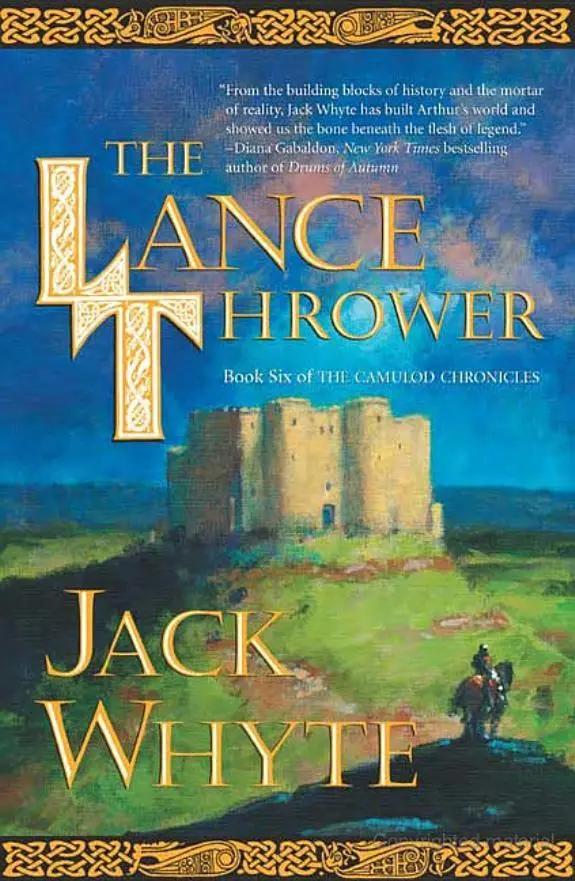
- Название:The Lance Thrower
- Автор:
- Жанр:
- Год:неизвестен
- ISBN:нет данных
- Рейтинг книги:5 / 5. Голосов: 1
-
Избранное:Добавить в избранное
- Отзывы:
-
Ваша оценка:
The Lance Thrower: краткое содержание, описание и аннотация
Предлагаем к чтению аннотацию, описание, краткое содержание или предисловие (зависит от того, что написал сам автор книги «The Lance Thrower»). Если вы не нашли необходимую информацию о книге — напишите в комментариях, мы постараемся отыскать её.
Clothar is a young man of promise. He has been sent from the wreckage of Gaul to one of the few schools remaining, where logic and rhetoric are taught along with battle techniques that will allow him to survive in the cruel new world where the veneer of civilization is held together by barbarism. He is sent by his mentor on a journey to aid another young man: Arthur Pendragon. He is a man who wants to replace barbarism with law, and keep those who work only for destruction at bay. He is seen, as the last great hope for all that is good.
Clothar is drawn to this man, and together they build a dream too perfect to last--and, with a special woman, they share a love that will nearly destroy them all...
The name of Clothar may be unknown to modern readers, for tales change in the telling through centuries. But any reader will surely know this heroic young man as well as they know the man who became his king. Hundreds of years later, chronicles call Clothar, the Lance Thrower, by a much more common name.
That of Lancelot.
The Lance Thrower — читать онлайн бесплатно полную книгу (весь текст) целиком
Ниже представлен текст книги, разбитый по страницам. Система сохранения места последней прочитанной страницы, позволяет с удобством читать онлайн бесплатно книгу «The Lance Thrower», без необходимости каждый раз заново искать на чём Вы остановились. Поставьте закладку, и сможете в любой момент перейти на страницу, на которой закончили чтение.
Интервал:
Закладка:
“That evening I went back to Antonia and told her everything I had discovered. She listened carefully, asked several questions mainly concerning you, then made arrangements to have another woman take care of feeding the infant she had previously adopted. Then she volunteered to accompany me back to Benwick, nursing you along the way. I felt greatly honored by her commitment to you, an unknown orphan, and accepted her offer immediately.
“Sadly, however, the journey from Ganis to Benwick grew into an odyssey of many months, much of the time spent avoiding wandering bands of brigands and marauders. Antonia barely survived it. She fell ill along the way and died shortly after we arrived safely in Benwick.”
I interrupted him with a comment that had just sprung into my mind. “So all the women in your story died.”
“What did you say?” Chulderic reined in his horse and sat blinking at me in what I took to be astonishment, but then his eyebrows rose even higher than they had been and he began to nod his head, hesitantly at first and then with more conviction. “Yes,” he said. “Yes, by God, you’re right. They did, all of them. I’ve never realized that before. Never even thought of it. They all died.”
We rode without speaking after that, each of us with his own thoughts, and soon we were back on the outskirts of the castle lands. With what I have always thought of since then as the resilience of youth, I felt no desire to ask any more questions about my parents’ death. I had asked, and I had been told, and I felt satisfied that I now knew the truth, but I felt no grief. How could I? I had never known Childebertus and his beautiful wife. They were mere names to me; people in a tale. I was fully aware, nevertheless, that the tale involved me and that I had an obligation to bring their murderer to justice.
I knew, too, that when I finally brought him to justice, the kingdom of Ganis that Clodas now ruled would become mine, by right of blood and birthright, but I was not yet concerned about that.
One more question remained to be asked of Chulderic, and I broached it as we approached the castle walls. “Magister Chulderic?”
It was the first time either one of us had spoken in almost half an hour, and the Master-at-Arms turned his head toward me and cocked one eyebrow. “Aye?”
“What can you tell me of Germanus?”
“Germanus, is it? Know him well, do you? Most people nowadays call him Bishop Germanus. Those of us who have known him long enough call him General Germanus, or simply the General. No one else that I know calls him plain Germanus. Where did you gain that right?”
“Pardon me.” I was duly abashed. “I did not mean to sound disrespectful. It’s just that my father says I am to go away with him, to Auxerre, to study. I have never been away from home and I had never heard of Bishop Germanus until last night, so I hoped you might tell me what you know about him.”
“Well, lad, I can’t. I know you are to go away with him when he comes, and I know you’ll miss your home at first. But you won’t pine for long and you will never regret meeting General Germanus. He is probably the finest man I ever met, including your father, but I only say that because your father died before he could achieve the things he wanted to achieve. The General, on the other hand, has had far more time to do what he has done, and he has done it all wondrously.
“Your father and Ban and the General were friends, but it began with your father and General Germanus. You see, they were all patrician … you know what that means? It’s all a matter of birth and breeding, who you are and where you were born, wealth and manners and education. I was a simple soldier, as I told you earlier, privileged to be included among their number, but I was never completely at ease with them, off duty.
“Germanus, he was five or six years older than me, and rich as an emperor. His family was an ancient and honored clan in northern Gaul, and Germanus was married to a cousin of the Emperor Honorius himself. He had been trained for a military career but he’d felt called to study law and he’d ended up as a successful lawyer in Rome. Honorius changed all that when he ordered him to take up soldiering … well, he asked him, really, according to Germanus, but who’s going to say no to an Emperor? Anyway, he needed someone to look after his interests back in Germanus’s home territories in Gaul, and he thought his friend Germanus was the very man for the job. Germanus’s young wife had died, along with her infant, in childbirth, and Germanus was so distraught, his friends were afraid he might lock himself away from the world. Army was the best thing that could have happened to him.
“So just bear in mind he’s a bishop, but he’s also a warrior, and one of the best, so he’ll train your body and your fighting skills as well as he’ll train your mind. Here, we’re back and I have matters to attend to. Is there anything else you want to ask before I leave you?”
I shook my head, knowing I would never again walk in terror of the Master-at-Arms. I would respect him more than ever after today, but having seen beneath the grim facade he wore habitually, I would never again fear him. “No, Magister,” I told him, and thanked him for his patience and forbearance that afternoon.
He nodded courteously and wished me well in Auxerre, after which he turned and rode away, making his way to the castle stables. I watched him until he rounded the edge of the curtain wall fronting the main gates, and I did not set eyes on him again for six more years.
III
FATHER GERMANUS
 IT HAS BEEN a matter of astonishment to me throughout my adult life that, having spent no more than half a day in the company of Chulderic, King Ban’s Master-at-Arms, I can recall everything he said to me, practically verbatim, and yet when it comes to speaking of my great tutor and mentor Germanus, the renowned Bishop of Auxerre, I often find myself ready to gnash my teeth with fury and frustration because I can remember so little with any clarity. Certainly I can remember incidents, and when I push myself toward recalling those in detail I can sometimes remember the surrounding circumstances quite accurately, but overall I have no sense of any flow of time in those recollections, as though my years with the bishop comprised no more than a series of unconnected incidents. I am aware of a series of lacunae in my memory—holes and spaces and missing parts that prevent me from having any solid conviction of wholeness in my relationship with the saintly bishop.
Saintly is not an inappropriate word to use in describing Germanus of Auxerre, for before he ever came into my life, men and women were already speaking in awe of his sanctity, his holiness and goodness. It was public knowledge that early in his first years as Bishop of Auxerre he had cast out demons from a man who had stolen large amounts of money, and in the process of the exorcism had forced the demon to divulge the place where the hoard was concealed—these events had taken place openly and were witnessed by many people, and the results had been indisputable. Ever since that time, the bishop had been besieged by people seeking cures for illnesses and possession, and he had performed many miracles on behalf of his flock. I was not surprised, then, that within months of his death people had already begun speaking of him as Saint Germanus. Whether or not the bishop truly was a saint, however, I find myself unqualified to judge, precisely because it was Germanus himself who taught me never to presume to make moral judgments, since those were the sole property of God to make or unmake.
Читать дальшеИнтервал:
Закладка:
Похожие книги на «The Lance Thrower»
Представляем Вашему вниманию похожие книги на «The Lance Thrower» списком для выбора. Мы отобрали схожую по названию и смыслу литературу в надежде предоставить читателям больше вариантов отыскать новые, интересные, ещё непрочитанные произведения.







Обсуждение, отзывы о книге «The Lance Thrower» и просто собственные мнения читателей. Оставьте ваши комментарии, напишите, что Вы думаете о произведении, его смысле или главных героях. Укажите что конкретно понравилось, а что нет, и почему Вы так считаете.