Jack Whyte - The Lance Thrower
Здесь есть возможность читать онлайн «Jack Whyte - The Lance Thrower» весь текст электронной книги совершенно бесплатно (целиком полную версию без сокращений). В некоторых случаях можно слушать аудио, скачать через торрент в формате fb2 и присутствует краткое содержание. Жанр: Старинная литература, на английском языке. Описание произведения, (предисловие) а так же отзывы посетителей доступны на портале библиотеки ЛибКат.
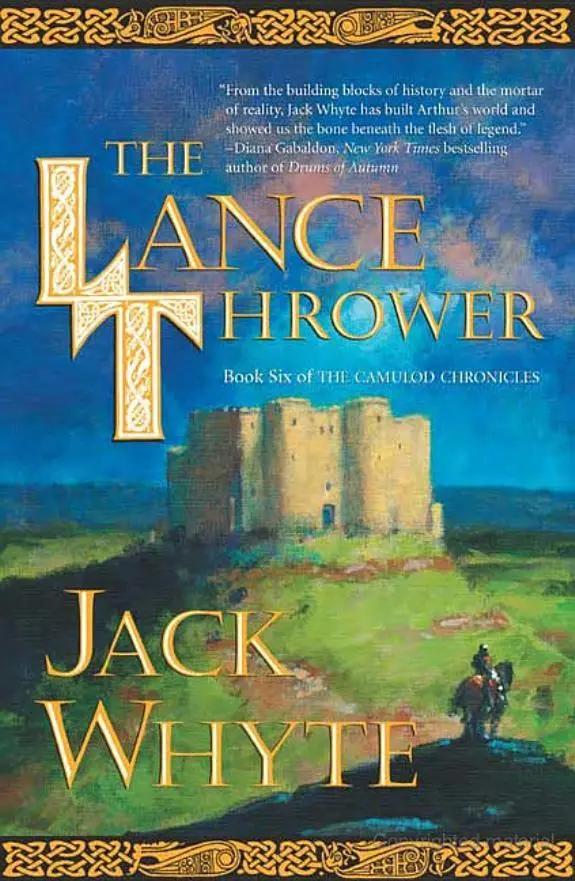
- Название:The Lance Thrower
- Автор:
- Жанр:
- Год:неизвестен
- ISBN:нет данных
- Рейтинг книги:5 / 5. Голосов: 1
-
Избранное:Добавить в избранное
- Отзывы:
-
Ваша оценка:
The Lance Thrower: краткое содержание, описание и аннотация
Предлагаем к чтению аннотацию, описание, краткое содержание или предисловие (зависит от того, что написал сам автор книги «The Lance Thrower»). Если вы не нашли необходимую информацию о книге — напишите в комментариях, мы постараемся отыскать её.
Clothar is a young man of promise. He has been sent from the wreckage of Gaul to one of the few schools remaining, where logic and rhetoric are taught along with battle techniques that will allow him to survive in the cruel new world where the veneer of civilization is held together by barbarism. He is sent by his mentor on a journey to aid another young man: Arthur Pendragon. He is a man who wants to replace barbarism with law, and keep those who work only for destruction at bay. He is seen, as the last great hope for all that is good.
Clothar is drawn to this man, and together they build a dream too perfect to last--and, with a special woman, they share a love that will nearly destroy them all...
The name of Clothar may be unknown to modern readers, for tales change in the telling through centuries. But any reader will surely know this heroic young man as well as they know the man who became his king. Hundreds of years later, chronicles call Clothar, the Lance Thrower, by a much more common name.
That of Lancelot.
The Lance Thrower — читать онлайн бесплатно полную книгу (весь текст) целиком
Ниже представлен текст книги, разбитый по страницам. Система сохранения места последней прочитанной страницы, позволяет с удобством читать онлайн бесплатно книгу «The Lance Thrower», без необходимости каждый раз заново искать на чём Вы остановились. Поставьте закладку, и сможете в любой момент перейти на страницу, на которой закончили чтение.
Интервал:
Закладка:
I sat blinking at that, entranced by the image he had conjured, trying in vain to imagine the size and amount of treasure involved and to see it, in my mind’s eye, filling the vast underground chamber of my father’s treasury, awash in a sea of gold and brilliant colors as the flickering light of torches reflected from the heaps of gold and jewels.
“What happened to it, Magister, all that money?”
“Clodas took it, along with everything else.”
“Clodas. Someday I will kill Clodas of Ganis.”
“Aye, mayhap you will. No one will blame you, I know that. He owes you more than one life. Besides, his treasury is yours by right.”
I felt myself frowning now. “Clodas of Ganis. The King said Clodas wasn’t always known by that name. But last night King Ban called you Chulderic of Ganis. Is that correct? Is that truly where you are from?”
The Master-at-Arms barked deep in his throat, and it might have been a laugh, although it might as easily have been a cough. “No, lad. I’m from Ostia, the port of Rome,” he growled. “I had never heard of Ganis until Ban mentioned it, and I didn’t get that name until I came here with you, ten years ago. Chulderic’s a common name in these parts and there were already four Chulderics here when I arrived. Each of them was known by the name of the place he came from, and one of them was already from Ostia, another from Rome. So I became Chulderic of Ganis.”
“What did you do in Ostia, Magister?”
“What did I do in Ostia?” He made a formless, grunting sound deep in his chest. “No one has ever asked me that before. What did I do in Ostia? I should know, I was there for years … . I survived, I suppose, and that, considering who I was and where I found myself, was an achievement. I grew up there, fighting for every scrap of food I ate and fighting even harder simply to live when there was nothing to eat … . I was an orphan and a thief, forced to live by my wits, and they served me well, since I am still here to speak of it. I had no family … and no memories of anyone, from my earliest days … . I lived on the streets, alone, sleeping in doorways most of the time, for as long as I can remember, and the one vision I had that kept me alive throughout that entire time was an image of myself as a soldier. I don’t know how or when it began, but I grew up dreaming of being a soldier—not a mere warrior, mark you, but a uniformed Roman soldier, a legionary—because soldiers, to me, were always self-sufficient and dependent upon no man for their food. They were tall and strong and confident, and they had fine weapons and they were clean and wore warm clothing and well-made armor and everyone knew who they were and what they were. I never met a single one, mind you, who showed me any kindness, but somehow, among them all, they saved my life.
“I was fourteen when I first tried to enlist, and they laughed at me because I was a small, undernourished, and skinny fourteen. I was so furious that I wept. I tried seven more times after that—seven times in two years—and they turned me away each time. But then they took me in the next time, on my ninth attempt, with no hesitation. I suppose I had grown old enough by then to look my age.”
He glanced across to where I sat watching him, and sniffed. “Now I’m a Master-at-Arms, so who would guess I ever was a thief?”
There was nothing I could say to that, and I only had the vaguest suspicion that there might be a grin hiding underneath his scowl, so I sat mute for a spell, then changed the topic.
“Why did Clodas of Ganis kill my parents, Magister, and how was he able to do so?”
Chulderic stiffened as though I had slapped him, and then his shoulders slumped forward. “Why and how are two different matters, boy. I’ve been thinking of that, and wondering about it, for ten years now. He killed them because they were there and they had what he wanted. This is a creature born to kill, this Clodas. He is depraved … evil. And yet he hides the evil effortlessly, with an almost supernatural ability to dissemble, to appear to be what he is not. Easy for me now to say what I know to be true, that he is without a man’s emotions, empty of mercy or compassion, incapable of love or sympathy or sorrow. But this was not the face he showed to us who thought we were his friends. From us, he concealed every inkling of his true nature—from us men, at least, because I seem to recall that most women disliked him and distrusted him instinctively. I suppose that makes men more gullible and foolish than women. It’s certainly true that he was able to gull all of us who knew him. Jesu! It makes me sick when I recall how much we trusted him … and honored him, for that matter. But then, truth to tell, none of us could even imagine the depths of treachery and depravity that existed within him while he was making us all love and admire him.”
The old man stared out across the scene in front of us. “Believe me, lad, he was a piece of work … the kind of man to make you doubt every notion you ever had of what is admirable or honorable or worthy of trust.
“How did he do it? Within the six months following your father’s arrival, he and King Garth visited every town, every fort, and every settlement, no matter how poor or insignificant, in the Ganis federation, and that is how your father first met Clodas, on one of those journeys. In those days, Clodas was not known to anyone as Clodas of Ganis. If anything, he would have been Clodas of Rich Vale, but even that would have been ludicrous. His station was far more humble back then. His father, Dagobert, was the chief magistrate and nominal ruler of the district called Rich Vale, one of the larger fiefs of Ganis which lay far to the southeast of Garth’s own lands. But Dagobert was an administrative ruler, more of a public official than a leader in any military sense. He was also some kind of cousin to King Garth, a relative by blood, but I know not how close, although I believe someone once told me that Garth’s grandsire had been a brother to Dagobert’s grandmother, or perhaps his great-grandmother.
“When Childebertus first met Clodas and his people, there was no slightest sign from any of them that they might all one day disagree. Clodas represented his father that day, for Dagobert had fallen gravely ill and would later die of his illness. Clodas presented himself as a loyal kinsman and ally of King Garth, and welcomed him and your father warmly as honored guests, extending all the hospitality of his father’s hall to the King’s party. Your grandfather was Clodas’s King, and took the welcome as no more than his due, barely aware of anything other than the formality of the occasion. Your father, on the other hand, being the man he was, accepted Clodas’s hospitality in the spirit in which he believed it was being offered. It would never have crossed his mind to doubt the truthfulness or the intent of his host. And Clodas took great pains to ingratiate himself with both his visitors.
“Less than a month after returning home to Ganis, they received the word of Dagobert’s death, and of Clodas’s elevation to his father’s rank and holdings, and a month or so after that, they returned to Rich Vale to pay their respects to Clodas, to ratify him as his father’s successor, and to commiserate with him over the death of his father. It was at that time that they first began discussing how the garrison at Rich Vale could be strengthened, to their mutual advantage. King Garth, using the combined resources of his regal title and your father’s money, with Childebertus’s full blessing in the latter, offered to quintuple the strength of Rich Vale’s resident forces, which had so far been a mere token presence, providing that Clodas himself would undertake to command his own garrison thereafter, with suitable assistance from Ganis, and to build sufficient housing for his new recruits. Clodas agreed, and it was arranged that a new muster of mercenaries would report to Clodas’s command the following spring.
Читать дальшеИнтервал:
Закладка:
Похожие книги на «The Lance Thrower»
Представляем Вашему вниманию похожие книги на «The Lance Thrower» списком для выбора. Мы отобрали схожую по названию и смыслу литературу в надежде предоставить читателям больше вариантов отыскать новые, интересные, ещё непрочитанные произведения.







Обсуждение, отзывы о книге «The Lance Thrower» и просто собственные мнения читателей. Оставьте ваши комментарии, напишите, что Вы думаете о произведении, его смысле или главных героях. Укажите что конкретно понравилось, а что нет, и почему Вы так считаете.