Jack Whyte - The Lance Thrower
Здесь есть возможность читать онлайн «Jack Whyte - The Lance Thrower» весь текст электронной книги совершенно бесплатно (целиком полную версию без сокращений). В некоторых случаях можно слушать аудио, скачать через торрент в формате fb2 и присутствует краткое содержание. Жанр: Старинная литература, на английском языке. Описание произведения, (предисловие) а так же отзывы посетителей доступны на портале библиотеки ЛибКат.
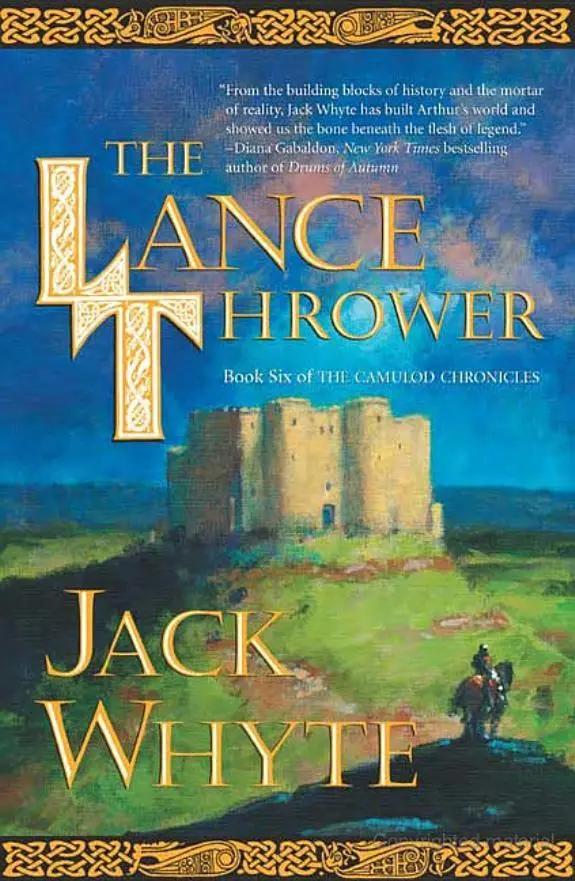
- Название:The Lance Thrower
- Автор:
- Жанр:
- Год:неизвестен
- ISBN:нет данных
- Рейтинг книги:5 / 5. Голосов: 1
-
Избранное:Добавить в избранное
- Отзывы:
-
Ваша оценка:
The Lance Thrower: краткое содержание, описание и аннотация
Предлагаем к чтению аннотацию, описание, краткое содержание или предисловие (зависит от того, что написал сам автор книги «The Lance Thrower»). Если вы не нашли необходимую информацию о книге — напишите в комментариях, мы постараемся отыскать её.
Clothar is a young man of promise. He has been sent from the wreckage of Gaul to one of the few schools remaining, where logic and rhetoric are taught along with battle techniques that will allow him to survive in the cruel new world where the veneer of civilization is held together by barbarism. He is sent by his mentor on a journey to aid another young man: Arthur Pendragon. He is a man who wants to replace barbarism with law, and keep those who work only for destruction at bay. He is seen, as the last great hope for all that is good.
Clothar is drawn to this man, and together they build a dream too perfect to last--and, with a special woman, they share a love that will nearly destroy them all...
The name of Clothar may be unknown to modern readers, for tales change in the telling through centuries. But any reader will surely know this heroic young man as well as they know the man who became his king. Hundreds of years later, chronicles call Clothar, the Lance Thrower, by a much more common name.
That of Lancelot.
The Lance Thrower — читать онлайн бесплатно полную книгу (весь текст) целиком
Ниже представлен текст книги, разбитый по страницам. Система сохранения места последней прочитанной страницы, позволяет с удобством читать онлайн бесплатно книгу «The Lance Thrower», без необходимости каждый раз заново искать на чём Вы остановились. Поставьте закладку, и сможете в любой момент перейти на страницу, на которой закончили чтение.
Интервал:
Закладка:
“Your father thanked the King for his generous gift, then rode away, straight backed and stiff shouldered, filled with rage at himself, he told me later, for his stupidity in offering to leave. He had not even had an opportunity to speak with Elaine, to tell her what had happened. She loved him, he knew, as he loved her, and her father had promised to tell her what he had done, but Childebertus would never forgive himself, he thought, for denying their love to both of them in what he now recognized as a moment of foolish enthusiasm.”
“He rode away alone, then? Why didn’t you go with him, for company on the road?”
“I would have, had I been there, but I was in Benwick at that time, acting as Ban’s deputy during his absence.”
“Well …” I was almost spluttering, outraged by the injustice of what had been done to my father. “Had he no friends to ride with him? Did King Ban not object to his being sent away alone?”
“Aye, he did. Ban was angry and upset when he first heard that your father would leave the next day. His anger sprang out of his loyalty to your father, for whom he felt responsible, as well as from his own awareness that he himself could not accompany his friend—not now that he had a wife to take back to his own home, with all her belongings and her personal attendants. None of those, he knew, would be ready to leave for another week, at least, and he himself could not leave without them. So he demanded that Childebertus select an escort from among Ban’s own men, to ride with him—Ban had brought an unusually large force with him to Ganis, more for display than for real safety, and could easily afford to send a large number of them with his friend to protect him. But your father was still feeling noble then, determined to suffer and endure the agonies of his self-hatred and contempt in seclusion. So, yes, he rode off alone.”
“What happened then … Magister?” I almost addressed him as an equal, but I caught myself in time to add the respectful acknowledgment of his rank. He did not notice, however, and answered my question without hesitation.
“Ban sent an escort after him, regardless of your father’s wishes, but Childebertus must have seen them coming behind him, because he vanished before they could make contact with him and they could find no trace of him from then on. They eventually returned to Ganis, to report their failure to Ban, and he was not happy with them. But there was nothing to be done.”
“But that can’t be all, Magister! There must be more. How could my father ever have wed my mother, having sworn by his honor never to see her again? Did he forswear himself?”
Chulderic smiled now, amused at my panic. “Easy, boy, calm down. Your father’s honor was never in question. King Garth himself absolved him of his promise. I told you the old man was neither foolish nor indecisive. Exactly a month after the wedding, on the very day that Ban and his new wife left King Garth’s lands to return to Benwick, Garth received word, in the form of a written report from an imperial legate, that Gundevald of Stone Vale was dead, killed in battle months earlier when his force was surrounded and wiped out by an overwhelming concentration of Ostrogoths whose existence in that part of the world had been unsuspected until that encounter.”
I had been listening avidly, because I knew Gundevald must have died somehow—otherwise, how could my father and my mother have wed?—and this confirmation of my own judgment pleased me greatly.
“Well, those were the worst tidings King Garth could have received. He knew that Ban, his new son-in-law, was an able man and a valiant fighter and would have made a fine consort to Vivienne, had she ever become Queen of Ganis, but he had always known, too, that such a thing would never be, because it had never been intended. Vivienne would go with Ban to his home in Benwick, hundreds of miles to the south and east, where he already had a people of his own to rule.
“At the time of the pair’s betrothal, you see, almost two decades earlier, Garth had been in the prime of his manhood, with a fertile and loving wife who, to that point, had given him three fine, healthy sons and twin daughters. Full of a young man’s belief in his own invincibility and flushed with his pride of fatherhood, Garth had foreseen no need then to fret over his own future. The marriage of his daughter to the son of his old friend Ban the Bald had been arranged purely to strengthen the ties between Ganis and his friend and ally, Ban the Bald of Benwick. Since that time, however, Garth had lost his beloved wife, who had died in childbirth along with her infant. He had never remarried, but had kept himself surrounded by women of all ages, using all of them shamelessly to help him look after and care for his children, and most particularly his three sons.
“And then, late in his life and within the space of two years, all three of his sons had been taken from him—one crushed in a fall from a horse, the youngest swept away and lost forever in a flooded river later in the same year, and the eldest and most promising, Dion, devoured by the spotted fever. Suddenly Garth was alone, with only one unwed daughter left to succeed him, and his enemies were as aware as he that Garth of Ganis was no longer as mighty as he once had been.
“That knowledge was the reason for Garth’s promising his daughter to Gundevald of Stone Vale in the first place. He was very concerned about protecting his kingdom and his people, but he was equally concerned about protecting his unwed daughter. The Salian Franks have very strongly held ideas about women succeeding and taking possession of family holdings. They don’t like that at all and they’ve been trying for years to put a stop to it. They want a dead man’s holdings to pass to another male; if not a son, then the nearest male relative. Garth was long-headed when it came to things like that. He could not have foreseen what would happen to his sons, but he was clear thinking enough to ensure that even in the worst imaginable circumstances, his daughter would not end up penniless and disinherited as a helpless woman in a man’s world. He saw it as his duty to protect her against the day when he could not be there to see to it himself. Gundevald, like Ban the Bald of Benwick, had been a valued friend of Garth’s for years. His lands of Stone Vale bordered Garth’s own holding, and although they were neither as fertile nor as extensive as King Garth’s Ganis, they were more rugged, easier to defend, and they abutted Ganis on two sides.
“Furthermore, Gundevald was the last of his family, the sole survivor of a long line of successful and enterprising merchants whose ventures, operating mainly out of Massilia, the oldest port of southern Gaul, had covered every part of the Empire for more than two hundred years. By an accident of birth and the attrition of the few remaining heirs of his natural family, Gundevald had become the sole inheritor of a private trading empire so complex and diversified that he could never possibly spend all of his wealth. And his immense wealth enabled him to enjoy a personal power that few men could wield. He counted himself a friend of the Emperor, Honorius, and thanks to the Emperor’s blessing, Gundevald commanded his own private army, maintaining it out of his own coffers and placing it at the disposal of Honorius in time of war.
“Garth knew there were some people who thought it less than fortunate that Gundevald was almost twice Elaine’s age and so had little youth and less beauty with which to sway or win a young girl’s heart, but he knew, too, that Gundevald would make a fine, strong, and dutiful husband for his only remaining unwed daughter, and a powerful protector for her lands and her people once Garth was gone. But now Gundevald was dead, and Elaine was almost nineteen, having spent three full years waiting for him to return and marry her.
Читать дальшеИнтервал:
Закладка:
Похожие книги на «The Lance Thrower»
Представляем Вашему вниманию похожие книги на «The Lance Thrower» списком для выбора. Мы отобрали схожую по названию и смыслу литературу в надежде предоставить читателям больше вариантов отыскать новые, интересные, ещё непрочитанные произведения.







Обсуждение, отзывы о книге «The Lance Thrower» и просто собственные мнения читателей. Оставьте ваши комментарии, напишите, что Вы думаете о произведении, его смысле или главных героях. Укажите что конкретно понравилось, а что нет, и почему Вы так считаете.