W.E.B. Griffin - Retreat, Hell!
Здесь есть возможность читать онлайн «W.E.B. Griffin - Retreat, Hell!» весь текст электронной книги совершенно бесплатно (целиком полную версию без сокращений). В некоторых случаях можно слушать аудио, скачать через торрент в формате fb2 и присутствует краткое содержание. Год выпуска: 0101, Жанр: Старинная литература, на английском языке. Описание произведения, (предисловие) а так же отзывы посетителей доступны на портале библиотеки ЛибКат.
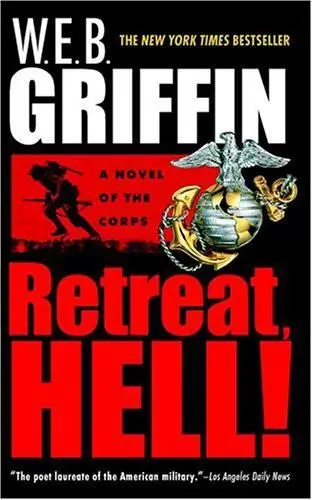
- Название:Retreat, Hell!
- Автор:
- Жанр:
- Год:0101
- ISBN:нет данных
- Рейтинг книги:3 / 5. Голосов: 1
-
Избранное:Добавить в избранное
- Отзывы:
-
Ваша оценка:
Retreat, Hell!: краткое содержание, описание и аннотация
Предлагаем к чтению аннотацию, описание, краткое содержание или предисловие (зависит от того, что написал сам автор книги «Retreat, Hell!»). Если вы не нашли необходимую информацию о книге — напишите в комментариях, мы постараемся отыскать её.
Megaseller Griffin (Honor Bound; Brotherhood of War; Men at War) musters another solid entry in his series chronicling the history of the U.S. Marines, now engaged in the Korean War. Gen. Douglas MacArthur, nicknamed El Supremo by his subordinates, is taken by surprise when the North Korean Army surges south across the 38th parallel. After early losses, he rallies his troops and stems the tide, but not for long. Intertwining stories of literally an army of characters reveal how MacArthur and his sycophantic staff overlook the entire Red Chinese Army, which is massed behind the Yalu River and about to enter the war. Brig. Gen. Fleming Pickering attempts to mediate the ongoing battles between feisty, give-'em-hell Harry Truman and the haughty MacArthur, while worrying about his pilot son, Malcolm "Pick" Pickering, who has been shot down behind enemy lines. The introduction of the Sikorsky H-19A helicopter into the war by Maj. Kenneth "Killer" McCoy and sidekick Master Gunner Ernie Zimmerman details the invention of tactics that will become commonplace in Vietnam. Readers looking for guts and glory military action will be disappointed, as barely a shot is fired in anger, but fans of Griffin's work understand that the pleasures are in the construction of a complex, big-picture history of war down to its smallest details: "There were two men in the rear seat, both of them wearing fur-collared zippered leather jackets officially known as Jacket, Flyers, Intermediate Type G-1." Veterans of the series will enjoy finding old comrades caught up in fresh adventures, while new-guy readers can easily enter here and pick up the ongoing story.
Retreat, Hell! — читать онлайн бесплатно полную книгу (весь текст) целиком
Ниже представлен текст книги, разбитый по страницам. Система сохранения места последней прочитанной страницы, позволяет с удобством читать онлайн бесплатно книгу «Retreat, Hell!», без необходимости каждый раз заново искать на чём Вы остановились. Поставьте закладку, и сможете в любой момент перейти на страницу, на которой закончили чтение.
Интервал:
Закладка:
"I hope he's wrong now," the captain said. "This part of the world is a lousy place to have to fight a war in the winter."
"The troops seem to think they'll be home for Christmas," Dunn said.
"Let's hope they're right," the captain said, then: "Changing the subject, you have a message straight from CNO."
"I have a message from CNO?"
"Yeah," the captain said, then took it from his pocket and handed it to him.
"I thought you were pulling my chain, sir," Dunn said as he unfolded the single sheet of teletypewriter paper.
SECRET
URGENT
WASHINGTON DC 0945 16 OCTOBER 1950
FROM: CHIEF OF NAVAL OPERATIONS
SUBJECT: CITATION FOR DECORATION FOR MAJOR M.S. PICKERING, USMCR
TO: COMMANDING OFFICER MAG 33 ABOARD BADOENG STRAIT
INFO: CHAIRMAN JOINT CHIEFS OF STAFF
NAVAL LIAISON OFFICER TO THE PRESIDENT
SUPREME COMMANDER UNITED NATIONS COMMAND TOKYO
COMMANDANT USMC COMMANDER-IN-CHIEF PACIFIC
1. IT IS THE DESIRE OF THE PRESIDENT THAT MAJOR MALCOLM S. PICKERING, USMCR, BE AWARDED THE NAVY CROSS FOR HIS HEROISM AND VALOR ABOVE AND BEYOND THE CALL OF DUTY DURING THE PERIOD HE SPENT BEHIND ENEMY LINES BETWEEN HIS BEING SHOT DOWN AND HIS RESCUE.
2 . IT IS DIRECTED THAT YOU
A. ACKNOWLEDGE RECEIPT OF THIS MESSAGE BY URGENT MESSAGE.
B. IMMEDIATELY PREPARE A SUITABLE CITATION FOR THIS AWARD AND FORWARD IT BY THE MOST EXPEDITIOUS MEANS THROUGH APPROPRIATE CHANNELS TO CHIEF OF NAVAL OPERATIONS, ATTN: CHIEF, AWARDS BRANCH.
C. FURNISH CNO A COPY OF THE PROPOSED CITATION BY URGENT MESSAGE AT THE TIME YOU BEGIN TO FORWARD IT THROUGH APPROPRIATE CHANNELS. (SEE 2.A. ABOVE)
FOR THE CHIEF OF NAVAL OPERATIONS
WALLACE T. GERARD
VICE ADMIRAL
DEPUTY CNO
SECRET
"No," Dunn blurted. "I won't do it."
"Excuse me?"
"I won't do it," Dunn repeated.
"What are you talking about, Billy?" the captain asked.
"Pickering did nothing that merits the award of the Navy Cross," Dunn said.
"The President seems to think he does," the captain said.
"Pickering did what he was expected to do," Dunn said. "He evaded capture until he was able to get back. That's all."
"Colonel," the captain said formally, then reached over and took the message from Dunn's hand and read from it: " 'It is the desire of the President that Major Malcolm S. Pickering, USMCR, be awarded the Navy Cross.' That seems to/settle the question, wouldn't you agree?"
"Let the President write the citation. I won't."
The captain dropped his eyes to the message and read from it again: " 'You will immediately prepare a suitable citation for this award. ..." That sounds pretty clear to me."
“Not only was Pickering not doing anything more than any shot-down pilot is expected to do, but it was his fault—and mine—that he got shot down in the first place."
"You want to explain that to me, Colonel?" the captain asked somewhat coldly.
"What he was doing when he was shot down was trying to become the first locomotive ace in the Marine Corps," Dunn said. "I knew what he was doing, and I didn't stop him."
"What do you mean, 'locomotive ace'?"
"He wanted credit for shooting up five locomotives; in his mind that would make him a locomotive ace. He'd already checked with the Air Force to see if any Air Force pilot was credited with more locomotives in World War Two."
The captain looked at him, shook his head, but said nothing.
"It was a joke to him," Dunn said. "The whole war is a joke to him. And I knew what he was doing and didn't stop him."
"I thought you were old pals."
"He was my wingman at Guadalcanal," Dunn said. "I love the sonofabitch, but I am not going to go through with this nonsense of giving him the Navy Cross. What he did was cause a lot of good people to put their dicks on the chopping block to save his sorry ass, and I am not going to help him get a medal like that for being a three-star horse's ass and, for that matter, a lousy Marine officer."
"Calm down, Colonel," the captain said.
"I beg your pardon for my language, sir," Dunn said. "But I am not going to go along with this bullshit."
The captain raised his hand in a gesture that meant take it easy. "Jesus!" Dunn said disgustedly. The captain said nothing.
"There was a standing order at Fighter One on the 'Canal," Dunn said. "No buzzing the field, period. We couldn't risk the airplanes. Pick used to do full-emergency-power barrel rolls over the field every time he shot down an airplane," Dunn said. "And sometimes just whenever the hell he felt like it. That's when I should have pulled the wiseass bastard up short."
"When you have your emotions under control, Colonel, let me know," the captain said coldly.
Dunn looked at him for a long moment.
"My apologies, sir," he said finally.
"What are you going to do?" the captain asked. "You have been ordered by the Chief of Naval Operations to immediately prepare a suitable citation.' "
"I'm unable to comply with that order, sir."
The captain said nothing.
"A lot of good men have earned the Navy Cross—" Dunn began.
"Including you, Colonel," the captain interrupted. "Is that what this is about?"
"—and giving Major Pickering the decoration for having done nothing beyond what he was expected to do," Dunn went on, "would be an insult to every one of them."
"Be that as it may, the Commander-in-Chief 'desires' that Pickering be awarded the Navy Cross. You can't fight that, Colonel. You have an order. You have no choice but to obey it."
"I am unable to do that, sir," Dunn said.
Thirty minutes later, a message went out from the Badoeng Strait.
SECRET
URGENT
BADOENG STRAIT 1405 17 OCTOBER 1950
FROM: COMMANDING OFFICER MAG 33
TO: CHIEF OF NAVAL OPERATIONS ATTN: CHIEF, AWARDS BRANCH
REFERENCE PARA 2. MSG CNO SUBJ: CITATION FOR DECORATION FOR MAJOR M.S. PICKERING, USMCR
DATED 16 OCTI1950
2. THE UNDERSIGNED IS UNABLE TO COMPLY.
WILLIAM C. DUNN
LIEUTENANT COLONEL,
USMC COMMANDING
SECRET
[TWO]
U.S. Naval Hospital
U.S. Navy Base, Sasebo
Sasebo, Japan
1625 18 October 19SO
Lieutenant (j.g.) Rosemary Hills, Nurse Corps, USNR—a five-three, one-hundred-fifteen-pound twenty-three-year-old from Chicago—had the duty, which placed her at a desk in the nurses' station of Ward 4-G between 1600 and 2400 hours.
There were six Corpsmen always on duty in Ward 4-G, and usually two or three of them could be found at the nurses' station. They dealt with the routine operations of Ward 4-G, and turned to Lieutenant Hills only when something required the attention of the ward nurse on duty, a registered nurse, or acommissioned officer, or any combination thereof.
She was a little uncomfortable when she glanced up from her desk and saw a Marine standing on the other side of the counter, obviously wanting something, and saw there was no Corpsman behind the counter—or anywhere in sight—to deal with him.
Lieutenant Hills had not been in the Navy very long, and was not completely familiar with all the subtleties of Navy rank and protocol, and was even less familiar with those of the Marine Corps.
She knew from the rank insignia on his collar points and shoulders that the man standing before her was a master gunner, which was the equivalent of a Navy warrant officer, which meant that he ranked between the senior enlisted Marine and the junior Marine officer.
She remembered, too, from orientation at the Great Lakes Naval Training Center, that Marine master gunners were special, as lieutenants—Marine and Navy—were ordinary. There were very few master gunners, and they were all ex-senior enlisted Marines with all sorts of experience that qualified them to be master gunners.
Читать дальшеИнтервал:
Закладка:
Похожие книги на «Retreat, Hell!»
Представляем Вашему вниманию похожие книги на «Retreat, Hell!» списком для выбора. Мы отобрали схожую по названию и смыслу литературу в надежде предоставить читателям больше вариантов отыскать новые, интересные, ещё непрочитанные произведения.






Обсуждение, отзывы о книге «Retreat, Hell!» и просто собственные мнения читателей. Оставьте ваши комментарии, напишите, что Вы думаете о произведении, его смысле или главных героях. Укажите что конкретно понравилось, а что нет, и почему Вы так считаете.