W.E.B. Griffin - Retreat, Hell!
Здесь есть возможность читать онлайн «W.E.B. Griffin - Retreat, Hell!» весь текст электронной книги совершенно бесплатно (целиком полную версию без сокращений). В некоторых случаях можно слушать аудио, скачать через торрент в формате fb2 и присутствует краткое содержание. Год выпуска: 0101, Жанр: Старинная литература, на английском языке. Описание произведения, (предисловие) а так же отзывы посетителей доступны на портале библиотеки ЛибКат.
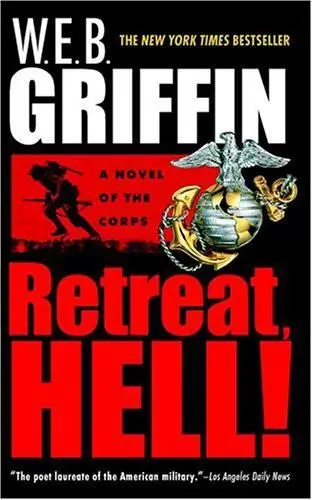
- Название:Retreat, Hell!
- Автор:
- Жанр:
- Год:0101
- ISBN:нет данных
- Рейтинг книги:3 / 5. Голосов: 1
-
Избранное:Добавить в избранное
- Отзывы:
-
Ваша оценка:
Retreat, Hell!: краткое содержание, описание и аннотация
Предлагаем к чтению аннотацию, описание, краткое содержание или предисловие (зависит от того, что написал сам автор книги «Retreat, Hell!»). Если вы не нашли необходимую информацию о книге — напишите в комментариях, мы постараемся отыскать её.
Megaseller Griffin (Honor Bound; Brotherhood of War; Men at War) musters another solid entry in his series chronicling the history of the U.S. Marines, now engaged in the Korean War. Gen. Douglas MacArthur, nicknamed El Supremo by his subordinates, is taken by surprise when the North Korean Army surges south across the 38th parallel. After early losses, he rallies his troops and stems the tide, but not for long. Intertwining stories of literally an army of characters reveal how MacArthur and his sycophantic staff overlook the entire Red Chinese Army, which is massed behind the Yalu River and about to enter the war. Brig. Gen. Fleming Pickering attempts to mediate the ongoing battles between feisty, give-'em-hell Harry Truman and the haughty MacArthur, while worrying about his pilot son, Malcolm "Pick" Pickering, who has been shot down behind enemy lines. The introduction of the Sikorsky H-19A helicopter into the war by Maj. Kenneth "Killer" McCoy and sidekick Master Gunner Ernie Zimmerman details the invention of tactics that will become commonplace in Vietnam. Readers looking for guts and glory military action will be disappointed, as barely a shot is fired in anger, but fans of Griffin's work understand that the pleasures are in the construction of a complex, big-picture history of war down to its smallest details: "There were two men in the rear seat, both of them wearing fur-collared zippered leather jackets officially known as Jacket, Flyers, Intermediate Type G-1." Veterans of the series will enjoy finding old comrades caught up in fresh adventures, while new-guy readers can easily enter here and pick up the ongoing story.
Retreat, Hell! — читать онлайн бесплатно полную книгу (весь текст) целиком
Ниже представлен текст книги, разбитый по страницам. Система сохранения места последней прочитанной страницы, позволяет с удобством читать онлайн бесплатно книгу «Retreat, Hell!», без необходимости каждый раз заново искать на чём Вы остановились. Поставьте закладку, и сможете в любой момент перейти на страницу, на которой закончили чтение.
Интервал:
Закладка:
"Captain," the officer of the deck said. "I have a radar target five miles dead ahead."
Captain Welsh was interested but not alarmed. There was no reason to believe the target in any way posed a danger to the invasion fleet. Carrier aircraft were patrolling the area. They would have reported the presence of any naval force long before the DeHaven’s radar picked it up.
Captain Walsh looked at the radar screen.
"Probably a fishing boat of some kind," he opined. "He's about to get a surprise, isn't he?"
He nevertheless reached for the ship-to-ship microphone.
"McKinley, DeHaven, "he said.
The USS Mount McKinley was the command vessel of the convoy. It carried aboard both the senior Naval officer of the convoy and the senior officer of the Army and Marine Corps troops who were to be landed.
"Go, DeHaven" an officer on the bridge of the McKinley replied.
"I have a radar target at about five miles, probably a fishing vessel."
"And?"
"I'm waiting until I have him in sight until I do anything."
"There's some Corsairs overhead. I'll have them take a look, and advise."
"Roger, thank you. DeHaven out."
O728 19 October 195O
Two Navy Corsairs approached the DeHaven from dead ahead at less than a thousand feet, dipped their wings, and then began to climb.
O729 19 October 195O
"DeHaven, McKinley, the Corsairs report it's a junk. I think that they probably woke them up, and they'll get out of the way." "Thank you, McKinley."
O731 19 October 195O
"McKinley, DeHaven, I have the junk in sight. Unless they're blind, they have to see us, but they are not changing course. And it looks to me as if she's under power."
"Junks don't have power, DeHaven. They are propelled by what are called 'sails.' "
"Thank you so much."
"They'll probably get out of the way when they see more than one vessel headed their way. Advise."
"Will do."
O735 19 October 195O
"McKihley, DeHaven, my junk is not changing course."
"Well, we don't want to run over him, do we? The admiral says to get him to change course."
"Understand. I'll make a run across his bow."
O741 19 October 195O
"McKinley, you're not going to believe this, but my junk just hoisted a large American flag. And she is not changing course."
"The admiral does not want the junk to approach the convoy."
"What am I supposed to do, fire a shot across her bow?"
A new voice came over the ship-to-ship.
"DeHaven, this is Admiral Feeney. If putting a shot across her bow is necessary, then that's what you should do."
"Aye, aye, sir. Sir, it is my intention to come alongside the vessel and signal an order to her to change course."
"Proceed," the admiral said.
O746 19 October 195O
"McKinley, DeHaven is alongside the junk. She is under power. A man in what looks like black pajamas has hailed DeHaven with a loudspeaker and says he is a Marine major named McCoy and desires to approach McKinley. Request guidance."
"DeHaven, Admiral Feeney. The junk is not, repeat not, to approach the McKinley. Take whatever action is appropriate."
"Aye, aye, sir."
[FOUR]
The Bridge, USS Mount McKinley (LCC-2O)
39 Degrees 34 Minutes North Latitude
128 Degrees 43 Minutes East Longitude
The Sea of Japan
O747 19 October 195O
"I think I know who that is," Major General Edward M. Almond, USA, said to Rear Admiral Ignatius Feeney, USN.
"You what?"
"I suggest you give him approval to approach your ship," Almond went on.
"It might prove very interesting."
"You're serious, Ned, aren't you?" Admiral Feeney asked, surprised.
Almond nodded. "Remember the islands in the Flying Fish Channel that were cleared before we got there?" he asked. "Unless I'm mistaken, that's the man who cleared them. OSS."
"OSS? Really?" Rear Admiral Feeney said. He reached for the ship-to-ship microphone. "DeHaven, permit the junk to approach the McKinley."
Both Navy reconnaissance aircraft and minesweepers on the scene had reported that there were still enough mines in the approaches to the harbors of both Wonsan and Hamhung to preclude the movement of oceangoing vessels into the harbors.
The invasion fleet, both to conserve fuel and because there was no point in making speed when the anticipated course for the next thirty-six hours was one large circle after another, was moving at ten knots.
Ten knots was still considerably faster than what Admiral Feeney—who, with General Almond, was now on the McKinleys flying bridge—understood the maximum speed of a junk under sail to be, and he was thus more than a little surprised when the junk approached the McKinley head-on, made a quick 180-degree turn, and then pulled alongside.
"I'll be damned," Admiral Feeney said. "That junk is motorized."
A man wearing black pajamas stood on the forecastle of the junk, holding an electric megaphone in his hand.
"Ahoy, McKinley. Can you hear me?"
"Loud and clear," Admiral Feeney said into the microphone of his electric megaphone.
"I have three wounded aboard," the man in the black pajamas called.
"Including Major McCoy, apparently," General Almond said. "Look at his leg."
The left leg of the pajamas was torn off above the knee. A bloody compress was on the upper thigh.
"Is that your OSS man?" Admiral Feeney asked.
Almond nodded. "Admiral, you are looking at the legendary Killer McCoy, U.S. Marine Corps," he said.
"I don't want that junk crashing into the hull," Admiral Feeney said almost to himself, then took the few short steps onto the bridge.
"The admiral is on the bridge!" a talker called out.
Admiral Feeney approached Captain Joseph L. Farmer, USN, the captain of the McKinley, and asked, "Have you a minute for me, sir?"
"You have the conn," Captain Farmer said to his executive officer, then followed Feeney out onto the flying bridge.
Admiral Feeney began, "The master of that vessel—"
"Jesus, he's been wounded!" Captain Farmer blurted.
"—reports that he has three wounded aboard. I was wondering what you think of lowering a lifeboat to the junk—not into the water—and transferring the wounded to the lifeboat from the junk as a means of getting them aboard."
"I think we can do that, sir," Captain Farmer said.
He went back onto the bridge.
A piercing whistle and then Captain Farmer's voice came over the ship's loudspeakers a moment later. "Attention all hands. All, repeat all, nonessential personnel will immediately leave the port-side boat deck immediately. Port-side Lifeboat One Crew report to your station immediately. Medical Emergency Team report to port-side Lifeboat One immediately."
The captain came back on the flying bridge.
A much younger voice—that of the talker—repeated the orders he had just broadcast.
The admiral, the general, and the captain watched silently from the flying bridge as the port-side Number One lifeboat's davits swung the lifeboat away from the ship, and then—after an ensign and three white hats got aboard— lowered it slowly toward the sea.
When the lifeboat was even with the forecastle of the junk, the man with the bandage on his upper left thigh threw a line to a white hat in the lifeboat, who hauled on it and pulled the junk slowly sidewards to the lifeboat.
Five men in black pajamas, all Orientals, appeared on the deck of the junk, then began to move three wounded men up onto the forecastle. Two of them had to be carried. The third was able, with help, to make it up the ladder on his feet.
Читать дальшеИнтервал:
Закладка:
Похожие книги на «Retreat, Hell!»
Представляем Вашему вниманию похожие книги на «Retreat, Hell!» списком для выбора. Мы отобрали схожую по названию и смыслу литературу в надежде предоставить читателям больше вариантов отыскать новые, интересные, ещё непрочитанные произведения.









Обсуждение, отзывы о книге «Retreat, Hell!» и просто собственные мнения читателей. Оставьте ваши комментарии, напишите, что Вы думаете о произведении, его смысле или главных героях. Укажите что конкретно понравилось, а что нет, и почему Вы так считаете.