W.E.B. Griffin - Retreat, Hell!
Здесь есть возможность читать онлайн «W.E.B. Griffin - Retreat, Hell!» весь текст электронной книги совершенно бесплатно (целиком полную версию без сокращений). В некоторых случаях можно слушать аудио, скачать через торрент в формате fb2 и присутствует краткое содержание. Год выпуска: 0101, Жанр: Старинная литература, на английском языке. Описание произведения, (предисловие) а так же отзывы посетителей доступны на портале библиотеки ЛибКат.
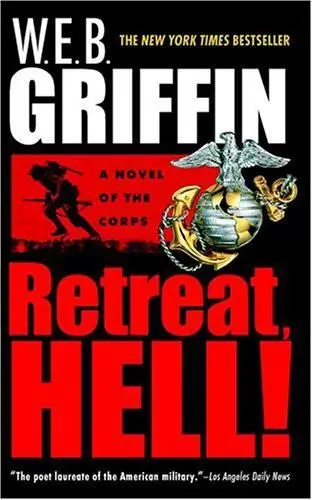
- Название:Retreat, Hell!
- Автор:
- Жанр:
- Год:0101
- ISBN:нет данных
- Рейтинг книги:3 / 5. Голосов: 1
-
Избранное:Добавить в избранное
- Отзывы:
-
Ваша оценка:
Retreat, Hell!: краткое содержание, описание и аннотация
Предлагаем к чтению аннотацию, описание, краткое содержание или предисловие (зависит от того, что написал сам автор книги «Retreat, Hell!»). Если вы не нашли необходимую информацию о книге — напишите в комментариях, мы постараемся отыскать её.
Megaseller Griffin (Honor Bound; Brotherhood of War; Men at War) musters another solid entry in his series chronicling the history of the U.S. Marines, now engaged in the Korean War. Gen. Douglas MacArthur, nicknamed El Supremo by his subordinates, is taken by surprise when the North Korean Army surges south across the 38th parallel. After early losses, he rallies his troops and stems the tide, but not for long. Intertwining stories of literally an army of characters reveal how MacArthur and his sycophantic staff overlook the entire Red Chinese Army, which is massed behind the Yalu River and about to enter the war. Brig. Gen. Fleming Pickering attempts to mediate the ongoing battles between feisty, give-'em-hell Harry Truman and the haughty MacArthur, while worrying about his pilot son, Malcolm "Pick" Pickering, who has been shot down behind enemy lines. The introduction of the Sikorsky H-19A helicopter into the war by Maj. Kenneth "Killer" McCoy and sidekick Master Gunner Ernie Zimmerman details the invention of tactics that will become commonplace in Vietnam. Readers looking for guts and glory military action will be disappointed, as barely a shot is fired in anger, but fans of Griffin's work understand that the pleasures are in the construction of a complex, big-picture history of war down to its smallest details: "There were two men in the rear seat, both of them wearing fur-collared zippered leather jackets officially known as Jacket, Flyers, Intermediate Type G-1." Veterans of the series will enjoy finding old comrades caught up in fresh adventures, while new-guy readers can easily enter here and pick up the ongoing story.
Retreat, Hell! — читать онлайн бесплатно полную книгу (весь текст) целиком
Ниже представлен текст книги, разбитый по страницам. Система сохранения места последней прочитанной страницы, позволяет с удобством читать онлайн бесплатно книгу «Retreat, Hell!», без необходимости каждый раз заново искать на чём Вы остановились. Поставьте закладку, и сможете в любой момент перейти на страницу, на которой закончили чтение.
Интервал:
Закладка:
"General, with respect, that's . . ."
"What? Not authorized?"
"No, sir."
"Well, maybe not, Colonel. But the only person who can challenge me is a retired Army general named Smith, and I don't think he will. You have your orders, Colonel."
After a long moment, Ed Banning said, "Aye, aye, sir."
He started back toward the entrance and then turned.
"Sir, I'd really be grateful if you could keep this between us."
"You'd rather appear to be a horse's ass than admit you have human emotions? Like hell I will."
Banning didn't reply, but neither did he continue toward the house.
"Get moving, Ed," Pickering said. After a moment, Banning nodded and then walked quickly toward the house.
Chapter Thirteen
[ONE]
USS Badoeng Strait (CVE-116)
39.58 Degrees North Latitude
128.33 Degrees East Longitude
The Sea of Japan
1125 17 October 195O
The Badoeng Strait was at sea about fifty miles east of a midpoint between Hungnam and Wonsan.
There had not been much call for air strikes from any of the units of I ROK Corps, which was pursuing the retreating North Korean army up the rugged east coast of the Korean Peninsula.
With about two-thirds of his fuel remaining, Lieutenant Colonel William C. Dunn, USMC, had decided to take his three-Corsair flight north of Chongjin, which would place them close to the borders between North Korea and China, and North Korea and Manchuria.
He could then take a look around, then fly down the east coast of the peninsula, looking for targets of opportunity on the way back to the Badoeng Strait.
For a number of reasons, starting with the fact that he was a good Marine officer who obeyed his orders, he was very careful not only not to cross the border but to keep far enough south of it so that it could not be credibly charged that he had violated either Chinese or Russian territory, even by mistake.
But he did take the flight inland far enough and high enough so that over extreme Northern Korea, he could look down and across the borders into both China and Manchuria.
He saw nothing that suggested the presence of troops massed on either side of the border prepared to enter the conflict. He had in mind, of course, what McCoy had told him and the skipper in the captain's cabin on the Badoeng Strait about 600,000 Chinese either on their side of the border, or already starting to cross into North Korea.
It was possible, of course, that McCoy was dead wrong. It was also possible that McCoy was right. Again.
On the way back down the coast, they found the targets of opportunity they knew would be there, and made strafing passes at North Korean troops either on the roads or hiding on either side of them. They stopped this only when the fuel available became sort of questionable and most of their ammunition had been expended. It made no sense to either run out of fuel or to return to the Badoeng Strait with a lot of ammunition unfired.
Colonel Dunn brought the flight down pretty close to the deck and flew over Socho-Ri. The H-19As were not in sight, which meant either that their camouflage was very good or that they were off someplace. He decided it was the camouflage, because Major Donald, the Army pilot, had told him they preferred to make their flights in the very early hours or just before nightfall, so as to provide as small a "window of possible observation" as possible.
He dipped his wings as Marines on the ground, recognizing the gull-winged fighters, came out of the thatch-roofed, stone-walled houses and waved at them.
Then he climbed to 5,000 feet and headed for the Badoeng Strait.
He landed last, as was his custom, caught the second wire, and was jerked to a halt.
As he hauled himself out of the cockpit, he saw one of the ship's officers on the deck, obviously waiting for him.
The officer, a blond-headed lieutenant j.g., saluted as Dunn jumped from the wing root to the deck.
"Shooting back, were they, Colonel?"
"Excuse me?" Dunn asked as he returned the salute.
The j.g. pointed to the rear of the Corsair's fuselage and its vertical stabilizer.
"I'll be damned!" Dunn said. There were seven holes in the Corsair—five in the fuselage and two in the vertical stabilizer. They looked like .50-caliber holes.
"I didn't see any tracers coming close," Dunn said, as much to himself as to the j.g.
"The captain's compliments, Colonel. The captain would be pleased if you would take lunch with him."
"Would the captain be pleased to see me immediately, or more pleased after I've had a shower?"
"I think the captain would prefer the latter, sir," the j.g. said, smiling.
"My compliments to the captain, Lieutenant."
"Aye, aye, sir."
Dunn went to the pilot's ready room and listened as Captain Jack Derwinski and Lieutenant Sam Williams, the two pilots who had flown the sortie with him, were debriefed by an air intelligence officer.
Finally, the AIO turned to him.
"Colonel?"
"I have nothing to add," Dunn said.
That was true. They had flown an observation/interdiction mission, seen nothing of interest, and engaged targets of opportunity—small units of North Korean ground troops—and then come home. Then he remembered, and added: "There was some antiaircraft fire from the ground, probably .50-caliber machine gun."
"How do you know that, Colonel? For the record."
"Because there are seven half-inch holes in my fuselage and vertical stabilizer," Dunn said, "that I know weren't there when I took off."
"No shit, Colonel?" Jack Derwinski said, obviously surprised. "I didn't see any tracers."
"Either did I, Captain Derwinski," Dunn said with a smile, "which, as a devout believer in the adage that the one that gets you is the one you don't see, I find just a wee bit disconcerting."
"You didn't feel anything?" Derwinski pursued.
Dunn shook his head no.
"They must have just gone through the skin without hitting anything else," Dunn said, then turned to the AIO. "You better make that fourteen holes in my airplane. Seven in and seven, thank the good Lord, out."
"Yes, sir," the AIO said, smiling. "Fourteen holes."
Dunn filled a china mug with coffee from the machine and carried it with him to his cabin.
He showered, shaved, put on fresh khakis, and made his way to the bridge.
The captain waved him onto the bridge.
"I understand the bad guys have been shooting back at you, Colonel," he said.
"Worse than that, sir," Dunn said. "Somebody has apparently been teaching them how to shoot."
"Ready for a little lunch?"
"Yes, sir. Thank you, sir."
The captain pushed himself out of his chair and led Dunn off the bridge to his cabin, where a white-jacketed steward and a table set for two were waiting for them.
"We can serve ourselves, Danny. Thank you," the captain said to the steward as he waved Dunn into a chair.
He waited for the steward to leave them, then said, "You went pretty far north today, did you?"
"Yes, sir."
"See anything interesting? Of the sort your friend in the black pajamas was talking about?"
"No, sir."
"He stared me with that talk of six hundred thousand Chinese," the captain said. "You think he was right?"
"Killer McCoy, over the years, has been right most of the time," Dunn said.
The captain lifted a dome off one serving plate and then another, and lowered this domes to the table. Lunch was pork chops, mashed potatoes, and green beans.
"Help yourself," the captain said as he forked a pork chop to his plate.
Dunn, filling his plate, said: "I was thinking—today, as a matter of fact, on our way back to the ship, when I didn't see a sign of a Chinese platoon, much less a field army—that if I had to bet, I'd bet on McCoy. He doesn't say something unless he believes it."
Читать дальшеИнтервал:
Закладка:
Похожие книги на «Retreat, Hell!»
Представляем Вашему вниманию похожие книги на «Retreat, Hell!» списком для выбора. Мы отобрали схожую по названию и смыслу литературу в надежде предоставить читателям больше вариантов отыскать новые, интересные, ещё непрочитанные произведения.





Обсуждение, отзывы о книге «Retreat, Hell!» и просто собственные мнения читателей. Оставьте ваши комментарии, напишите, что Вы думаете о произведении, его смысле или главных героях. Укажите что конкретно понравилось, а что нет, и почему Вы так считаете.