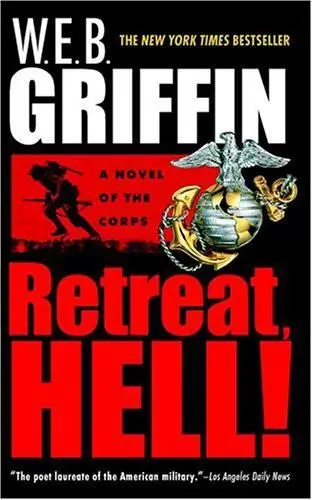
W.E.B. Griffin - Retreat, Hell!
Здесь есть возможность читать онлайн «W.E.B. Griffin - Retreat, Hell!» весь текст электронной книги совершенно бесплатно (целиком полную версию без сокращений). В некоторых случаях можно слушать аудио, скачать через торрент в формате fb2 и присутствует краткое содержание. Год выпуска: 0101, Жанр: Старинная литература, на английском языке. Описание произведения, (предисловие) а так же отзывы посетителей доступны на портале библиотеки ЛибКат.
- Название:Retreat, Hell!
- Автор:
- Жанр:
- Год:0101
- ISBN:нет данных
- Рейтинг книги:3 / 5. Голосов: 1
-
Избранное:Добавить в избранное
- Отзывы:
-
Ваша оценка:
Retreat, Hell!: краткое содержание, описание и аннотация
Предлагаем к чтению аннотацию, описание, краткое содержание или предисловие (зависит от того, что написал сам автор книги «Retreat, Hell!»). Если вы не нашли необходимую информацию о книге — напишите в комментариях, мы постараемся отыскать её.
Megaseller Griffin (Honor Bound; Brotherhood of War; Men at War) musters another solid entry in his series chronicling the history of the U.S. Marines, now engaged in the Korean War. Gen. Douglas MacArthur, nicknamed El Supremo by his subordinates, is taken by surprise when the North Korean Army surges south across the 38th parallel. After early losses, he rallies his troops and stems the tide, but not for long. Intertwining stories of literally an army of characters reveal how MacArthur and his sycophantic staff overlook the entire Red Chinese Army, which is massed behind the Yalu River and about to enter the war. Brig. Gen. Fleming Pickering attempts to mediate the ongoing battles between feisty, give-'em-hell Harry Truman and the haughty MacArthur, while worrying about his pilot son, Malcolm "Pick" Pickering, who has been shot down behind enemy lines. The introduction of the Sikorsky H-19A helicopter into the war by Maj. Kenneth "Killer" McCoy and sidekick Master Gunner Ernie Zimmerman details the invention of tactics that will become commonplace in Vietnam. Readers looking for guts and glory military action will be disappointed, as barely a shot is fired in anger, but fans of Griffin's work understand that the pleasures are in the construction of a complex, big-picture history of war down to its smallest details: "There were two men in the rear seat, both of them wearing fur-collared zippered leather jackets officially known as Jacket, Flyers, Intermediate Type G-1." Veterans of the series will enjoy finding old comrades caught up in fresh adventures, while new-guy readers can easily enter here and pick up the ongoing story.
Retreat, Hell! — читать онлайн бесплатно полную книгу (весь текст) целиком
Ниже представлен текст книги, разбитый по страницам. Система сохранения места последней прочитанной страницы, позволяет с удобством читать онлайн бесплатно книгу «Retreat, Hell!», без необходимости каждый раз заново искать на чём Вы остановились. Поставьте закладку, и сможете в любой момент перейти на страницу, на которой закончили чтение.
Интервал:
Закладка:
"Give him the medal anyway?" Truman interrupted. "What did you have in mind?"
"Mr. President, it is self-evident that Major Pickering's valor on the battlefield was distinguished."
"The Distinguished Service Cross?" Truman asked.
"The major is a Marine, Mr. President," General Bradley said. "It would be the Navy Cross."
"Yes, of course," the President said. "I agree. I don't know how that's done, but I'm sure that General Bradley and General MacArthur can handle that between them."
"Yes, sir," Bradley said.
The President wasn't finished: "I also think whoever rescued him from behind enemy lines needs recognition," he went on. "That would be Major McCoy, wouldn't it, General Pickering?"
"Either McCoy or one of his men, sir," Pickering said.
"I would suggest, Mr. President," MacArthur said, "the Silver Star for the officer who risked his life to snatch Major Pickering from the midst of the enemy, and Bronze Stars for the others."
Truman looked at Omar Bradley.
"I agree, Mr. President," Bradley said.
"You'll take care of all this?"
"Yes, sir."
"Okay," the President said. "Let's get started with this. The first thing . . .”
[TWO]
Aboard the Bataan
3O.59 Degrees North Latitude
172.44 Degrees East Longitude
The Pacific Ocean
1615 15 October 195O
Captain George F. Hart, USMCR, gently nudged Brigadier General Fleming Pickering, USMCR, with his elbow, and, when he had his attention, directed it with a just-perceptible nod of his head down the aisle of the Bataan.
There were few passengers on the Douglas C-54 four-engine transport. Pickering and Hart were seated toward the rear, in what Hart called "the cheap seats." In them were seated the junior officers—including the aides-de-camp of the senior officers—and the warrant officers and noncoms brought from Tokyo to do whatever was necessary for the senior officers.
Pickering saw Brigadier General Courtney Whitney coming down the aisle to the rear of the airplane. In doing so he passed a number of rows of empty seats. There was little question in Pickering's mind that Whitney was headed for him. He was the only senior officer sitting in the cheap seats.
Whitney stopped at Pickering's seat.
"General Pickering," he said, "the Supreme Commander would like to see you at your convenience."
"Thank you, General Whitney," Pickering said.
Whitney turned and started back toward the front of the aircraft.
Pickering looked at Hart with a raised eyebrow. Hart smiled, hunched his shoulders, and feigned a shiver. Pickering smiled back. It had indeed been an icy encounter. Another one.
Brigadier General Whitney and Brigadier General Pickering had not exchanged a word on Wake Island, and Pickering hadn't thought—until Whitney came down the aisle—that they would exchange one on the way to Japan.
Pickering waited until Whitney had taken his seat before unfastening his seat belt and standing up. Whitney took the seat nearest to the door of MacArthur's compartment. It was the seat traditionally reserved for the most senior of MacArthur's staff aboard.
Pickering knocked at the door to MacArthur's compartment and was told to come in.
"Ah, Fleming!" MacArthur said, coming half out of his chair to offer Pickering his hand. "I was afraid you might have been asleep. I told Whitney not to disturb you."
"I was awake, sir," Pickering said.
MacArthur waved him into the seat facing his.
"First, of course, I had to go through the messages from Tokyo." He indicated several manila folders that were imprinted with Top Secret in red. "And then I had to let poor Whitney down gently."
"Sir?"
"Entre nous, "MacArthur said. "I have been trying for some time to get him a second star. I thought perhaps a private word between myself and General Bradley might help—"
My God! Pickering thought. He actually tried to use a meeting between him and the President of the United States to get one of the Bataan Gang promoted!
He wanted to make a man who never commanded a company, much less a regiment, a major general!
Who are you to talk, General Pickering? The only unit you've ever commanded was a squad.
MacArthur had left the rest of the sentence unspoken, but when he saw the surprise on Pickering's face, he went on.
"I was surprised, too," he said. "I thought Bradley would arrange it as a personal courtesy to me, but all he said was that he would 'look into it,' which, of course, is a polite way of saying no."
Pickering couldn't think of a reply.
"I thought I would tell you this," MacArthur went on, "because you've just learned you're not going to get the promotion you so richly deserved."
"Are you talking about General Smith being named Director of the CIA, sir?"
"Of course."
"You heard that I was being considered?"
"I have a few friends in the Pentagon," MacArthur said. "Not many, but a few. You were the logical choice for the job. But you were obviously tarnished with the brush of being someone held in very high regard by the Viceroy of Japan."
Pickering's surprise was again evident on his face.
"Oh, I know they call me that," MacArthur said. "They also call me 'Dugout Doug,' which I don't really think is fair. And 'El Supremo.' "
"I'm guilty of the latter, General," Pickering said. "I don't think anyone uses that as a pejorative. It's sort of like calling a company commander 'the Old Man.' "
MacArthur smiled but said, "That too. 'The Old Man in the Dai Ichi Building.' "
"General, before President Truman named General Smith, I told him I didn't think I was qualified to be Director of the CIA."
"It got as far—before you took a Pentagon knife in the back—as the President actually offering you the job, did it?"
"The President told me, when he told me that he had named General Smith, that he had considered me but decided General Smith was the best man for the job. I told him I completely agreed."
"You know Smith?"
"I met him for the first time after I spoke with the President."
"From everything I hear, he was the brains behind Eisenhower," MacArthur said. "Well, for the record, I think you would have been the best man for the job."
"I respectfully disagree," Pickering said with a smile.
"Well, it's water over the dam," MacArthur said.
"Yes, sir, it is."
"As soon as we get within radio range of Tokyo, I'll set the wheels in motion about your son," MacArthur said. "The first step, obviously, is to get a more precise indication of his physical condition than . . . What did the message say, 'very dirty and very hungry'?"
Pickering chuckled.
"It also said, 'uninjured, unwounded, and in sound psychological condition,'" he said.
MacArthur acted as if Pickering hadn't spoken.
"And once we have that information," he went on, "which shouldn't take long to acquire, we can decide whether it would be best for you to fly out to the Badoeng Strait, and arrange for that, or to wait until your boy is to be flown from the carrier to Tokyo."
"That's very kind of you, General," Pickering said.
"Not at all," MacArthur said. "I'm delighted that everything has turned out so well for you."
MacArthur stood up. After a moment, Pickering realized that he was being dismissed and got hurriedly to his feet.
MacArthur put his hand on Pickering's arm in an affectionate gesture.
"I hate to turn you into a runner, but would you mind sending Colonel Thebideaux in here as you pass through the cabin? He's the plump little chap with the shiny cranium."
"Yes, sir, of course. And thank you again, General."
Читать дальшеИнтервал:
Закладка:
Похожие книги на «Retreat, Hell!»
Представляем Вашему вниманию похожие книги на «Retreat, Hell!» списком для выбора. Мы отобрали схожую по названию и смыслу литературу в надежде предоставить читателям больше вариантов отыскать новые, интересные, ещё непрочитанные произведения.







Обсуждение, отзывы о книге «Retreat, Hell!» и просто собственные мнения читателей. Оставьте ваши комментарии, напишите, что Вы думаете о произведении, его смысле или главных героях. Укажите что конкретно понравилось, а что нет, и почему Вы так считаете.