W.E.B. Griffin - Retreat, Hell!
Здесь есть возможность читать онлайн «W.E.B. Griffin - Retreat, Hell!» весь текст электронной книги совершенно бесплатно (целиком полную версию без сокращений). В некоторых случаях можно слушать аудио, скачать через торрент в формате fb2 и присутствует краткое содержание. Год выпуска: 0101, Жанр: Старинная литература, на английском языке. Описание произведения, (предисловие) а так же отзывы посетителей доступны на портале библиотеки ЛибКат.
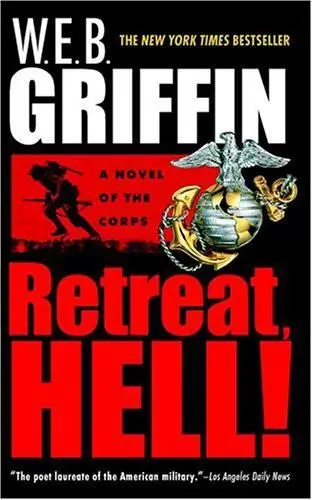
- Название:Retreat, Hell!
- Автор:
- Жанр:
- Год:0101
- ISBN:нет данных
- Рейтинг книги:3 / 5. Голосов: 1
-
Избранное:Добавить в избранное
- Отзывы:
-
Ваша оценка:
Retreat, Hell!: краткое содержание, описание и аннотация
Предлагаем к чтению аннотацию, описание, краткое содержание или предисловие (зависит от того, что написал сам автор книги «Retreat, Hell!»). Если вы не нашли необходимую информацию о книге — напишите в комментариях, мы постараемся отыскать её.
Megaseller Griffin (Honor Bound; Brotherhood of War; Men at War) musters another solid entry in his series chronicling the history of the U.S. Marines, now engaged in the Korean War. Gen. Douglas MacArthur, nicknamed El Supremo by his subordinates, is taken by surprise when the North Korean Army surges south across the 38th parallel. After early losses, he rallies his troops and stems the tide, but not for long. Intertwining stories of literally an army of characters reveal how MacArthur and his sycophantic staff overlook the entire Red Chinese Army, which is massed behind the Yalu River and about to enter the war. Brig. Gen. Fleming Pickering attempts to mediate the ongoing battles between feisty, give-'em-hell Harry Truman and the haughty MacArthur, while worrying about his pilot son, Malcolm "Pick" Pickering, who has been shot down behind enemy lines. The introduction of the Sikorsky H-19A helicopter into the war by Maj. Kenneth "Killer" McCoy and sidekick Master Gunner Ernie Zimmerman details the invention of tactics that will become commonplace in Vietnam. Readers looking for guts and glory military action will be disappointed, as barely a shot is fired in anger, but fans of Griffin's work understand that the pleasures are in the construction of a complex, big-picture history of war down to its smallest details: "There were two men in the rear seat, both of them wearing fur-collared zippered leather jackets officially known as Jacket, Flyers, Intermediate Type G-1." Veterans of the series will enjoy finding old comrades caught up in fresh adventures, while new-guy readers can easily enter here and pick up the ongoing story.
Retreat, Hell! — читать онлайн бесплатно полную книгу (весь текст) целиком
Ниже представлен текст книги, разбитый по страницам. Система сохранения места последней прочитанной страницы, позволяет с удобством читать онлайн бесплатно книгу «Retreat, Hell!», без необходимости каждый раз заново искать на чём Вы остановились. Поставьте закладку, и сможете в любой момент перейти на страницу, на которой закончили чтение.
Интервал:
Закладка:
MacArthur—with the encouragement of Willoughby and Whitney, Pickering had come to understand—had not wanted the OSS in his theater of operations. Willoughby, MacArthur's intelligence officer, and Whitney, who had been commissioned a major in the Philippines just before the war, and was serving as sort of an adviser, were agreed that intelligence activities should be under MacArthur's intelligence officer. Whitney, moreover, had decided he had the background to become spymaster under Willoughby.
MacArthur had not refused to accept the OSS in his theater, he had simply been not able to find time in his busy schedule to receive the OSS officer sent to his headquarters by Wild Bill Donovan, the head of the OSS.
Donovan, who was a close personal friend of Roosevelt, had complained to him about MacArthur's behavior, and Roosevelt had solved the problem by commissioning Pickering into the Marine Corps, assigning him to the OSS, and sending him to deal with MacArthur.
Pickering had a dozen clashes with the Bataan Gang during World War II, the most galling to Willoughby and Whitney his making contact with an officer fighting as a guerrilla on Mindanao after MacArthur—acting on Willoughby's advice—had informed the President there "was absolutely no possibility of U.S. guerrilla activity in the Philippines at this time."
Pickering had sent a team commanded by a young Marine intelligence officer—Lieutenant K. R. McCoy—to Japanese-occupied Mindanao on a Navy submarine. McCoy had established contact with a reserve lieutenant colonel named Wendell Fertig, who had refused to surrender, promoted himself to brigadier general, announced he was "Commanding General of United States Forces in the Philippines," and begun guerrilla warfare against the Japanese occupiers.
When, late in the war, MacArthur's troops landed on Mindanao, they found Brigadier General Fertig waiting for them with 30,000 armed and uniformed troops, including a band. Pickering had had Fertig's forces supplied by Navy submarines all through the war.
Every report of Fertig's successes—even of a successful completion of a submarine supply mission to him—during the war had been a galling reminder to the Bataan Gang that Pickering had done what MacArthur had said—on their advice—was impossible to do.
Pickering had learned that MacArthur had a petty side to his character. The one manifestation of this that annoyed Pickering the most—even more than MacArthur's refusal to award the 4th Marines on Corregidor the Presidential Unit Citation because "the Marines already have enough medals"—was MacArthur's refusal to promote Fertig above his actual rank of lieutenant colonel even though Fertig had successfully commanded 30,000 troops in combat. An Army corps has that many troops and is commanded by a three-star general.
Whitney had risen steadily upward in rank—he ended World War II as a colonel and was now a brigadier general—and this added to Pickering's annoyance and even contempt.
Aware that he was being a little childish himself, Pickering took pleasure in knowing that Brigadier General Whitney's pleasure with himself for being at El Supremo's elbow when he met with the President would be pretty well soured when he saw Pickering get off the Presidential aircraft.
There turned out to be less of an arrival ceremony for the President than there had been at K-16 when MacArthur had landed there to turn the seat of the South Korean government back to Syngman Rhee.
The door of the Independence opened, and two Secret Service men and a still cameraman and a motion picture cameraman went down the stairs. Then Truman came out of his compartment and went down the stairs.
MacArthur saluted. Truman smiled and put out his hand, then started shaking hands with the others of MacArthur's party.
The first man off the Independence after Truman was a stocky Army chief warrant officer in his mid-thirties. He carried a leather briefcase in one hand and a heavy canvas equipment bag in the other. He wore a web pistol belt with a holstered .45 around his waist. A jeep was waiting for him. He got in it and drove off before General of the Army Omar Bradley came down the stairs.
George Hart knew—and had told Pickering—what the equipment bag contained, and what Chief Warrant Officer Delbert LeMoine, of the Army Security Agency, was doing with it. LeMoine was the Presidential cryptographer. Messages intended for the President that had come in since they left Hawaii had been forwarded to Wake Island. Wake Island, however, did not have the codes. The President would have to wait for his mail until LeMoine decrypted it.
The dignitaries aboard the Independence came down the stairs one by one and shook hands with MacArthur and the members of his staff he had brought with him from Tokyo. Pickering decided he was not an official member of the Truman party, and waited until the handshaking was over before he got off the Independence.
He gave Brigadier General Courtney Whitney a friendly wave. Whitney returned it with a nod and a strained smile.
Truman and MacArthur got in the backseat of a something less than Presidential—or MacArthurian—1949 Chevrolet staff car and drove off for a private meeting.
Then everyone else was loaded, without ceremony, into a convoy of cars and jeeps and driven to one of the single-story frame buildings lining the tarmac. Inside, a simple buffet of coffee and doughnuts had been laid out for them.
Pickering had just taken a bite of his second doughnut when another Army warrant officer touched his arm.
"Would you come with me, please, General?" he asked.
"Sure," Pickering said. "What's up?"
The warrant officer didn't reply, but when Hart started to follow them, he said, "Just the general, Captain."
The warrant officer led Pickering to a frame building—identical to the one where coffee and doughnuts were being served—a hundred yards away and held open the door for him.
There was an interior office, guarded by a sergeant armed with a Thompson submachine gun. He stepped out of the way as Pickering and the warrant officer approached, and then the warrant officer knocked at the door. A moment later LeMoine unlocked the door, opened it, and motioned Pickering inside.
Then he closed and locked the door and turned to Pickering with a smile.
"We have a mutual friend, General," he said.
"Who's that?"
"Master Sergeant Paul Keller," LeMoine said. "He worked for me when we were in Moscow."
"Good man," Pickering said.
"He says much the same about you, General," LeMoine said. "And he has the same kind of problems I do, wondering who gets to see what and when."
"I'm not sure I follow you," Pickering said.
"Why don't you have a chair, General?" LeMoine said. "I've got to take a leak, and I'll see if I can't get us some coffee."
He pulled a chair on wheels away from a table, waited until Pickering sat down, then walked to the door, unlocked it, walked through it, and then closed and locked it.
There was one sheet of paper on the table.
Pickering wondered why LeMoine had left it on display.
A man like that does not make mistakes. Christ, whatever it is, he wants me to see it!
TOP SECRET-PRESIDENTIAL
WASHINGTON 2215 14OCT1950
FROM DIRECTOR CIA
TO (EYES ONLY) THE PRESIDENT OF THE UNITED STATES
FOLLOWING RECEIVED 22 07 14OCT1950 FROM MAJOR K R MCCOY USMCR
MESSAGE BEGINS
MAJOR MALCOLM S. PICKERING USMCR RETURNED TO US CONTROL 1200 14OCT1950. TRANSPORTED USS
BADOENG STRAIT AS OF 1300 14OCT1950.
SUBJECT OFFICER IS DIRTY, UNSHAVEN, AND VERY HUNGRY, BUT IS UNWOUNDED, UNINJURED, AND IN
SOUND PSYCHOLOGICAL CONDITION.
FOLLOWING CIVILIAN PERSONNEL SHOULD BE CONTACTED BY MOST EXPEDITIOUS MEANS, ASKED NOT TO
Читать дальшеИнтервал:
Закладка:
Похожие книги на «Retreat, Hell!»
Представляем Вашему вниманию похожие книги на «Retreat, Hell!» списком для выбора. Мы отобрали схожую по названию и смыслу литературу в надежде предоставить читателям больше вариантов отыскать новые, интересные, ещё непрочитанные произведения.






Обсуждение, отзывы о книге «Retreat, Hell!» и просто собственные мнения читателей. Оставьте ваши комментарии, напишите, что Вы думаете о произведении, его смысле или главных героях. Укажите что конкретно понравилось, а что нет, и почему Вы так считаете.