W.E.B. Griffin - Retreat, Hell!
Здесь есть возможность читать онлайн «W.E.B. Griffin - Retreat, Hell!» весь текст электронной книги совершенно бесплатно (целиком полную версию без сокращений). В некоторых случаях можно слушать аудио, скачать через торрент в формате fb2 и присутствует краткое содержание. Год выпуска: 0101, Жанр: Старинная литература, на английском языке. Описание произведения, (предисловие) а так же отзывы посетителей доступны на портале библиотеки ЛибКат.
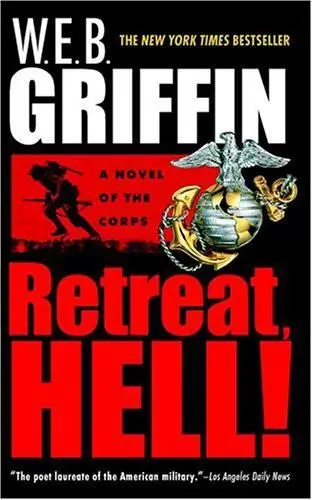
- Название:Retreat, Hell!
- Автор:
- Жанр:
- Год:0101
- ISBN:нет данных
- Рейтинг книги:3 / 5. Голосов: 1
-
Избранное:Добавить в избранное
- Отзывы:
-
Ваша оценка:
Retreat, Hell!: краткое содержание, описание и аннотация
Предлагаем к чтению аннотацию, описание, краткое содержание или предисловие (зависит от того, что написал сам автор книги «Retreat, Hell!»). Если вы не нашли необходимую информацию о книге — напишите в комментариях, мы постараемся отыскать её.
Megaseller Griffin (Honor Bound; Brotherhood of War; Men at War) musters another solid entry in his series chronicling the history of the U.S. Marines, now engaged in the Korean War. Gen. Douglas MacArthur, nicknamed El Supremo by his subordinates, is taken by surprise when the North Korean Army surges south across the 38th parallel. After early losses, he rallies his troops and stems the tide, but not for long. Intertwining stories of literally an army of characters reveal how MacArthur and his sycophantic staff overlook the entire Red Chinese Army, which is massed behind the Yalu River and about to enter the war. Brig. Gen. Fleming Pickering attempts to mediate the ongoing battles between feisty, give-'em-hell Harry Truman and the haughty MacArthur, while worrying about his pilot son, Malcolm "Pick" Pickering, who has been shot down behind enemy lines. The introduction of the Sikorsky H-19A helicopter into the war by Maj. Kenneth "Killer" McCoy and sidekick Master Gunner Ernie Zimmerman details the invention of tactics that will become commonplace in Vietnam. Readers looking for guts and glory military action will be disappointed, as barely a shot is fired in anger, but fans of Griffin's work understand that the pleasures are in the construction of a complex, big-picture history of war down to its smallest details: "There were two men in the rear seat, both of them wearing fur-collared zippered leather jackets officially known as Jacket, Flyers, Intermediate Type G-1." Veterans of the series will enjoy finding old comrades caught up in fresh adventures, while new-guy readers can easily enter here and pick up the ongoing story.
Retreat, Hell! — читать онлайн бесплатно полную книгу (весь текст) целиком
Ниже представлен текст книги, разбитый по страницам. Система сохранения места последней прочитанной страницы, позволяет с удобством читать онлайн бесплатно книгу «Retreat, Hell!», без необходимости каждый раз заново искать на чём Вы остановились. Поставьте закладку, и сможете в любой момент перейти на страницу, на которой закончили чтение.
Интервал:
Закладка:
"At least let me call a doctor."
"If I thought I needed a doctor, I'd tell you," Ernie said. Then she had another thought. "Where's the general?" she said.
"He's with the President, on the way to Wake Island. MacArthur left here for Wake at seven this morning."
"How will he hear about this?"
"The President is never out of touch," Keller said. "They will forward my— Major McCoy's—message to him wherever he is, and there's always a cryptographer with the President. He'll get it, Ernie."
"And we're going to have to get word to Jeanette, too," Ernie said. "She's on her way to Wonsan."
"I wish you'd let me call a doctor."
"Do you think you can find her?"
"That shouldn't be hard," Keller said. "As soon as I leave here, I'll start calling around. She's probably at the Press Center in Pusan."
"First things first, Paul," Ernie said. "Go sit on the couch before you fall down, and Jai-Hu-san will bring you a drink."
"First things first I'm going to get you a doctor!"
Ernie, laboriously, assisted by Jai-Hu-san, got to her feet. She walked to Keller, who was just over six feet one and weighed just over two hundred pounds, put her hands on her hips, and looked up at him. "For Christ's sake, Paul, go sit on the goddamn couch!" Master Sergeant Paul T. Keller, USA, walked over to the couch and sat down.
[EIGHT]
The weather was getting nasty by the time Lieutenant Whaleburton put the C-47 down at K-16, and by the time they took off the weather was, in Whaleburtons phraseology, "marginal."
"Not a problem, Miss Priestly," he said. "If it gets any worse, we'll just head for Pusan."
The weather got worse.
Thirty minutes out of Seoul, Lieutenant Whaleburton said, "If I get up in that soup, I'll never find Wonsan, so what I'm going to do is drop down below it. And if it gets any worse than this, I'm going to head for Pusan. But I really would like to get that blood to Wonsan."
It quickly got worse, much worse, with lots of turbulence.
When Lieutenant Whaleburton saw the ridge in the Taebaek mountain range ahead of him, he of course pulled back on the yoke to get over it.
He almost made it.
The right wingtip made contact with the granite of the peak, spinning the aircraft around and down. Before it stopped moving down the mountainside, it came apart and the aviation gasoline exploded.
Lieutenant Whaleburton didn't even have time to make a radio report.
Chapter Eleven
[ONE]
Wake Island
O625 15 October 19SO
As the Independence landed, Brigadier General Fleming Pickering saw, with a sense of relief, that the Bataan was already on the ground. He'd overheard some of President Truman's staff wondering if that was going to happen, whether, in other words, MacArthur would time his landing so that the President would arrive first and have to wait for the Supreme Commander to arrive from Tokyo. At first, Pickering had dismissed the conjecture as utter nonsense, but then he thought about it and had to admit that MacArthur was indeed capable of doing something like that. It was, he thought, like two children playing King of the Hill, except that Truman and MacArthur were not children, and Truman was, if not a king, than certainly the most powerful man on the planet. A king worried that one of his faithful subjects had his eyes on the throne.
Pickering had realized—maybe especially after he'd met with General Walter Bedell Smith—that Truman was anything but the flaming liberal incompetent the Republican party had painted him to be.
He had then realized—the late-dawning realization making him feel like a fool—that Senator Richardson K. Fowler, who was as much entitled to be called "Mr. Republican" as any politician, was fully aware of this.
That had led him to recall Truman's visit to tell him he was naming General Walter Bedell Smith to replace Admiral Hillencoetter. When he had told Truman he had always felt he was in water over his head, Truman had told him that not only had "Beetle" Smith said the same thing, but Wild Bill Donovan as well. Pickering had been so surprised—in the case of Donovan, astonished— to hear that that it was only later that he recalled what Truman had said when he'd assumed the presidency on Roosevelt's death, that "he was going to need all the help he could get."
That certainly suggested that Truman thought he had been given responsibility he wasn't at all sure he was qualified to handle.
And the truth was that Truman had proven himself wrong. Almost all the decisions he had made—right from the beginning, when he'd ordered the atomic bombs to be dropped on Japan—had been the right ones.
He of course had been mistaken to give in to the brass and disestablish the Office of Strategic Services. And Fleming Pickering found Truman's suggestion that it was about time to disband the U.S. Marine Corps to be stupid and outrageous. But Truman had realized he'd made a mistake about the OSS, and quickly formed the CIA, and after the performance of the Marines in the Pusan Perimeter and at Inchon, Truman had changed his mind about the Marines and said so.
Truman's selection of General Smith to head the CIA had been the right one, even though his old friend Ralph Howe, the one general officer he really trusted, had relentlessly pushed Pickering for the job, and appointing Pickering would have pleased Senator Fowler personally and silenced a lot of Republican criticism.
As the Independence stopped, Pickering saw from his window the Supreme Commander, United Nations Command, standing on the tarmac waiting for the Commander-in-Chief.
MacArthur was wearing his trademark washed-out khakis and battered, gold-encrusted cap.
Jesus, Truman is the Commander-in-Chief! At least El Supremo could have put on a tunic and neck scarf!
Then he saw the others in the MacArthur party. Brigadier General Courtney Whitney was among them; Major General Charles Willoughby was not. That was surprising.
He wondered if Willoughby, who was almost invariably at the Supreme Commander's side, might somehow have fallen into displeasure.
Is El Supremo punishing Willoughby for something by bringing Whitney here and leaving Willoughby in Japan? I know damned well Willoughby would want to be here.
The two were, in Pickering's judgment, the most shameless of the Bataan Gang in sucking up to MacArthur, in constant competition for his approval, or even for an invitation to cocktails and dinner.
Both disliked Pickering. He had long before decided this was because of his personal relationship with MacArthur, which was far closer than their own. Pickering declined more invitations to cocktails, or bridge, or dinner with the MacArthurs than both of them received. And MacArthur often addressed Pickering by his first name, an "honor" he rarely accorded Willoughby or Whitney or, for that matter, anyone else.
There was more than that, of course. Pickering had never been subordinate to MacArthur. Worse than that, they knew—and there was no denying this— that he was, in effect, a spy in their midst, making frequent reports on MacArthurs activities that they never got to see.
In the case of Whitney, Pickering had made a social gaucherie the day he had met MacArthur when he arrived in Australia from the Philippines with members of his staff—soon to be dubbed the "Bataan Gang." He had not recognized Major Whitney as a Manila lawyer he had known before the war.
The truth was that he simply hadn't remembered the man. Whitney had decided he had been intentionally snubbed, and had never gotten over it.
Pickering had written his wife from Australia, in early 1942, that his relations with MacArthurs staff ranged from frigid to frozen, and that had been when he had been a temporarily commissioned Navy captain sent to the Pacific by Navy Secretary Frank Knox. The temperature had dropped even lower when he had been sent to the Pacific as a Marine brigadier general and with the title of Deputy Director of the OSS for Asia.
Читать дальшеИнтервал:
Закладка:
Похожие книги на «Retreat, Hell!»
Представляем Вашему вниманию похожие книги на «Retreat, Hell!» списком для выбора. Мы отобрали схожую по названию и смыслу литературу в надежде предоставить читателям больше вариантов отыскать новые, интересные, ещё непрочитанные произведения.









Обсуждение, отзывы о книге «Retreat, Hell!» и просто собственные мнения читателей. Оставьте ваши комментарии, напишите, что Вы думаете о произведении, его смысле или главных героях. Укажите что конкретно понравилось, а что нет, и почему Вы так считаете.