Michael Cremo - Human Devolution - A Vedic Alternative To Darwin's Theory
Здесь есть возможность читать онлайн «Michael Cremo - Human Devolution - A Vedic Alternative To Darwin's Theory» весь текст электронной книги совершенно бесплатно (целиком полную версию без сокращений). В некоторых случаях можно слушать аудио, скачать через торрент в формате fb2 и присутствует краткое содержание. Год выпуска: 2003, ISBN: 2003, Издательство: Torchlight Publishing, Жанр: Старинная литература, на английском языке. Описание произведения, (предисловие) а так же отзывы посетителей доступны на портале библиотеки ЛибКат.
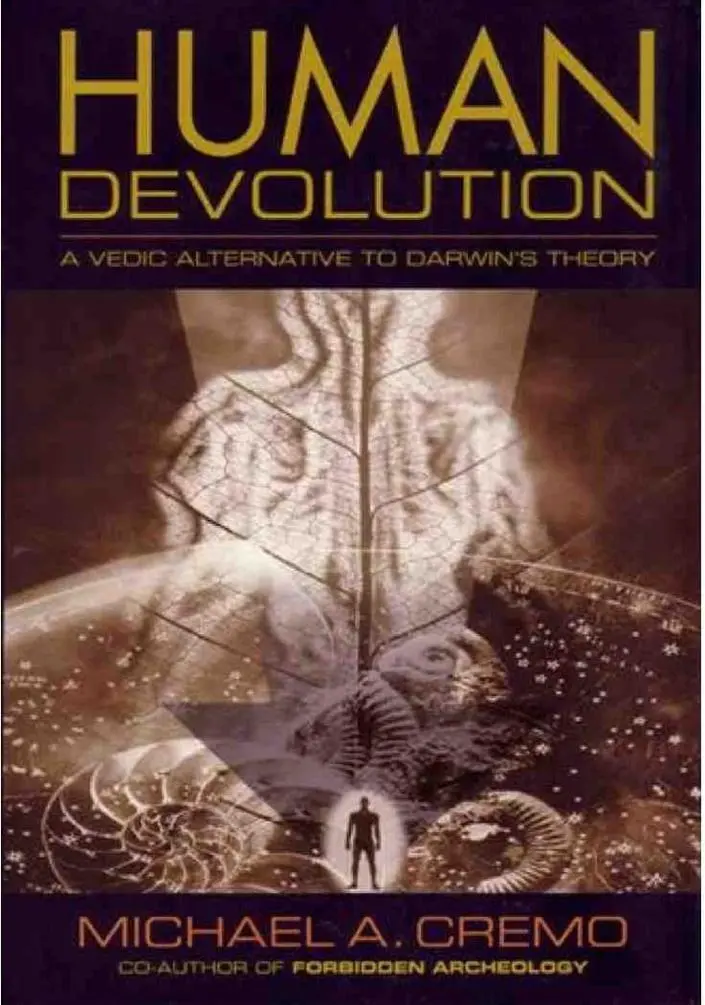
- Название:Human Devolution: A Vedic Alternative To Darwin's Theory
- Автор:
- Издательство:Torchlight Publishing
- Жанр:
- Год:2003
- ISBN:9780892133345
- Рейтинг книги:4 / 5. Голосов: 1
-
Избранное:Добавить в избранное
- Отзывы:
-
Ваша оценка:
Human Devolution: A Vedic Alternative To Darwin's Theory: краткое содержание, описание и аннотация
Предлагаем к чтению аннотацию, описание, краткое содержание или предисловие (зависит от того, что написал сам автор книги «Human Devolution: A Vedic Alternative To Darwin's Theory»). Если вы не нашли необходимую информацию о книге — напишите в комментариях, мы постараемся отыскать её.
Human Devolution: A Vedic Alternative To Darwin's Theory — читать онлайн бесплатно полную книгу (весь текст) целиком
Ниже представлен текст книги, разбитый по страницам. Система сохранения места последней прочитанной страницы, позволяет с удобством читать онлайн бесплатно книгу «Human Devolution: A Vedic Alternative To Darwin's Theory», без необходимости каждый раз заново искать на чём Вы остановились. Поставьте закладку, и сможете в любой момент перейти на страницу, на которой закончили чтение.
Интервал:
Закладка:
‘Good One.’”
Still, it appears that the Gilyak did recognize some intervention by their God in their affairs, and did sometimes give him some attention. Schrenck (1881–1895, p. 239) noted, “In one village, however, I heard that God is very angry if a shaman is put to death” and “when a Gilyak crosses a dangerous passage on his journey, he pours a bowl of spirits on the earth or in the waters: this is the sacrifice to God.”
According to some, the name of the supreme God is Kurn. The same word is also given to the universe. Shternberg (1933, p. 49) says the Gilyak regard their supreme God (Kurn) as “personal, man-like.” In the beginning there was only water, and then Kurn made the earth. Kurn then lost his reindeer, which made tracks across the land. These tracks became the great rivers. As Kurn pursued his reindeer, he waved his lash at it, and the marks of the lash on the ground became the streams (Shternberg
1933, p. 320).
The Gilyak of Sakhalin call their island mif, meaning “the earth.” They consider it to be “a living, divine creature” says Shternberg (1933, p. 49). Its head lies in the Sea of Okhotsk to the north, and its two legs, represented by two peninsulas, stretch to the south, in the La Perouse Strait. Shternberg (1933, p. 50) says: “Here is Kryuspal, a marvelous cone, one of the highest peaks of Sakhalin, which impresses everyone approaching the island from the sea with its grandeur, a lonely, stern demon of the sea . . . And even the lonely cliffs sticking out of the water all along the shore of the island—all of this is alive, gods who ran away from their clans under the influence of internecine wars. All the rest of nature is equally alive: the menacing tol (the sea), the somber forests of the mountainous island, the fast mountain rivers, etc. When cutting down a tree, the Gilyak is afraid to destroy its soul and places upon its stump a special being, the inau [in the form of a sharpened stick] . . . which returns soul and life to it. The mountains, the ocean, cliffs, trees, animals—this is only a mask under which the gods conceal themselves from the curiosity of man.”
Sometimes, a smaller killer whale ( kosatka ) accompanies a larger one in the sea. A Gilyak explained to Shternberg that the smaller kosatka is the sword of the larger one. It only seemed to be a kosatka. Actually, it was a sword. And as for the big kosatka , its actual form was like that of a Gilyak hunter. Shternberg (1933, p. 50) said his Gilyak informant told him that what to us seems like a sea animal is actually the boat of the Gilyak spirit of the kosatka. The kosatka is considered a sacred animal, and it is not hunted. When the dead body of a kosatka happens to wash up on the shore, the Gilyak give it a ceremonial burial (Shternberg 1933, p. 54).
According to the Gilyak, humans have several souls, of various sizes. The large souls are the same size as the human body, and a person may have different numbers of these, with those of higher rank, such as shamans, having more than those of lower rank. A person also has a number of small egg-shaped souls. These are located in the head of the large soul. When the large soul ceases to exist, a small soul expands to large size, duplicating it. (Shternberg 1933, p. 78) It is the small soul that experiences itself in dreams (Shternberg 1933, p. 79). Sometimes it is said that a person has three souls. The principal soul is called cheg:n, and the other two are called shadows, or assistants. Shternberg (1933, p. 306) says that “when the cheg:n of a shaman is wounded, the shaman dies.” If a dream is very clear and comes true, it is produced by the main soul. If it does not come true, then it is produced by one of the shadow souls.
Gilyak shamans provide a connection between the visible world and the invisible world. Shternberg (1933, p. 74) says that there are shamans “who in night visions or in a trance receive a revelation from the godprotector about their high calling.” Their primary activity is to cure diseases by driving out evil spirits. They also predict the future and perform sacrifices. They can control natural forces. For example, they can prevent rain or cause rain. They can also use their powers to cause harm to others. They can cause a person to die, or can punish a village by sending a flood (Seeland 1882, pp. 242–243). The shamans have two kinds of divine beings who serve as their assistants. They are called kekhn and kenchkh. The kekhn are the most important assistants. They help the shaman cure diseases by making a disease-causing devil leave a person’s body. They can also help the shaman retrieve a person’s soul, if it has been taken by a devil. The kekhn can take the forms of wolves, seals, eagles, reindeer, and owls, among others (Shternberg 1933, p. 74).
The shaman may cure a person in three ways. By the first method, the shaman takes help of dreams to find a cure. By the second method, the shaman drives out the evil disease-causing spirit by loud chanting and dancing. By the third method, the shaman, in addition to chanting and dancing, summons kekhn to help him (Shternberg 1933, p. 74). The chanting and dancing puts the shaman into a state of consciousness in which he can directly perceive the kekhn , his spirit helpers and protectors. “We can fully believe that he actually hears and sees them,” says Shternberg (1933, p. 75). “I hope that no one will suspect me of a partiality for the shamans, but I can calmly testify that in my presence the ecstasy of the shaman . . . brought the Gilyak to such a state that they . . . saw everything that the shaman himself saw in his trance. The shaman skillfully has recourse to first one, then another of his kekhn, depending on the circumstances. Thus, if the devil has stubbornly settled inside the organism and does not want to leave, the shaman calls on the ar-rymndkekhn, which turns into a fiery ball and makes its way into the belly of the shaman and from there to the most distant parts of his body, so that during the seance the shaman emits fire out of his mouth or nose or from any part of his body. After being thus filled with fire, he touches the sore spot with his lips and lets in fire, which conclusively drives out the devil.” In the case of a drowning, the shaman will send a kekhn after the
soul of the drowned person. The kekhn will go to the place of the master spirit of the sea, taking along a white reindeer. There the soul of the drowned man is kept in the yurt of the master spirit of the sea. When the sea spirits see the white reindeer, an animal strange to them, they come out of the yurt to look at it in wonder. At that time, the kekhn goes into the yurt and takes the soul of the drowned man, to bring it back to the world of the living (Shternberg 1933, p. 75).
The shaman, despite his many kekhn, is at times not able to help a person, especially if the person is being attacked by the very powerful devils of the mountains or seas. These devils destroy the body of the person, and carry away the soul. However, the soul, freed of the burden of the gross physical body, may be able to exercise its own powers to escape to the protection of the friendly mountain and sea deities. Afterwards, the soul may take human form and journey to Miyvo, the “settlement of the dead.” Under some circumstances, the evil spirits leave the soul of a dead person alone, allowing it to peacefully journey to Miyvo (Shternberg 1933, p. 79).
Miyvo is said to be located in the center of the earth. The residents engage in hunting an unending supply of animals and catching an unlimited supply of fish (Hawes 1903, p. 163). Shternberg (1933, p. 79) says: “There everything is as it is here: the same earth, the same sky, sea, rivers, and forest; only there the sun shines when we have night, and the moon when we have day. The dead come to life and continue to live there in the same settlements as on earth, fish, kill beasts, celebrate clan festivals, marry and procreate. Only the material status changes: the poor man becomes rich and the rich man poor. . . . Even in the new world, however, sickness and death await man. From there the soul must migrate into a third world, and so on until such time as the soul degenerates and turns into ever smaller and smaller beings, a small bird, a gnat, and, finally, ashes. Sometimes souls are born again on our planet, completing again the infinite series of transformations.” Concerning rebirth in this world, there is a legend telling of a Gilyak who died in a fight with a bear. The Gilyak body had a certain pattern of wounds on the face. Later, a boy was born to a Gilyak family, with the exact same pattern of scars on his face (Shternberg 1933, p. 368).
Читать дальшеИнтервал:
Закладка:
Похожие книги на «Human Devolution: A Vedic Alternative To Darwin's Theory»
Представляем Вашему вниманию похожие книги на «Human Devolution: A Vedic Alternative To Darwin's Theory» списком для выбора. Мы отобрали схожую по названию и смыслу литературу в надежде предоставить читателям больше вариантов отыскать новые, интересные, ещё непрочитанные произведения.










Обсуждение, отзывы о книге «Human Devolution: A Vedic Alternative To Darwin's Theory» и просто собственные мнения читателей. Оставьте ваши комментарии, напишите, что Вы думаете о произведении, его смысле или главных героях. Укажите что конкретно понравилось, а что нет, и почему Вы так считаете.