SS
Здесь есть возможность читать онлайн «SS» весь текст электронной книги совершенно бесплатно (целиком полную версию без сокращений). В некоторых случаях можно слушать аудио, скачать через торрент в формате fb2 и присутствует краткое содержание. Жанр: Справочники, на английском языке. Описание произведения, (предисловие) а так же отзывы посетителей доступны на портале библиотеки ЛибКат.

- Название:SS
- Автор:
- Жанр:
- Год:неизвестен
- ISBN:нет данных
- Рейтинг книги:5 / 5. Голосов: 1
-
Избранное:Добавить в избранное
- Отзывы:
-
Ваша оценка:
SS: краткое содержание, описание и аннотация
Предлагаем к чтению аннотацию, описание, краткое содержание или предисловие (зависит от того, что написал сам автор книги «SS»). Если вы не нашли необходимую информацию о книге — напишите в комментариях, мы постараемся отыскать её.
SS — читать онлайн бесплатно полную книгу (весь текст) целиком
Ниже представлен текст книги, разбитый по страницам. Система сохранения места последней прочитанной страницы, позволяет с удобством читать онлайн бесплатно книгу «SS», без необходимости каждый раз заново искать на чём Вы остановились. Поставьте закладку, и сможете в любой момент перейти на страницу, на которой закончили чтение.
Интервал:
Закладка:
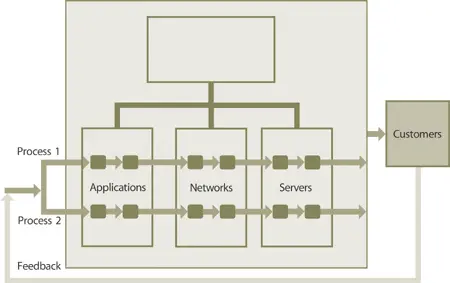
Figure 5.14 Process as a means for managing the silos of the organization chart
Some processes can be self-contained within a functional area, while others are cross-functional. Some processes manage and produce a product or service received by a customer external to IT. Organizational performance improves as these processes allow. The discipline of these processes is commonly known as IT Service Management (ITSM). ITSM means thinking of IT as a cohesive set of business resources and capabilities. These resources and capabilities are managed through processes and ultimately represented as services.
5.3.1.2 Business Service Management
IT priorities must be clearly aligned with other driver s of business value. In order for IT to organize its activities around business objective s, the organization must link to business processes and services – not just observe them. IT leadership must engage in a meaningful dialogue with line-of-business owners and communicate in terms of desired outcomes.
The transition from managing infrastructures to managing services is marked by a fundamental difference (Figure 5.15). While managing infrastructure requires a focus on component operational availability , managing services is centred on customer and business needs. Operational information about the infrastructure’s health is a critical foundation but is not enough. IT organizations intuitively recognize the need to link their activities with business objectives but frequently struggle in deciding how far to go in exposing the linkages between business activities and IT execution.
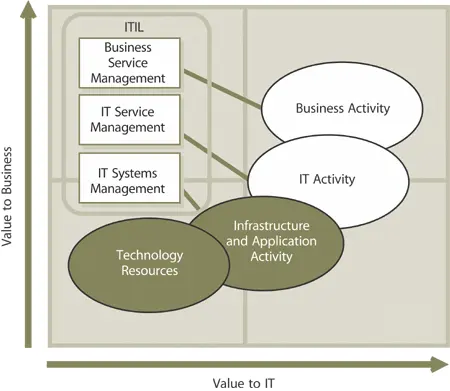
Figure 5.15 The IT management continuum
Organization s are increasingly less focused on IT infrastructure and application s than on coupling applications internally and with business partners in the quest to automate end-to-end business process es and deliver business service s. The challenge is to derive operational objective s from business services and to manage accordingly. Business perspective s, however, often do not easily relate to IT infrastructure.
A strategy aimed at this challenge is Business Service Management (BSM). BSM differs from previous strategic methods by offering a holistic top-down approach aimed at aligning the IT infrastructure with the business .
Business Service Management is the ongoing practice of governing, monitoring and reporting on IT and the business service it impacts.
BSM provides the means by which the service provider manages business services. When the provider focuses its operations on business services it is better able to align investments in infrastructure and operational activities with business objective s. BSM sets forth a model for developing business-focused metric s, enabling adaptation to future needs as driven by the business requirement s.
The cornerstone to BSM is the ability to link service asset s to their higher-level business services. The links are based on causality instead of correlation. The view of IT infrastructure shifts from a topological map to a dependency model (Figure 5.16). This model identifies the asset-to-service linkages, allowing infrastructure event s to be tied to corresponding business outcomes.
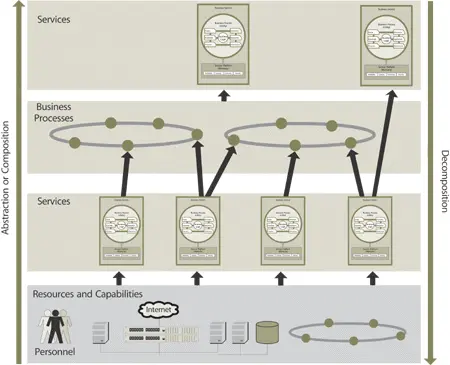
Figure 5.16 The embedded nature of services
5.4 Service Portfolio Management methods
If we think of SPM as a dynamic and ongoing process set, it should include the following work methods (also shown in Figure 5.17):
Define: inventory services, ensure business case s and validate portfolio data
Analyse: maximize portfolio value, align and prioritize and balance supply and demand
Approve: finalize proposed portfolio, authorize services and resource s
Charter: communicate decisions, allocate resources and charter services.
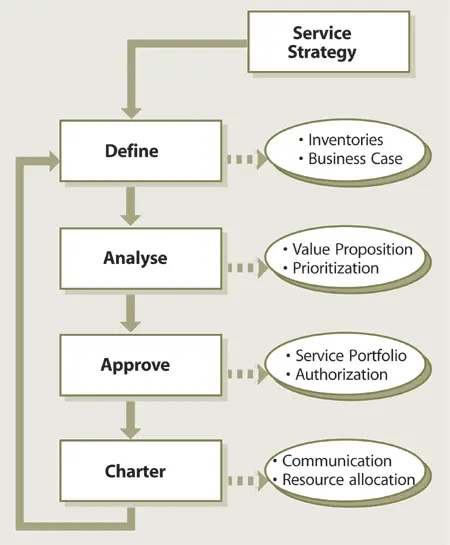
Figure 5.17 Service Portfolio process
5.4.1 Define
Begin with collecting information from all existing services as well as every proposed service. Every proposed service would include those in a conceptual phase. Namely, all services the organization would do if it had unlimited resources, capabilities and time. This documentation exercise is to understand the opportunity cost s of the existing portfolio. If a service provider understands what it cannot do, then it is better able to assess if it should keep doing what it is doing or reallocate its resource s and capabilities.
The next step in the process set, Analyse, should be well defined prior to beginning this phase. If the organization does not understand what analysis it will perform, it is unlikely to know the right data to collect. Data collection exercises are usually disruptive and should be as streamlined as possible.
The cyclic nature of the SPM process set means that this phase not only creates an initial inventory of services, but also validates the data on a recurring basis. Different portfolios will have different refresh cycles. Some cycles will be triggered by a particular event or business trend. For example, a Merger and Acquisition event triggers a portfolio re-examination.
Every service in the portfolio should include a business case . A business case is a model of what a service is expected to achieve. It is the justification for pursuing a course of action to meet stated organizational goals. As such, it acts as the link back to service strategy and funding. It is the assessment of a service investment in terms of potential benefits and the resources and capabilities required to provision and maintain it.
5.4.1.1 The Option Space Tool
A Service Portfolio is an expression of the provider’s service strategy. Executing a service strategy involves making a sequence of major decisions. Some are made immediately while others are intentionally deferred. Some commitments once made cannot be undone. Providers can only revise their plans for future commitments. SPM sets the framework within which future strategic decisions will be made.
A useful tool for making decisions on the timing and sequencing of investments in a Service Portfolio is called an Option Space (Figure 5.18). An Option Space can guide decisions to invest and, if so, when. (This section draws on Luehrman.27)
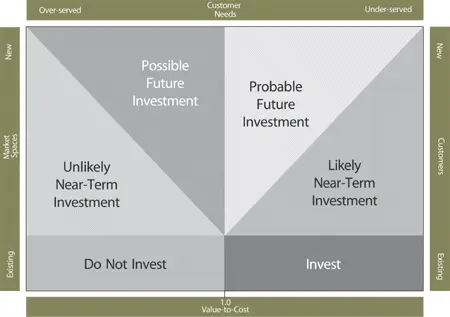
Figure 5.18 Option Space
The Value-to-Cost axis represents the ratio of a service’s worth to its cost . A Value-to-Cost of less than one designates a service worth less than what it costs. When the measure is greater than one, the present value of the service is greater than its cost. Financial measures, however, need not be the only measure. Other factors can and should be incorporated such as:
Читать дальшеИнтервал:
Закладка:
Обсуждение, отзывы о книге «SS» и просто собственные мнения читателей. Оставьте ваши комментарии, напишите, что Вы думаете о произведении, его смысле или главных героях. Укажите что конкретно понравилось, а что нет, и почему Вы так считаете.