Алан Милн - Once a Week
Здесь есть возможность читать онлайн «Алан Милн - Once a Week» весь текст электронной книги совершенно бесплатно (целиком полную версию без сокращений). В некоторых случаях можно слушать аудио, скачать через торрент в формате fb2 и присутствует краткое содержание. Год выпуска: 2014, Издательство: epubBooks Classics, Жанр: Юмористическая проза, на английском языке. Описание произведения, (предисловие) а так же отзывы посетителей доступны на портале библиотеки ЛибКат.
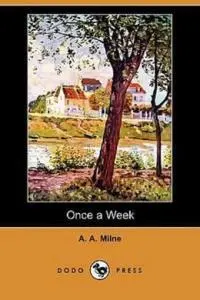
- Название:Once a Week
- Автор:
- Издательство:epubBooks Classics
- Жанр:
- Год:2014
- ISBN:нет данных
- Рейтинг книги:5 / 5. Голосов: 1
-
Избранное:Добавить в избранное
- Отзывы:
-
Ваша оценка:
Once a Week: краткое содержание, описание и аннотация
Предлагаем к чтению аннотацию, описание, краткое содержание или предисловие (зависит от того, что написал сам автор книги «Once a Week»). Если вы не нашли необходимую информацию о книге — напишите в комментариях, мы постараемся отыскать её.
Once a Week — читать онлайн бесплатно полную книгу (весь текст) целиком
Ниже представлен текст книги, разбитый по страницам. Система сохранения места последней прочитанной страницы, позволяет с удобством читать онлайн бесплатно книгу «Once a Week», без необходимости каждый раз заново искать на чём Вы остановились. Поставьте закладку, и сможете в любой момент перейти на страницу, на которой закончили чтение.
Интервал:
Закладка:
"But every one goes to Lynton for their honeymoon."
"Then let's be original and go to Birmingham. 'The happy couple left for Birmingham, where the honeymoon will be spent.' Sensation."
"'The bride left the train at Ealing.' More sensation."
"I think the great thing," I said, trying to be businesslike, "is to fix the county first. If we fixed on Rutland, then the rest would probably be easy."
"The great thing," said Celia, "is to decide what we want. Sea, or river, or mountains, or—or golf."
At the word golf I coughed and looked out of the window.
Now I am very fond of Celia—I mean of golf, and—what I really mean, of course, is that I am very fond of both of them. But I do think that on a honeymoon Celia should come first. After all, I shall have plenty of other holidays for golf … although, of course, three weeks in the summer without any golf at all― Still, I think Celia should come first.
"Our trouble," I said to her, "is that neither of us has ever been on a honeymoon before, and so we've no idea what it will be like. After all, why should we get bored with each other? Surely we don't depend on golf to amuse us?"
"All the same, I think your golf would amuse me," said Celia. "Besides, I want you to be as happy as you possibly can be."
"Yes, but supposing I was slicing my drives all the time, I should be miserable. I should be torn between the desire to go back to London and have a lesson with the professional and the desire to stay on honeymooning with you. One can't be happy in a quandary like that."
"Very well then, no golf. Settled?"
"Quite. Now then, let's decide about the scenery. What sort of soil do you prefer?"
When I left Celia that day we had agreed on this much: that we wouldn't bother about golf, and that the mountains, rivers, valleys, and so on should be left entirely to nature. All we were to enquire for was (in the words of an advertisement Celia had seen) "a perfect spot for a honeymoon."
In the course of the next day I heard of seven spots; varying from a spot in Surrey "dotted with firs," to a dot in the Pacific spotted with—I forget what, natives probably. Taken together they were the seven only possible spots for a honeymoon.
"We shall have to have seven honeymoons," I said to Celia when I had told her my news. "One honeymoon, one spot."
"Wait," she said. "I have heard of an ideal spot."
"Speaking as a spot expert, I don't think that's necessarily better than an only possible spot," I objected. "Still, tell me about it."
"Well, to begin with, it's close to the sea."
"So we can bathe when we're bored. Good."
"And it's got a river, if you want to fish―"
"I don't. I should hate to catch a fish who was perhaps on his honeymoon too. Still, I like the idea of a river."
"And quite a good mountain, and lovely walks, and, in fact, everything. Except a picture–palace, luckily."
"It sounds all right," I said doubtfully. "We might just spend the next day or two thinking about my seven spots, and then I might … possibly …feel strong enough to write."
"Oh, I nearly forgot. I have written, Ronald."
"You have?" I cried. "Then, my dear, what else matters? It's a perfect spot." I lay back in relief. "And there, thank 'evings, is another thing settled. Bless you."
"Yes. And, by the way, there is golf quite close too. But that," she smiled, "needn't prevent us going there."
"Of course not. We shall just ignore the course."
"Perhaps, so as to be on the safe side, you'd better leave your clubs behind."
"Perhaps I'd better," I said carelessly.
All the same I don't think I will. One never knows what may happen … and at the outset of one's matrimonial career to have to go to the expense of an entirely new set of clubs would be a most regrettable business.
IV
Seasonable Presents
"I suppose," I said, "it's too late to cancel this wedding now?"
"Well," said Celia, "the invitations are out, and the presents are pouring in, and mother's just ordered the most melting dress for herself that you ever saw. Besides, who's to live in the flat if we don't?"
"There's a good deal in what you say. Still, I am alarmed, seriously alarmed. Look here." I drew out a printed slip and flourished it before her.
"Not a writ? My poor Ronald!"
"Worse than that. This is the St. Miriam's bill of fare for weddings. Celia, I had no idea marriage was so expensive. I thought one rolled–gold ring would practically see it."
It was a formidable document. Starting with "full choir and organ" which came to a million pounds, and working down through "boys' voices only," and "red carpet" to "policemen for controlling traffic—per policeman, 5s.," it included altogether some two dozen ways of disposing of my savings.
"If we have the whole menu ," I said, "I shall be ruined. You wouldn't like to have a ruined husband."
Celia took the list and went through it carefully.
"I might say 'Season,'" I suggested, "or 'Press.'"
"Well, to begin with," said Celia, "we needn't have a full choir."
"Need we have an organ or a choir at all? In thanking people for their kind presents you might add, 'By the way, do you sing?' Then we could arrange to have all the warblers in the front. My best man or my solicitor could give the note."
"Boys' voices only," decided Celia. "Then what about bells?"
"I should like some nice bells. If the price is 'per bell' we might give an order for five good ones."
"Let's do without bells. You see, they don't begin to ring till we've left the church, so they won't be any good to us ."
This seemed to me an extraordinary line to take.
"My dear child," I remonstrated, "the whole thing is being got up not for ourselves, but for our guests. We shall be much too preoccupied to appreciate any of the good things we provide—the texture of the red carpet or the quality of the singing. I dreamt last night that I quite forgot about the wedding–ring till 1.30 on the actual day, and the only cab I could find to take me to a jeweller's was drawn by a camel. Of course, it may not turn out to be as bad as that, but it will certainly be an anxious afternoon for both of us. And so we must consider the entertainment entirely from the point of view of our guests. Whether their craving is for champagne or bells, it must be satisfied."
"I'm sure they'll be better without bells. Because when the policemen call out 'Mr. Spifkins' carriage,' Mr. Spifkins mightn't hear if there were a lot of bells clashing about."
"Very well, no bells. But, mind you," I said sternly, "I shall insist on a clergyman."
We went through the rest of the menu , course by course.
"I know what I shall do," I said at last. "I shall call on my friend the Clerk again, and I shall speak to him quite frankly. I shall say, 'Here is a cheque for a thousand pounds. It is all I can afford—and, by the way, you'd better pay it in quickly or it will be dishonoured. Can you do us up a nice wedding for a thousand inclusive?'"
"Like the Christmas hampers at the stores."
"Exactly. A dozen boys' voices, a half–dozen of bells, ten yards of awning, and twenty–four oranges, or vergers, or whatever it is. We ought to get a nice parcel for a thousand pounds."
"Or," said Celia, "we might send the list round to our friends as suggestions for wedding presents. I'm sure Jane would love to give us a couple of policemen."
"We'd much better leave the whole thing to your father. I incline more and more to the opinion that it is his business to provide the wedding. I must ask my solicitor about it."
"He's providing the bride."
"Yes, but I think he might go further. I can't help feeling that the bells would come very well from him. 'Bride's father to bridegroom—A peal of bells.' People would think it was something in silver for the hall. It would do him a lot of good in business circles."
Читать дальшеИнтервал:
Закладка:
Похожие книги на «Once a Week»
Представляем Вашему вниманию похожие книги на «Once a Week» списком для выбора. Мы отобрали схожую по названию и смыслу литературу в надежде предоставить читателям больше вариантов отыскать новые, интересные, ещё непрочитанные произведения.





Обсуждение, отзывы о книге «Once a Week» и просто собственные мнения читателей. Оставьте ваши комментарии, напишите, что Вы думаете о произведении, его смысле или главных героях. Укажите что конкретно понравилось, а что нет, и почему Вы так считаете.