Алан Милн - Once a Week
Здесь есть возможность читать онлайн «Алан Милн - Once a Week» весь текст электронной книги совершенно бесплатно (целиком полную версию без сокращений). В некоторых случаях можно слушать аудио, скачать через торрент в формате fb2 и присутствует краткое содержание. Год выпуска: 2014, Издательство: epubBooks Classics, Жанр: Юмористическая проза, на английском языке. Описание произведения, (предисловие) а так же отзывы посетителей доступны на портале библиотеки ЛибКат.
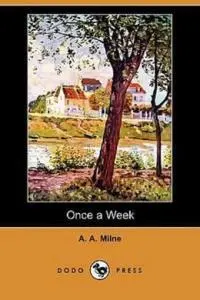
- Название:Once a Week
- Автор:
- Издательство:epubBooks Classics
- Жанр:
- Год:2014
- ISBN:нет данных
- Рейтинг книги:5 / 5. Голосов: 1
-
Избранное:Добавить в избранное
- Отзывы:
-
Ваша оценка:
Once a Week: краткое содержание, описание и аннотация
Предлагаем к чтению аннотацию, описание, краткое содержание или предисловие (зависит от того, что написал сам автор книги «Once a Week»). Если вы не нашли необходимую информацию о книге — напишите в комментариях, мы постараемся отыскать её.
Once a Week — читать онлайн бесплатно полную книгу (весь текст) целиком
Ниже представлен текст книги, разбитый по страницам. Система сохранения места последней прочитанной страницы, позволяет с удобством читать онлайн бесплатно книгу «Once a Week», без необходимости каждый раз заново искать на чём Вы остановились. Поставьте закладку, и сможете в любой момент перейти на страницу, на которой закончили чтение.
Интервал:
Закладка:
"By the way, Ronald, we did settle on the eleventh, didn't we?"
I looked at her blankly, my mind naturally full of motor–bicycles.
"The wedding," smiled Celia.
"Right–o," I said with enthusiasm. I was glad to be assured that I should not go on talking about motor–bicycles for ever, and that on the eleventh, anyhow, there would be a short interruption for the ceremony. Feeling almost friendly to the cousin, I plunged into his favourite subject again.
On the way home Celia returned to the matter.
"Or you would rather it was the twelfth?" she asked.
"I've never heard a word about this before," I said. "It all comes as a surprise to me."
"Why, I'm always asking you."
"Well, it's very forward of you, and I don't know what young people are coming to nowadays. Celia, what's the good of my talking to your cousin for three hours about motor–bicycling? Surely one can get married just as well without that?"
"One can't get married without settling the day," said Celia, coming cleverly back to the point.
Well, I suppose one can't. But somehow I had expected to be spared all this bother. I think my idea was that Celia would say to me suddenly one evening, "By the way, Ronald, don't forget we're being married to–morrow," and I should have said "Where?" And on being told the time and place, I should have turned up pretty punctually; and after my best man had told me where to stand, and the clergyman had told me what to say, and my solicitor had told me where to sign my name, we should have driven from the church a happy married couple … and in the carriage Celia would have told me where we were spending the honeymoon.
However, it was not to be so.
"All right, the eleventh," I said. "Any particular month?"
"No," smiled Celia, "just any month. Or, if you like, every month."
"The eleventh of June," I surmised. "It is probably the one day in the year on which my Uncle Thomas cannot come. But no matter. The eleventh let it be."
"Then that's settled. And at St. Miriam's?"
For some reason Celia has set her heart on St. Miriam's. Personally I have no feeling about it. St. Andrew's–by–the–Wardrobe or St. Bartholomew's–Without would suit me equally well.
"All right," I said, "St. Miriam's."
There, you might suppose, the matter would have ended; but no.
"Then you will see about it to–morrow?" said Celia persuasively.
I was appalled at the idea.
"Surely," I said, "this is for you, or your father, or—or somebody to arrange."
"Of course it's for the bridegroom," protested Celia.
"In theory, perhaps. But anyhow not the bridegroom personally. His best man … or his solicitor … or … I mean, you're not suggesting that I myself― Oh, well, if you insist. Still, I must say I don't see what's the good of having a best man and a solicitor if― Oh, all right, Celia, I'll go to–morrow."
So I went. For half an hour I padded round St. Miriam's nervously, and then summoning up all my courage, I knocked my pipe out and entered.
"I want," I said jauntily to a sexton or a sacristan or something—"I want—er—a wedding." And I added, "For two."
He didn't seem as nervous as I was. He enquired quite calmly when I wanted it.
"The eleventh of June," I said. "It's probably the one day in the year on which my Uncle Thomas― However, that wouldn't interest you. The point is that it's the eleventh."
The clerk consulted his wedding–book. Then he made the surprising announcement that the only day he could offer me in June was the seventeenth. I was amazed.
"I am a very old customer," I said reproachfully. "I mean, I have often been to your church in my time. Surely―"
"We've weddings fixed on all the other days."
"Yes, yes, but you could persuade somebody to change his day, couldn't you? Or if he is very much set on being married on the eleventh you might recommend some other church to him. I daresay you know of some good ones. You see, Celia—my—that is, we're particularly keen, for some reason, on St. Miriam's."
The clerk didn't appreciate my suggestion. He insisted that the seventeenth was the only day.
"Then will you have the seventeenth?" he asked.
"My dear fellow, I can't possibly say off–hand," I protested. "I am not alone in this. I have a friend with me. I will go back and tell her what you say. She may decide to withdraw her offer altogether."
I went back and told Celia.
"Bother," she said. "What shall we do?"
"There are other churches. There's your own, for example."
"Yes, but you know I don't like that. Why shouldn't we be married on the seventeenth?"
"I don't know at all. It seems an excellent day; it lets in my Uncle Thomas. Of course, it may exclude my Uncle William, but one can't have everything."
"Then will you go and fix it for the seventeenth to–morrow?"
"Can't I send my solicitor this time?" I asked. "Of course, if you particularly want me to go myself, I will. But really, dear, I seem to be living at St. Miriam's nowadays."
And even that wasn't the end of the business. For, just as I was leaving her, Celia broke it to me that St. Miriam's was neither in her parish nor in mine, and that, in order to qualify as a bridegroom, I should have to hire a room somewhere near.
"But I am very comfortable where I am," I assured her.
"You needn't live there, Ronald. You only want to leave a hat there, you know."
"Oh, very well," I sighed.
She came to the hall with me; and, having said good–bye to her, I repeated my lesson.
"The seventeenth, fix it up to–morrow, take a room near St. Miriam's, and leave a hat there. Good–bye."
"Good–bye…. And oh, Ronald!" She looked at me critically as I stood in the doorway. "You might leave that one," she said.
II
Furnishing
"By the way," said Celia suddenly, "what have you done about the fixtures?"
"Nothing," I replied truthfully.
"Well, we must do something about them."
"Yes. My solicitor—he shall do something about them. Don't let's talk about them now. I've only got three hours more with you, and then I must dash back to my work."
I must say that any mention of fixtures has always bored me intensely. When it was a matter of getting a house to live in I was all energy. As soon as Celia had found it, I put my solicitor on to it; and within a month I had signed my name in two places, and was the owner of a highly residential flat in the best part of the neighbourhood. But my effort so exhausted me that I have felt utterly unable since to cope with the question of the curtain–rod in the bathroom or whatever it is that Celia means by fixtures. These things will arrange themselves somehow, I feel confident.
Meanwhile the decorators are hard at work. A thrill of pride inflates me when I think of the decorators at work. I don't know how they got there; I suppose I must have ordered them. Celia says that she ordered them and chose all the papers herself, and that all I did was to say that the papers she had chosen were very pretty; but this doesn't sound like me in the least. I am convinced that I was the man of action when it came to ordering decorators.
"And now," said Celia one day, "we can go and choose the electric–light fittings."
"Celia," I said in admiration, "you're a wonderful person. I should have forgotten all about them."
"Why, they're about the most important thing in the flat."
"Somehow I never regarded anybody as choosing them. I thought they just grew in the wall. From bulbs."
When we got into the shop Celia became businesslike at once.
"We'd better start with the hall," she told the man.
"Everybody else will have to," I said, "so we may as well."
Читать дальшеИнтервал:
Закладка:
Похожие книги на «Once a Week»
Представляем Вашему вниманию похожие книги на «Once a Week» списком для выбора. Мы отобрали схожую по названию и смыслу литературу в надежде предоставить читателям больше вариантов отыскать новые, интересные, ещё непрочитанные произведения.










Обсуждение, отзывы о книге «Once a Week» и просто собственные мнения читателей. Оставьте ваши комментарии, напишите, что Вы думаете о произведении, его смысле или главных героях. Укажите что конкретно понравилось, а что нет, и почему Вы так считаете.