Edward Whittemore - Jerusalem Poker
Здесь есть возможность читать онлайн «Edward Whittemore - Jerusalem Poker» весь текст электронной книги совершенно бесплатно (целиком полную версию без сокращений). В некоторых случаях можно слушать аудио, скачать через торрент в формате fb2 и присутствует краткое содержание. Год выпуска: 2013, Издательство: Open Road Media, Жанр: Современная проза, на английском языке. Описание произведения, (предисловие) а так же отзывы посетителей доступны на портале библиотеки ЛибКат.
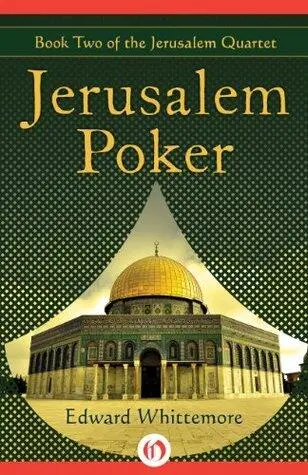
- Название:Jerusalem Poker
- Автор:
- Издательство:Open Road Media
- Жанр:
- Год:2013
- ISBN:нет данных
- Рейтинг книги:5 / 5. Голосов: 1
-
Избранное:Добавить в избранное
- Отзывы:
-
Ваша оценка:
Jerusalem Poker: краткое содержание, описание и аннотация
Предлагаем к чтению аннотацию, описание, краткое содержание или предисловие (зависит от того, что написал сам автор книги «Jerusalem Poker»). Если вы не нашли необходимую информацию о книге — напишите в комментариях, мы постараемся отыскать её.
But before the final hand is played to determine the destiny of the Holy City, a dangerous new player enters the picture: Nubar Wallenstein, an Albanian alchemist determined to achieve immortality, and heir to the world’s largest oil syndicate. He finances a vast network of spies dedicated to destroying the players, and his aim is to win complete power over Jerusalem.
Jerusalem Poker — читать онлайн бесплатно полную книгу (весь текст) целиком
Ниже представлен текст книги, разбитый по страницам. Система сохранения места последней прочитанной страницы, позволяет с удобством читать онлайн бесплатно книгу «Jerusalem Poker», без необходимости каждый раз заново искать на чём Вы остановились. Поставьте закладку, и сможете в любой момент перейти на страницу, на которой закончили чтение.
Интервал:
Закладка:
The Wandering Bulgar's Unofficial Guide to Boys' Orphanages in the Balkans, Illustrated, Complete With Diagrams of Fire Escapes and Suggested Crosscountry Itineraries. Anonymous, Mol, 1924.
Nubar smiled and stuffed the pamphlet into a drawer. He couldn't imagine why one of his UIA agents had seen fit to submit that very naughty guidebook as background material for an intelligence report.
Nubar had read the report and it had seemed to have nothing to do with the pamphlet written by the wandering Bulgar. Had the agent made a mistake or was he making some sly comment about Nubar?
Anyway, there would be time to study the diagrams of the fire escapes that evening while he was doing his mercury experiments. Now there was a more immediate problem.
For the third time that morning Nubar read through a perplexing document that had arrived just after breakfast, an appendix to the monthly summary of activities submitted by his control center in the Bulgarian seaport of Varna, which was responsible for monitoring all activities on the Black Sea.
The appendix was purported to be a verbatim record, taken down in shorthand, of a conversation between one of his Bulgarian agents and an underworld informer on the Adriatic island of Brac. The agent had gone to the island to investigate a rumor provided by a confidential source in Varna.
The rumor claimed that an unemployed Croatian peasant on the Adriatic island of Krk, after stealing a well-worn manuscript from a tourist, had gone into hiding on Brac. The stolen manuscript was said to be Paracelsus' Three Chapters on the French Disease, dated 1529, which had appeared in Nuremberg in 1530.
The underworld informer said the Croatian peasant in Brac was drunk most of the time on slivovitz.
Nevertheless, despite his drunken incoherency, he was still stubbornly insisting on a fee of three thousand Bulgarian leva just to let the manuscript be reviewed by an expert.
And the underworld informer, added the agent, although just as drunk as the peasant and also on slivovitz, was being just as stubborn, demanding a fee of three thousand Bulgarian leva for himself before he would reveal the peasant's hiding place in Brac, so the agent could contact the man directly.
The agent concluded by recommending payment of both sums, and his chief in Varna concurred. Routine permission to proceed was requested.
Routine?
Nubar snorted. Was there ever anything routine about a manuscript that just might possibly be a genuine Bombastus? In fact the longer Nubar considered the report the more suspicious he became.
Why hadn't this Adriatic information, for example, come from Belgrade Control? With the whole Black Sea to monitor, what was Varna Control doing conducting an operation all the way over on the other side of the Balkans?
More specifically, how competent was the agent's shorthand? As a Bulgarian, did he speak Croatian that well?
There were other seeming irregularities.
Could there really be any need for an underworld informer on an island as small as Brac? Could there even be any role for an underworld there?
Why was a peasant on Krk stealing well-worn manuscripts from tourists and then fleeing to Brac? How did he happen to be interested in learned sixteenth-century speculations, written in Latin, on the French disease? Would a drunken Croatian peasant know what the French disease was? Or did the peasant have the disease himself, and in that case was it so advanced his mind had already deteriorated to the point of insanity?
Would a tourist be likely to carry such a valuable document with him while taking a holiday on a tiny island like Krk?
Or to approach the problem differently, how did a confidential source in Bulgaria happen to be familiar with rumors on Brac? And how could an unemployed Croatian peasant from Krk, in the first place, afford to stay drunk on imported plum brandy in Brac, in the second place?
The third place being reserved for the fact that the plum brandy everyone was drunk on, curiously enough, just happened to be Bulgarian.
And along that same line of reasoning, why was everybody involved in the case asking to be paid in Bulgarian leva when the two islands in question were both Yugoslavian? What was the matter with good Yugoslavian dinars?
Nubar sat very straight in his chair, his pencil poised, well aware of his role in history. The great doctor had cloaked his discoveries to confuse the unworthy, but Nubar intended to be worthy and he wouldn't be so easily fooled. Could anyone in Krk be trusted? Could anyone in Brac? What were his people over there on the Black Sea really up to with their routine requests to proceed in the Adriatic?
Krk-Brac. In short, what was the truth?
Nubar wrote down an extensive list of questions to be answered before any more money was spent on the Krk-Brac operation. Having done so, he felt much better. He left his workbench to go to the window for a breath of air.
In the distance lay the Adriatic. Nubar looked down on the valleys where peasants were farming the Wallenstein land, at the workers several hundred feet below who were clearing the castle moat so that it could be filled with water again, a little more than a century after his grandfather had disappeared in the Holy Land and caused the castle to fall into ruin.
It had been his idea and Sophia was enthusiastic, but he hadn't suggested it out of devotion to his grandfather's memory. Rather, having turned twenty-one and become legally a man, he wanted the added protection of the moat, a hygienic insulation between himself and the outside world.
As he leaned on the windowsill Nubar noticed that one of the stones in the sill had become loose.
Abruptly his left eyelid drooped in excitement. He worked the stone free and leaned out the window with it, taking aim at a peasant laboring in the moat.
Down and away, down and down. The stone didn't hit the peasant on the head as he had hoped, it struck him on the shoulder. But from that height it was enough to knock the man down. There was a roar of pain far below, then one of anger. When last seen the man was scrambling out of the moat swinging a pickax, heading toward the workmen on top of the embankment. Nubar giggled and pulled in his head.
Order. Alignment. Hygiene.
Nubar spent the rest of the morning straightening his bookshelves, nudging the books forward or backward so the bindings made a perfectly flat surface. To facilitate this daily task, tiny metal conductors had been inserted at the base of the bindings in all his books, the conductors resting on metal contacts in the shelves that led in series to a circuit breaker. Ceramic insulators had been installed at both ends of every shelf. Nubar only had to stretch an electric wire taut down the length of a shelf, and throw a switch, to know whether the alignment was perfect or not.
Buzz.
Nubar nudged the offending book into place and moved to the next shelf.
When he was a little boy he had liked to lean forward on the toilet bowl and peek through his legs to see what was happening. A brown round head appeared and slowly lengthened, longer and longer. He held his breath. Plop. Another. The little brown logs circled peacefully down there. He pulled the chain and waved as they spiraled away.
Good-bye, little friends.
When he was nine he had become fascinated with butterflies and wanted to learn how to embalm them.
Sophia wrote to Venice and soon a slender young Italian lepidopterist arrived at the castle to assume his duties as Nubar's private embalming tutor. The Italian also taught him other things as Nubar, wide-eyed, bent over the trays of butterflies, his lips nestled between their richly colored spread wings.
On Sunday afternoons the Italian tutor took him to band concerts in towns on the Adriatic. Nubar sat sorely but happily on the hard wooden chairs, entranced by the uniforms, especially the conductor's with its cascading loops of gold braid.
Читать дальшеИнтервал:
Закладка:
Похожие книги на «Jerusalem Poker»
Представляем Вашему вниманию похожие книги на «Jerusalem Poker» списком для выбора. Мы отобрали схожую по названию и смыслу литературу в надежде предоставить читателям больше вариантов отыскать новые, интересные, ещё непрочитанные произведения.




Обсуждение, отзывы о книге «Jerusalem Poker» и просто собственные мнения читателей. Оставьте ваши комментарии, напишите, что Вы думаете о произведении, его смысле или главных героях. Укажите что конкретно понравилось, а что нет, и почему Вы так считаете.