Rupert Thomson - Katherine Carlyle
Здесь есть возможность читать онлайн «Rupert Thomson - Katherine Carlyle» весь текст электронной книги совершенно бесплатно (целиком полную версию без сокращений). В некоторых случаях можно слушать аудио, скачать через торрент в формате fb2 и присутствует краткое содержание. Год выпуска: 2015, ISBN: 2015, Издательство: Other Press, Жанр: Современная проза, на английском языке. Описание произведения, (предисловие) а так же отзывы посетителей доступны на портале библиотеки ЛибКат.
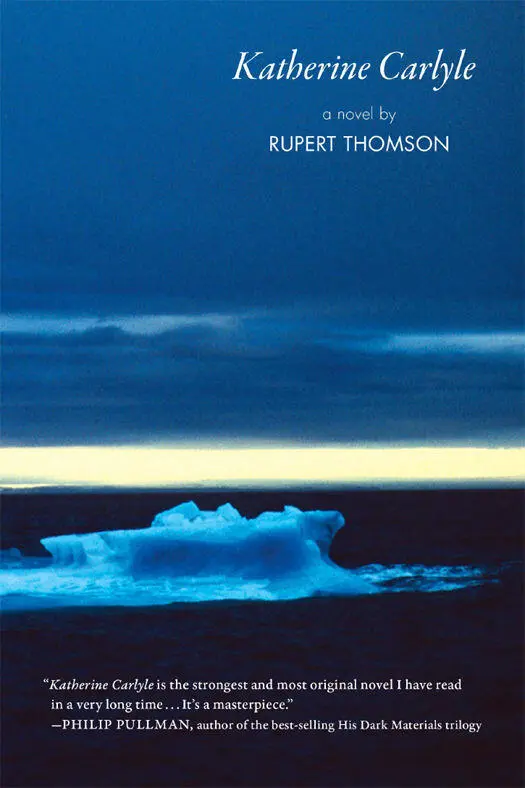
- Название:Katherine Carlyle
- Автор:
- Издательство:Other Press
- Жанр:
- Год:2015
- ISBN:9781590517390
- Рейтинг книги:5 / 5. Голосов: 1
-
Избранное:Добавить в избранное
- Отзывы:
-
Ваша оценка:
Katherine Carlyle: краткое содержание, описание и аннотация
Предлагаем к чтению аннотацию, описание, краткое содержание или предисловие (зависит от того, что написал сам автор книги «Katherine Carlyle»). Если вы не нашли необходимую информацию о книге — напишите в комментариях, мы постараемся отыскать её.
“[T]his road trip through a snow dome of mesmeric hallucinations is Thomson at his best.” —Richard Flanagan, author of The Narrow Road to the Deep North, winner of the 2015 Man Booker Prize
Katherine Carlyle is Rupert Thomson’s breakthrough novel. Written in the beautifully spare, lucid, and cinematic prose Thomson is known for, and powered by his natural gift for storytelling, it uses the modern techniques of IVF to throw new light on the myth of origins. It is a profound and moving novel about identity, the search for personal meaning, and how we are loved.
Unmoored by her mother’s death and feeling her father to be an increasingly distant figure, Katherine Carlyle abandons the set course of her life and starts out on a mysterious journey to the ends of the world. Instead of going to college, she disappears, telling no one where she has gone. What begins as an attempt to punish her father for his absence gradually becomes a testing ground of his love for her, a coming-to-terms with the death of her mother, and finally the mise-en-scène for a courageous leap to true empowerment.
Katherine Carlyle — читать онлайн бесплатно полную книгу (весь текст) целиком
Ниже представлен текст книги, разбитый по страницам. Система сохранения места последней прочитанной страницы, позволяет с удобством читать онлайн бесплатно книгу «Katherine Carlyle», без необходимости каждый раз заново искать на чём Вы остановились. Поставьте закладку, и сможете в любой момент перейти на страницу, на которой закончили чтение.
Интервал:
Закладка:
Yevgeny turns to me, eyebrows raised.
“Let’s go by train,” I say, then ask if he could book me an extra night at the Peking Hotel.
Later, out on the street, I thank him for all his help, and we agree to meet at the station, an hour before the train departs.
/
With Yevgeny gone, I hesitate, unsure how to spend the day. I feel a surge of impatience, then a kind of lethargy, and I’m reminded of the time I drove to the south of France and sat by a pool, waiting for something to happen. One thing’s certain: I won’t be seeing any sights. Moscow is a staging post, not an end in itself, and I can’t allow it to make too much of an impression.
In the Metro I take the gray line, going north. With their marble hallways and their elaborate chandeliers, the stations astonish me, but I’m content with glimpses. I leave the train at the last stop, Altufevo. There are underground kiosks selling painkillers, warm pies known as pirozhki, and woolly bobble hats. No trace of chandeliers or marble now. I think of Oswald, who took me to the edge of Berlin to show me something that wasn’t there. He thought it was worth looking at and he was right. I should send him a postcard, as promised.
I set off up a main road, passing bus shelters papered over with adverts and flyers. Old women squat on low stools by the curb. There are jars of pickled vegetables for sale, and tiny cloves of garlic, and pink-bellied river fish laid out on sheets of cardboard. The men are dressed in black leather jackets and jeans. Most of them carry bottles of beer. There are no ordinary houses or shops, only supermarkets and tower blocks. On the flat grassy areas in between are birch trees, and also trees I don’t recognize, with clusters of red berries dangling from their branches.
I stop for a bowl of soup in a café run by a family from Uzbekistan. Later, I cut through a park. Thin clouds veil the sky; the sun is weakening. Some distance from the footpath an old couple are picnicking on the trunk of a fallen tree, their shoulders touching. Their laughter reaches me. As I walk on, the man lifts a hand and waves. It’s only among strangers that I’m seen, only among strangers that I exist.
/
The following morning I meet Yevgeny at Yaroslavsky station, as agreed. Though he has booked us into separate sleeping compartments — an example of his tact — we sit together for the first leg of the journey, sipping the black tea he buys from a conductor. As Moscow recedes, the outskirts giving way to countryside, I ask Yevgeny about his mother. She’s ninety-four, he says, and he has spent the last three weeks trying to persuade her to move house. You should live near me, he tells her. Why? she says. So I can do your washing? He smiles, the lines deepening around his mouth, then he takes off his cap and ruffles his white hair. She’s so stubborn, he says. Tough as old shoe leather. During the Second World War she flew with the Russian air force. She was one of a handful of female pilots known as “night witches” who dropped bombs on the advancing German army. She was shot down twice, but made it through unscathed. She has received numerous medals and decorations from the state, though she lives modestly, in an apartment in the suburbs. He has the feeling she will outlast him. It’s possible that she’s immortal. He sees the look on my face. He’s joking, he says. Then, abruptly, he tells me he would like to rest his eyes. Even talking about her makes him tired.
I take my tea next door, to my compartment. That afternoon, as I sit beside the window, endless birch trees flashing by, I return to the InterContinental. Though two days have passed in my world, only an hour has gone by for my father and Lydia, enough time for them to have made love again and drifted off to sleep.
My father wakes suddenly, one hand grasping at the air. He has had a bad dream. The curtains have yet to be drawn; the windows are black. Light spills from the half-open bathroom door but doesn’t reach the corners of the room. Does he know where he is? Not right away. Then he notices the sheet of paper on the floor, my handwriting visible. Of course. Berlin.
And he has a lead.
Oswald .
Lydia stirs beside him and reaches for his hand. “David? What will you do?”
“I don’t know.” Sitting up, he stares at the tall vase of exotic twigs and grasses opposite the bed. “I really don’t know.”
“I should leave,” she says.
She crosses the room in the half-dark, pinning her hair up as she goes. He is struck by how at ease with her nakedness she is. His mind jams. She shuts the bathroom door and switches on the shower.
The train jerks, then speeds up. The sky has lowered, and rain streaks diagonally across the window. My imagination keeps racing ahead, and I have to remind myself that the Café Einstein rendezvous is still five days away. My father won’t have left Rome yet but he ought to have received my first letter. Though short, it will have been a comfort to him. Scenarios that might have crossed his mind — abduction, murder — can be ruled out. He still has a decision to make, however. What will he do?
A station slides into view. Sheets of water on the platform reflect its green facade. One of the buildings has a spire with a cross on top. The door swings open, and I glimpse lighted candles and a wall hung with icons.
I see Pavlo briefly, in his immaculate white T-shirt, accompanied by the seductive whir and hum of a spin drier, then I go back to thinking about my father. Despite myself, I have left clues as to my whereabouts, my movements — the hotel stationery, the photograph of Oswald … As my father travels from the airport into the city he studies the photo, trying to memorize the young man’s unmemorable face. He needs to be able to recognize Oswald if he comes across him. But what’s the likelihood of that?
I remember how Lydia stood by our table and listened to Oswald gossiping about his supervisor at KaDeWe. If Lydia recalls the stories and repeats them to my father he will have no trouble tracking Oswald down — and Oswald has valuable intelligence, for it was he who saw me at the station, on a train bound for Moscow …
My father might fly to Russia — or perhaps he will follow my example and take a train, arriving at Byelorusskaya station in the middle of the night. It’s October in Moscow. Dressed in an open-necked shirt and a pair of chinos, he has dark smears beneath his eyes, like the stains water leaves on bath enamel. Other travelers give him suspicious glances and push past, intent on journeys of their own. His finishes right there, though, under the mint-green sign that glows on the roof of the main station building. He could go to the police, but Russia, as he knows, is a profoundly bureaucratic country, impenetrable and vast, and I’m just another foreign girl. Though he is accustomed to difficult predicaments, he looks out of place, and his mouth is trembling, uncertain. I would like to be able to walk up to him and give him a hug. I’d like to say, You’ve done all you can do, Dad. Stop worrying. Go home . And he’d say, Honestly? Is that what you want? And I’d say, Yes, it’s what I want . I’d kiss him on the cheek and tell him that I love him. He’d say, I love you too, Kit. I always have . He’d pause, and then he’d say it again. I always have . He’d be holding me, looking down into my face. I need him to repeat those words. Some things you can’t hear enough.
/
As afternoon shades into evening I drop in on Yevgeny. He orders more black tea, then asks me about university. When I mention Oxford, his face opens in astonishment. He visited the city once, he says, when he was a professor, and then a second time, not long after he retired. In a garden next to Christ Church he saw a tree whose bright-yellow star-shaped leaves were thrown into relief by the dark stone of the wall behind them. He doesn’t know what kind of tree it was — it looked oriental somehow — but he has never forgotten the way it stood out against that wall. He also went to a museum filled with weapons, tribal masks, and musical instruments. The place was so dimly lit that a curator handed him a special windup flashlight. He could live in Oxford, he says. The air itself seemed educated, busy with knowledge. You could learn things simply by breathing. He laughs and then falls quiet. We rattle across a river. Low in the sky, on the horizon, is an orange vent, the first sun we have seen all day. Then more bare trees, more soggy rumpled land. Yevgeny’s reminiscences prompt no regrets in me, no nostalgia for the life I have rejected, only the wish that I could trade in my scholarship and send him to Oxford in my place.
Читать дальшеИнтервал:
Закладка:
Похожие книги на «Katherine Carlyle»
Представляем Вашему вниманию похожие книги на «Katherine Carlyle» списком для выбора. Мы отобрали схожую по названию и смыслу литературу в надежде предоставить читателям больше вариантов отыскать новые, интересные, ещё непрочитанные произведения.




Обсуждение, отзывы о книге «Katherine Carlyle» и просто собственные мнения читателей. Оставьте ваши комментарии, напишите, что Вы думаете о произведении, его смысле или главных героях. Укажите что конкретно понравилось, а что нет, и почему Вы так считаете.