Daniel Alarcon - War by Candlelight - Stories
Здесь есть возможность читать онлайн «Daniel Alarcon - War by Candlelight - Stories» весь текст электронной книги совершенно бесплатно (целиком полную версию без сокращений). В некоторых случаях можно слушать аудио, скачать через торрент в формате fb2 и присутствует краткое содержание. Год выпуска: 2006, Издательство: Harper Perennial, Жанр: Современная проза, на английском языке. Описание произведения, (предисловие) а так же отзывы посетителей доступны на портале библиотеки ЛибКат.
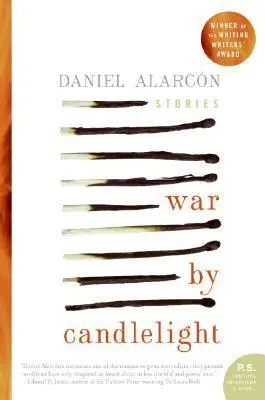
- Название:War by Candlelight: Stories
- Автор:
- Издательство:Harper Perennial
- Жанр:
- Год:2006
- ISBN:нет данных
- Рейтинг книги:2.5 / 5. Голосов: 2
-
Избранное:Добавить в избранное
- Отзывы:
-
Ваша оценка:
War by Candlelight: Stories: краткое содержание, описание и аннотация
Предлагаем к чтению аннотацию, описание, краткое содержание или предисловие (зависит от того, что написал сам автор книги «War by Candlelight: Stories»). Если вы не нашли необходимую информацию о книге — напишите в комментариях, мы постараемся отыскать её.
is an exquisite collection of stories that carry the reader from Third World urban centers to the fault lines that divide nations and people — a devastating portrait of a world in flux — and Daniel Alarcón is an extraordinary new voice in literary fiction, one you will not soon forget.
War by Candlelight: Stories — читать онлайн бесплатно полную книгу (весь текст) целиком
Ниже представлен текст книги, разбитый по страницам. Система сохранения места последней прочитанной страницы, позволяет с удобством читать онлайн бесплатно книгу «War by Candlelight: Stories», без необходимости каждый раз заново искать на чём Вы остановились. Поставьте закладку, и сможете в любой момент перейти на страницу, на которой закончили чтение.
Интервал:
Закладка:
One of the compañeros had directed that all the dogs were to be black, and we were in no position to question these things. An aesthetic decision, not a practical one. Lima has a nearly infinite supply of mutts, but not all of them are black. By two o’clock, we were slopping black paint on beige, brown, and white mutts, all squirming away the last of their breaths, fur tinged with red.
Given my erstwhile talents with the brush, I was charged with painting the not-quite-black ones. We had one there: dead, split open, its viscera slipping onto the pavement. We were tired, trying to decide if this mutt’s particular shade of brown was dark enough to pass for black. I don’t recall many strong opinions on the matter. The narcotic effects of action were drifting away, leaving us with a bleeding animal, dead, a shade too light.
I didn’t care what color the dog was.
Just as we were coming to a consensus that we would paint the dead mutt we had at our feet — just then I saw it: from the corner of my eye, darting down an alleyway, a black dog. It was spectacularly black, completely black, and before I knew it, I found myself racing down the cobblestones after it. I dropped the paintbrush one of my compañeros had handed me. They called after me, “Pintor!” but I was gone.
Enraged, I chased after the black animal, hoping to kill it, bring it back, string it up. That night, the way things were going, I wanted, more than anything, for my actions to make sense. I was tired of painting.
You should know the homeless dogs of Lima inhabit a higher plane of ruthlessness. They own the alleys, they are thieves of the colonial city, undressing trash heaps, urinating in cobblestone corners, always with an eye open. They’re witnesses to murders, robberies, shakedowns; they hustle through the streets with self-assurance, with a confidence that comes from knowing they don’t have to eat every day to live. That night we ran all over the plaza, butchering them, in awe of their treachery, raw and golden.
I knew how many cigarettes I smoked each day, and I knew how little I ran except when chasing a soccer ball now and then if a game came up, and I knew that there was little chance of catching it and — I’ll admit — it angered me to know that a dog might outdo me, and so I resolved that it would not. We ran. It surged ahead. I followed along the narrows of central Lima, beneath her ragged and decaying balconies, past her boarded buildings, her cloistered doorways, her shadows. I wanted the mutt dead. I ran with cruelty in my chest, like a drug pushing me faster, and then my leg buckled and I sputtered to a stop. I was blocks away from the plaza, in the grassy median of a broad, silent avenue lined with anemic palm trees, dizzy, lungs gasping for air. The poor dog slowed on the far sidewalk and turned to look at me, standing only a few feet away, panting, its head turned quizzically to one side, a look I’ve seen before, from family, from friends, or even from women unfortunate enough to love me, the look of those who wonder at me, who expect things and are eventually disappointed.
You should know that I felt nothing for the dog other than steely blue-black hatred. I was cold and angry. Hurt by too many German philosophers in translation. Wounded by watching my father go blind beneath great swaths of leather, bending and manipulating each until, like magic, a belt, or a saddle, or a soccer ball appeared. Frustrated by an absurd evening spent killing and painting for the revolution. I hated the dog. In the Arequipa of my youth, a street mutt had slept in our doorway once in a while, and mostly I had ignored it, had not petted it, but had watched it scratch itself or lick its own testicles and had never been stirred. I have loved many things, many people, but I felt no warmth toward this beast. Instead I envisioned there were stages of death, degrees of it, a descending staircase, and I wanted with all my heart to see this mutt, with its matted black fur, resting at the bottom. I called it and held my hand out. I sucked my teeth and coaxed it to me.
And it came. With a pit-pat of paws on the concrete, it crossed the avenue, as if it were coming home, as if it were somewhere else entirely, not in the midst of war. It was a beautiful dog, an innocent dog. It had a shiny black coat. It had been playing a game. Still, I felt anger toward it — for making me run, for each drop of sweat, for the heavy beating of my heart. I petted it for a moment, then grasped it by the nape of its neck, plunged the knife through its black fur, and twisted.
At that last moment, the dog struggled mightily, growling, lunging, but I held on and it did not bite me, but fell to the ground in a heap, blood gathering in a pool beneath its wound.
It groaned sadly, helplessly. I admired it as it bled: its strong white teeth, its muscular hind legs. It panted and heaved. I might have stayed there all night if not for a flash of light and gruff voice that called out. It was a police officer and he had a gun.
In Arequipa, I chiseled decorations on the saddles my father crafted each year for the parades. I helped him dye the leathers, and took the hammer and the small wedge and banged and hit and bled until each was beautiful. This is how I was raised: my father and I in the workshop, the intoxicating smell of the cured leather, the tools, each with its purpose and mythology. He taught me the meticulous process as his eyesight abandoned him. By the time I had mastered it, he was too blind to see my work. My mother would tell him, “The boy is learning,” and he glowed.
I dressed impeccably in my gray and white school uniform, and always did more than was expected of me. I placed first in my class, and took the university entrance exam at age seventeen. I was accepted to the university in Lima. My head was shaved, my father danced happily, and my mother cried, knowing I would soon leave her. Lima was known then for swallowing lives, drawing people from their ancestral homes, enveloping us in her concrete and noise. I became one of those people. I saw the city and felt its chaos and its energy; I couldn’t go home.
I have lived through Lima’s turbulent adolescence and her unbounded growth. She is mine now. I am not afraid of her, even as I am no longer in love with her. At the university I studied philosophy and then transferred to fine arts to study painting. I made angry canvases of red and black, with terrorized faces hidden beneath swaths of bold color. I painted in Rimac, just across the dirty river, in a small room with a window that looked out at the graceful contour of the colonial city. It was often cloudy, and my elderly landlady, Doña Alejandra, liked to let herself into my room to look at my work. I came upon her there, wrapped in my threadbare blanket, asleep in my chair, her chest rising in shallow breaths, on one of the handful of sunny days that I remember. Her own room had no windows.
I caught the eye of some people with a painting I exhibited at the university: a portrait of a man, eyes averted, his mouth squeezed in a tight grimace, gripping a hammer in his right hand, poised to nail a stake square into the flat of his left palm. He was blue and brown geometry against a red background. He was my father.
In the cafeteria, students stood on tables to denounce the dictator and his cronies. Slogans appeared on brick walls and were whitewashed by timid workers, only to appear again. We knew the struggle would come. It was the same all over the country. Many left school to prepare for the coming war.
My father’s blindness had hurt me. I longed to show him what I had accomplished. On my last visit home, in our small anteroom, I repainted my canvases with words, slowly, and only for him. He gazed blankly at the walls. I talked him through years of my canvases but never cracked the austere dark of his blindness. He nodded, told me he understood, but I knew I had failed him.
Читать дальшеИнтервал:
Закладка:
Похожие книги на «War by Candlelight: Stories»
Представляем Вашему вниманию похожие книги на «War by Candlelight: Stories» списком для выбора. Мы отобрали схожую по названию и смыслу литературу в надежде предоставить читателям больше вариантов отыскать новые, интересные, ещё непрочитанные произведения.






Обсуждение, отзывы о книге «War by Candlelight: Stories» и просто собственные мнения читателей. Оставьте ваши комментарии, напишите, что Вы думаете о произведении, его смысле или главных героях. Укажите что конкретно понравилось, а что нет, и почему Вы так считаете.