Adrian Pearson - Cow Country
Здесь есть возможность читать онлайн «Adrian Pearson - Cow Country» весь текст электронной книги совершенно бесплатно (целиком полную версию без сокращений). В некоторых случаях можно слушать аудио, скачать через торрент в формате fb2 и присутствует краткое содержание. Год выпуска: 2015, Издательство: Cow Eye Press, Жанр: Современная проза, на английском языке. Описание произведения, (предисловие) а так же отзывы посетителей доступны на портале библиотеки ЛибКат.
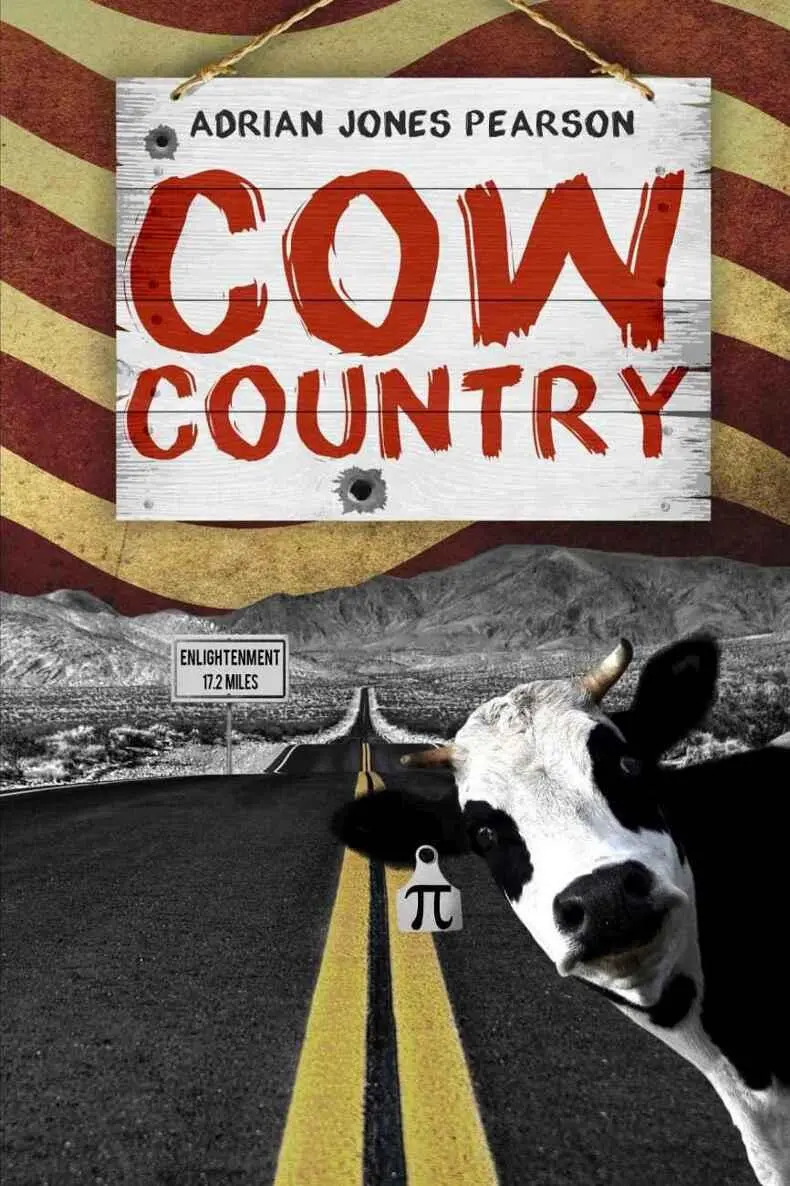
- Название:Cow Country
- Автор:
- Издательство:Cow Eye Press
- Жанр:
- Год:2015
- ISBN:нет данных
- Рейтинг книги:4 / 5. Голосов: 2
-
Избранное:Добавить в избранное
- Отзывы:
-
Ваша оценка:
Cow Country: краткое содержание, описание и аннотация
Предлагаем к чтению аннотацию, описание, краткое содержание или предисловие (зависит от того, что написал сам автор книги «Cow Country»). Если вы не нашли необходимую информацию о книге — напишите в комментариях, мы постараемся отыскать её.
Cow Country — читать онлайн бесплатно полную книгу (весь текст) целиком
Ниже представлен текст книги, разбитый по страницам. Система сохранения места последней прочитанной страницы, позволяет с удобством читать онлайн бесплатно книгу «Cow Country», без необходимости каждый раз заново искать на чём Вы остановились. Поставьте закладку, и сможете в любой момент перейти на страницу, на которой закончили чтение.
Интервал:
Закладка:
“Speak of the devil…!”
Bessie was now pointing to the front door where the English faculty had arrived as a group and were busily checking in with the secretaries. Among faculty of the college, Bessie explained, the English instructors were by far the most inspired, with each engaged in a particular project of literary and artistic merit: a sci-fi novel set in futuristic Connecticut, a collection of impossibly short stories, a book-length elegy detailing the rise and fall of the cattle industry in Cow Eye Junction. Of the five tenured English faculty at Cow Eye, exactly three were working on first novels; two were active playwrights; four had self-published at least one chapbook of non-rhyming poems; one had a movie script on option; and all five were in continuous and desperate search for a reliable literary agent.
“And who are those people?” I motioned to a dark table in the farthest corner of the room where a gloomy collection of half-lit faces sat staring blankly ahead. Each was wearing a black armband.
“The adjuncts,” she explained. “We’re not allowed to refer to them by name.”
Now more and more of the surging crowd was entering the cafeteria and in short order I was introduced to the school’s recently hired eugenics instructor; its business department chair; the dean of instruction; Carmelita the diversity officer; the full-time grant writer; the head librarian and her staff; Gladys from personnel; the mayor of Cow Eye Junction (who also happened to be our part-time welding instructor); and the Saab-driving, shih tzu-transporting art history professor whose house was not far from the makeshift bus shelter. One by one the surnames came at me like night through a windshield: Jumpston and Drumright and Manders and Poovey and Drisdell and Runkle and Toth. Crotwell and Voyles. Kilgus and Spratlin and Yaxley and Jowers. Quealy and Tutt. Prunty and Pristash. Clardy and Yerkes and Hotmire and Spritch. Breedlove and Tilly. Barnes and Weaver and Redfield and Tuley and Crootch and Slocum and Lineberry and Tibbs and….
At one point Bessie nudged me with her elbow and whispered, “Take special note of this one coming in now….”
An unassuming woman about forty-five years old had entered wearing simple jeans, a simple t-shirt, and wire-framed glasses that were also very simple. With a nondescript countenance and a look of internal calm she seemed to bask in the fact that there was nothing overtly notable about her, which made it all the more puzzling that Bessie had chosen to single this woman out from all the others.
“That’s Gwendolyn Dupuis,” she said. “Talisman of the new people. She’s from Massachusetts originally but has been here for about fifteen years. Loves numbers. Teaches logic. Gwen’s well known around campus for being Rusty’s mortal enemy. If Rusty resides on one side of a fence, you can be sure she’ll be parked on the exact opposite side. If Rusty wants this or that thing to happen in earnest, Gwen will no doubt be advocating just as earnestly for its antidote. Were he to represent our collective past, she would be more emblematic of our disunited present. And if he be Maryland by light of day, she will most certainly be South Carolina in the darkest of nights….” Intrigued, I watched the woman walk into the room, carefully make her way past the American flag hanging on the wall — the thirteen stripes and twenty-three stars running the entire length of the cafeteria — and then take her seat at the table furthest from Rusty Stokes next to Marsha Greenbaum.
By now faculty and staff of every conceivable ilk were pouring into the room, and Bessie’s introductions came even faster. That financial aid counselor over there, she gravely informed me, is from central New Hampshire and drives a Volkswagen. But the biology instructor sitting to her right drives a Dodge Dynasty and hails from Virginia.
“This is really overwhelming,” I said at last. “There’s no way I can remember all these names and faces and automobile makes. Not to mention states of the Union. I mean, all at once like this?”
“Just soak up what you can. You’ll have time to experience it for yourself soon enough….”
Around the cafeteria most faculty were now sitting with their respective departments and here and there I caught snippets of the competing conversations. Nearest to me, the English faculty were bemoaning the fickleness and corruption of the New York publishing industry and the hesitance of literary agents to take on writers from Cow Eye Junction. A table away, Rusty Stokes was presiding over the faculty from the animal science department, who occupied an entire table by themselves and were engaged in a lively discussion of a recent bovine insemination. From one table to the next I saw the nursing department, the automotive teachers, the financial aid counselors, maintenance and security, and the modern languages department. The humanities sat mostly on one side of the room and the sciences on the other. Liberal Arts occupied the tables closest to the front while the Trades took those furthest toward the back. For a college as small as this one, all the academic disciplines appeared to be well-represented, though there was surprisingly little interaction among them.
“And that’s not even the worst of it,” Bessie agreed. “Take a closer look at the tables. A better look ….”
And when I looked even more closely I saw that among the broad divisions there were subdivisions and within these subdivisions there were subdivisions of the subdivisions. For even at the individual tables there were noticeable separations and stratifications and limitless groupings and affiliations. With Bessie’s help I came to see how even among the humanities, things were not as harmonious as they outwardly appeared: that instructors from rural backgrounds sat together, as did those owning four-cylinder imports, those whose parents had been instrumental in repudiating majority rule, and those who if pressed for an answer would more readily identify themselves as spiritual rather than religious . PhDs huddled together quite apart from their less-decorated counterparts. Republicans sat on the left, Federalists on the right. Caucasoids kept largely to themselves leaving the college’s mongaloids to fill in where they could — while off to the side, sitting quietly by himself and occupying three-fifths of a very small chair, was a single tenured negroid. In the bustling cafeteria it all came together to make a strange, chaotic, swirling sort of sense — such as the harmony found in a pointillist electoral map observed from afar. Yet despite the chaos there was something vaguely reassuring about the scene until, amid the pulsating crowd, I noticed a curious absence. Something important was missing. Something vital and essential. An oversight of incalculable proportions: Where were the math instructors?
“Ah yes, our illustrious mathematics department,” Bessie sighed when I pointed out the subtrahend. “Something tells me they’re still in North Carolina….”
“Why North Carolina? What does that mean?”
“Give it time. You’ll start to see in a bit….”
At last the room was almost full. In one corner a small crowd of women had formed a semi-circle around an item of particular interest; shrieks of female delight rang out every so often.
“What’s happening over there?” I asked.
“That’s our new data analyst,” Bessie explained. “Our institutional researcher , I think they’re calling it now. He just moved to Cow Eye to take Merna Lee’s position. And apparently he’s gorgeous .”
Finally, when all of the faculty and staff of the college had taken their seats, Dr. Felch made his way to the lectern at the front of the room. Standing behind the microphone, he raised his hand above his shoulder as if taking a pledge of fealty and there he held it for several moments. Slowly, very slowly, the dull roar began to die down. Dr. Felch tapped the microphone a few times so that the sound reverberated around the cafeteria. “Does this thing work?” he said. And then: “Can you hear me?”
Читать дальшеИнтервал:
Закладка:
Похожие книги на «Cow Country»
Представляем Вашему вниманию похожие книги на «Cow Country» списком для выбора. Мы отобрали схожую по названию и смыслу литературу в надежде предоставить читателям больше вариантов отыскать новые, интересные, ещё непрочитанные произведения.









Обсуждение, отзывы о книге «Cow Country» и просто собственные мнения читателей. Оставьте ваши комментарии, напишите, что Вы думаете о произведении, его смысле или главных героях. Укажите что конкретно понравилось, а что нет, и почему Вы так считаете.