Alexander Theroux - Darconville’s Cat
Здесь есть возможность читать онлайн «Alexander Theroux - Darconville’s Cat» весь текст электронной книги совершенно бесплатно (целиком полную версию без сокращений). В некоторых случаях можно слушать аудио, скачать через торрент в формате fb2 и присутствует краткое содержание. Год выпуска: 1996, Издательство: Holt Paperbacks, Жанр: Современная проза, на английском языке. Описание произведения, (предисловие) а так же отзывы посетителей доступны на портале библиотеки ЛибКат.
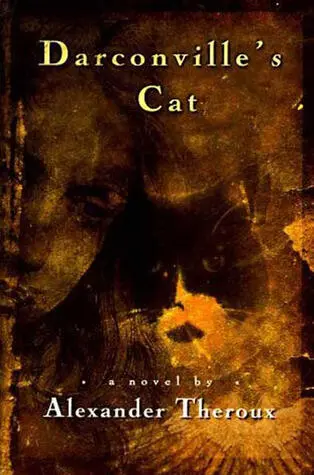
- Название:Darconville’s Cat
- Автор:
- Издательство:Holt Paperbacks
- Жанр:
- Год:1996
- ISBN:нет данных
- Рейтинг книги:3 / 5. Голосов: 2
-
Избранное:Добавить в избранное
- Отзывы:
-
Ваша оценка:
Darconville’s Cat: краткое содержание, описание и аннотация
Предлагаем к чтению аннотацию, описание, краткое содержание или предисловие (зависит от того, что написал сам автор книги «Darconville’s Cat»). Если вы не нашли необходимую информацию о книге — напишите в комментариях, мы постараемся отыскать её.
Darconville's Cat Its chapters embody a multiplicity of narrative forms, including a diary, a formal oration, an abecedarium, a sermon, a litany, a blank-verse play, poems, essays, parodies, and fables. It is an explosion of vocabulary, rich with comic invention and dark with infernal imagination.
Alexander Theroux restores words to life, invents others, liberates a language too long polluted by mutters and mumbles, anti-logic, and the inexact lunacies of the modern world where the possibility of communication itself is in question. An elegantly executed jailbreak from the ordinary,
is excessive; funny; uncompromising; a powerful epic, coming out of a tradition, yet contemporary, of both the sacred and the profane.
Darconville’s Cat — читать онлайн бесплатно полную книгу (весь текст) целиком
Ниже представлен текст книги, разбитый по страницам. Система сохранения места последней прочитанной страницы, позволяет с удобством читать онлайн бесплатно книгу «Darconville’s Cat», без необходимости каждый раз заново искать на чём Вы остановились. Поставьте закладку, и сможете в любой момент перейти на страницу, на которой закончили чтение.
Интервал:
Закладка:
“ We did,” quacked Harriet, looking beatific.
“Amen,” added Loretta.
Darconville asked: “Do you know this girl?”
“I’ve seen you in P.E., right?” said Harriet to Isabel who, bent over almost double, almost exanimate, didn’t respond one way or the other. Harriet looked up at Darconville. “We’ve howdied, but we haven’t shook.” She closed her eyes. “I know the characteristics of the unconverted heart.”
“It is prone to error,” said Loretta.
“Idleness, tippling, profanity.”
“And contention.”
“ ‘My sin is ever before me, neither is there rest in my bones because of sin,’ “ quoted Harriet Bowdler.
Darconville sighed. He felt tired, unsplendid, and null, bewildered by this visitation and divided as to whether he should just apologize to everyone and leave or stay there and somehow try to give honorable and ethical form to something that had ended as abruptly as a page torn in half. Instead, he stepped back as the girls administered to Isabel — two Serbs, one beautiful Croat — with a vocabulary of Bible gems and the slightly dictatorial attitude that vigorous religious conviction curiously assumes, especially in the proving, preaching, and perfricative mind of the Pentecostal. Like fundamentalists, like poppies, thought Darconville: the more they are trodden on, the more they flourish.
I will not ridicule them, he determined, for he himself, he knew, had accomplished nothing in the way of helping Isabel and felt that nothing accomplished left everything therefore to be. Further, was it not said that God often wished His glory to appear in the dulling of the wise, in the fall of the mighty, in the bewilderment of the alert? And so he kept to the shadows, an outlaw, logiciannaire, the acute and distinct Arminius.
Although a crescent moon could still be seen through the window of Fitts, the pale traces of early morning just touched the lower sky on the eastern outskirts of Quinsyburg, out toward Richmond. Darconville went to the window, the mild breeze through the rapfull curtains cooling his brow and in a semi-arrested, inefficient state closed his eyes as he listened to Harriet Bowdler — Loretta had momentarily disappeared — supplicating with Isabel to accept Christ Jesus and be “bom again” lest, unconverted, she die unredeemed and so caper about for eternity like the maroonest devils in hell, the particular area, Darconville knew, which the evangelical mind took to be God’s chiefest handiwork.
As he listened, he wondered. Was it all so simplistic and dim? It was and it wasn’t, thought the divided self. Darconville the rationalist: reality was not thinkable but in relation to an activity by means of which it becomes thinkable. Darconville the nominalist: but wasn’t truth suprarational? Incommunicable in the language of reason? Analyze, analyze, analyze! Isabel was correct. Surely one must enter love with a degree of folly which he can deceive and so, by deceiving, make wise. That was wisdom. I must become a fool, thought Darconville, I who have been so vain to know.
Suddenly, Loretta Boyco came padding back into the parlor and, smiling (a bit manically), short-armed each of them with a pamphlet — copies of “Glints from My Mirror” by W. C. Cloogy, Evangelist. Harriet then quickly dink-toed over to whisper something to Loretta, whose eyes, as she listened, shut tightly in holy mirth. And then she clapped! Would they both come to church tomorrow, it being Sunday, asked Loretta, to see Rev. Cloogy? To know him? asked Harriet. To hear him? asked Loretta. An opportunity, Harriet breathlessly assured them — rising and shaking a finger like Jael wagging a tentnail — that may be given to them only once! The accusative/dative, thought Darconville: the Accusation that is a Gift.
But to the Baptist church? That was a kind of Accusative of Place to Which, thought Darconville, with himself the object, and he almost smiled, reflecting on how, formerly, it would have taken a miracle of the first rank for him even to acknowledge the existence of that steeple-hatted communion of nescients and nincompoops called Baptists, a religion, broadly, only by reason of numbers and the obfusc light of twentieth-century lamps. He looked at Isabel. But she sat silent: in fact, somehow removed from it all, she seemed, the princesse lointaine , to enjoy the efforts of those two dumbledores attentively buzzing around her. In any case, perhaps a miracle was necessary to bring them together. For where had facts got them? And in how many a holy synaxarion had he read as a youth of even greater wonders — of dearths forestalled, serpents extirpated, rods embudded, courtesans converted, fluxes cured, tyrants mortified, cadavers translated, and, yes, minds completely changed! Darconville didn’t know what to say. He looked at Loretta, who stood with her hip sprung out. Well? He looked at Harriet, who folded her arms and asked again. Would they come? Ordinarily not given to habits of sudden adaption, Darconville nevertheless again heard sounded the depths of his own spiritual bankruptcy and intellectual obstinacy, and so just when one girl, again, was about to echo her coreligionist’s question, he who had come within a finger-breadth of saying no turned thereupon and said, “Yes.”
Struck like a duck in thunder, Loretta Boyco suddenly gooched Harriet Bowdler in the ribs and, shooting their hands up, both hysterically shrieked, “ Praise the Lord !”
The town of Quinsyburg still slumbered. It was quite early yet, and, though on the horizon the edge of dawn promised to widen, the greyish darkness held. It had been one of the longest nights of his life, and that he’d survived it seemed to Darconville a miracle in its own right. He crossed the Quinsy lawns and, exhausted, came to his house. He entered and pulled the bolt; it syllabified a dactyl— mlr a. k’l !
It was only then, dragging himself wearily up the flight of stairs that creaked with the pain that doubled them up in the middle, that Darconville realized the implications of his promise to go to the Wyanoid Baptist Church, a perturbation of spirit weighing on him not so much for the denomination as for another fact, suddenly remembered, that no miracle of Christ’s ever took place in the Temple of Jerusalem.
XLVI The Wyanoid Baptist Church
One can know what God is not; one cannot know what He is.
— St. AUGUSTINETHE WYANOID BAPTIST CHURCH — a box-shaped affair surrounded by catbriars and scrubby, asymmetrical rows of chinabeny trees — stood on the main street. There was a faint odor of mundungus in the Sunday morning air, but the sun shone brightly. Southern Baptists, who had separated from their Northern counterparts in 1845, were generally to be found a congregation of thin-lipped believers in immersion, closed communion, and total teetotalism, and, while it did not share his own ancient religion’s boast eternal of semper eadem —neither was it, at once, holy, catholic, and apostolic— Darconville, standing on the front steps there, turned his back on the history of sacrilege in its shingles and determined to try to be more altruistic.
The parishioners, stepping out of their old automobiles and dented pickup trucks, all had something flat about them, and as they walked into church, moved, each, perhaps by the thought of future glory which he or she fought in himself as too worldly and so rechristened duty, the mood was made manifest in the general soberness of appearance. It was all flat . They had flat heads, flat shoes, flat chests, flat faces, flat clothes, and flat, very flat voices.
Darconville felt a bit guilty for such prejudgments and vowed, with a smile, to discontinue “satirizing,” the penance for which the great medieval Church of Rome prescribed twelve genuflections at every canonical hour, three hundred blows with a leather cat, and a cross-vigil. At that very moment two black girls, wearing their Sunday best, hesitated in front of the church, when suddenly a sanctimonious busybody with pegged teeth came running down the front stairs, took them by the shoulders, and, smacking through a hole of lipstick, told them they shouldn’t be there, should they, that they had their own church, hadn’t they, and that they knew that very well, didn’t they, mmm? The girls, wounded, looked past the woman to Darconville and hurried away. The woman’s face stank with virtue, he thought, as his own inaction stank with vice, but what could he do? There was nothing to be done, he reasoned, that would actually do anything, for we are renegades all, he thought, unfair each, every one a fool. What ever changed? The blacks are the invisibles of the whites. The poor are the wealth of the rich — but the thought, swiftly addressed by some words of St. Paul, only reflected the madness of all men: “For that which I do, I allow not; for what I would, that do I not; but what I hate, that do I.” Slowly, it came to him that the enemy of Christ was not the atheist but rather the bankrupt Christian, and with great disappointment he soon felt part of all he heard and what he saw, for he himself was how it was, overwhelmed in the the of being there and making not a jot of difference by the fact. And then, as recognition caught hold of remorse, he suddenly realized that it had been on this very spot not a year ago that, speaking to Miss Trappe, he had smugly assured himself that the price for privacy was anonymity. And O, how anonymous he had become! Buffoon of my own ruins, thought Darconville, miscalled Quinsyburg! I have become what I am!
Читать дальшеИнтервал:
Закладка:
Похожие книги на «Darconville’s Cat»
Представляем Вашему вниманию похожие книги на «Darconville’s Cat» списком для выбора. Мы отобрали схожую по названию и смыслу литературу в надежде предоставить читателям больше вариантов отыскать новые, интересные, ещё непрочитанные произведения.












Обсуждение, отзывы о книге «Darconville’s Cat» и просто собственные мнения читателей. Оставьте ваши комментарии, напишите, что Вы думаете о произведении, его смысле или главных героях. Укажите что конкретно понравилось, а что нет, и почему Вы так считаете.