John Gardner - Stillness & Shadows
Здесь есть возможность читать онлайн «John Gardner - Stillness & Shadows» весь текст электронной книги совершенно бесплатно (целиком полную версию без сокращений). В некоторых случаях можно слушать аудио, скачать через торрент в формате fb2 и присутствует краткое содержание. Год выпуска: 2010, Издательство: Open Road Media, Жанр: Современная проза, на английском языке. Описание произведения, (предисловие) а так же отзывы посетителей доступны на портале библиотеки ЛибКат.
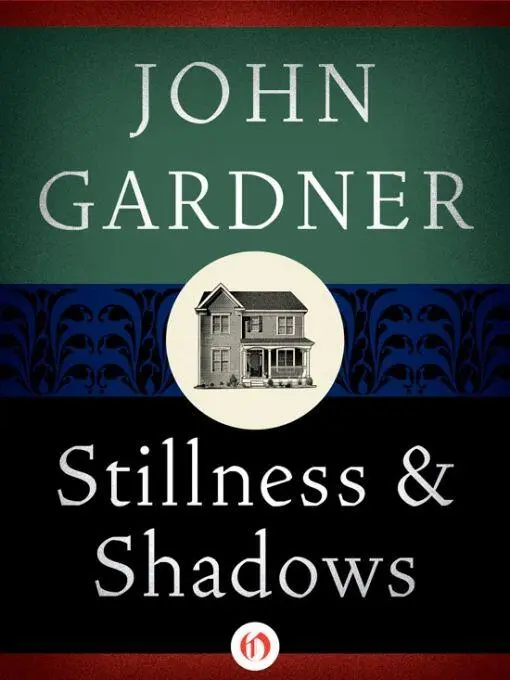
- Название:Stillness & Shadows
- Автор:
- Издательство:Open Road Media
- Жанр:
- Год:2010
- ISBN:нет данных
- Рейтинг книги:5 / 5. Голосов: 1
-
Избранное:Добавить в избранное
- Отзывы:
-
Ваша оценка:
Stillness & Shadows: краткое содержание, описание и аннотация
Предлагаем к чтению аннотацию, описание, краткое содержание или предисловие (зависит от того, что написал сам автор книги «Stillness & Shadows»). Если вы не нашли необходимую информацию о книге — напишите в комментариях, мы постараемся отыскать её.
Inspired by therapy sessions Gardner experienced with his first wife, Stillness is an insightful portrait of one couple’s struggle for fulfillment in a tumultuous world.
Private detective Gerald Craine is pursuing an unknown murderer. At the same time, he himself is the target of an unknown person’s pursuit. Stumbling through an alcohol-soaked haze, Craine desperately seeks meaning and understanding in a world fraught with fragmented narratives.
Shadows: John Gardner’s friend Nicholas Delbanco has supplemented this unfinished novel with seven sections from Gardner’s original manuscript that provide critical insight into Gardner’s approach to developing the novel and its characters, giving a rare glimpse inside the creative process of one of the twentieth century’s most inventive writers.
This ebook features a new illustrated biography of John Gardner, including original letters, rare photos, and never-before-seen documents from the Gardner family and the University of Rochester Archives.
Stillness & Shadows — читать онлайн бесплатно полную книгу (весь текст) целиком
Ниже представлен текст книги, разбитый по страницам. Система сохранения места последней прочитанной страницы, позволяет с удобством читать онлайн бесплатно книгу «Stillness & Shadows», без необходимости каждый раз заново искать на чём Вы остановились. Поставьте закладку, и сможете в любой момент перейти на страницу, на которой закончили чтение.
Интервал:
Закладка:
Carnac’s whisper came through to him from the other side of the bookshelf. “Hssst! Look down by your belly, Mr. Craine! Quick!”
Before he had time to think better of it, some thought of the scar on his belly in his mind, Craine raised the book and looked down, below it and between his lifted arms. Carnac’s black fingers came poking out, reaching through from the far side of the bookshelf, holding fanned-out red and white bicycle cards.
“Pick a card,” Carnac whispered. He waited. Then, as if the police might swoop in at any moment, “Come on, man!”
Craine lowered the book with his left hand, slowly, then after a moment reached forward with his right, his mouth turned down grimly, and drew a card from the fan. He tipped it over slowly. “Ace of hearts,” he said. His voice was thin and jarring, even in his own ears, like an iron wheel on concrete. He put the book down — slid it, opened to his place, onto the books on the bookshelf — then slowly, deliberately, tore up the card, glanced at the floor, then put the pieces in his pocket.
“Pick another,” Carnac whispered, as if everything was exactly as it should be. His smell came through the bookshelves, sour as medicine.
Craine picked another card and slowly tipped it over. “It’s another ace of hearts,” he said, and methodically tore it up.
“Two aces of hearts!” Carnac whispered as if in astonishment. “There’s some mystery in this! Pick another!”
Craine picked another, tipped it over — another ace of hearts — and tore it up.
“Man, you lucky I caught you when I did,” Carnac whispered, and drew his hands and the remaining cards back in through the bookshelf, out of sight. “Strange forces is converging. No question about it!” The cards and the tips of his fingers reappeared, the cards face up. They were now all twos of diamonds.
Craine lowered his head to look over the tops of the books into Carnac’s eye. It was wet, as if tear-filled, and unnaturally wide, staring as if trying to pin him where he stood. Craine glanced down, and instantly, as if reading his mind, Carnac jerked his hands and the cards back out of sight.
Craine leaned closer to the bookshelf. “You don’t fool me, Carnac,” he said, too quietly for anyone else to hear. “I know what you’re up to.”
The wet eye closed. “God bless you for saying that, brother! You got a heart of gold!” The eye popped open, very wide, as sober as the eye of a myna bird. “You the only one in this universe understands me, that’s why I takin good care of you. I lose you, Craine, and I’m ’onna sink into hopeless confusion. You hear about St. Peter, trine walkin on the waves?”
Craine laughed sharply, then scowled and abruptly turned away. It was his usual experience with Carnac; everything just at the edge of making sense. His madness was surely studied, like that of a fool to some old-time king. But also he was crazy; he’d been diagnosed. Sometimes he would sit on the sidewalk and cry. As if guiltily, Craine’s mind flicked away from the thought, and his right hand, unbeknownst to him, moved to touch the bottle in his pocket. He glanced at the watch on his left wrist — ten a.m., too early to be as drunk as he was, he thought, unaware that he was thinking it. He retrieved his book, still open, from its shelf.
As Craine started down the aisle, retreating, Carnac called softly, “That’s a interesting point you make, tearin up my cards. I guess I never looked at it that way before.” He sounded hurt, and, again for no reason he could think of, Craine felt guilty. He glanced at his watch.
As he emerged into the central area of the bookstore, where the tables were, Craine stopped abruptly. The doctor from the university stood six feet away, gazing at the floor, slightly smiling, the dictionary under his arm. There was someone else there, Craine believed for a moment, or rather someone else standing not far off, toward the back of the store, motionless, hidden among the stacks. He got a sudden mental image — as if the person in the stacks had beamed it at him — of a huge winged bull carved in stone. He would have known, if he’d thought for a moment, thought hard, that it was a memory from his childhood, a visit to some museum with his aunt Harriet; he might even have worked out why it was that he thought of just that, just then; but Gerald Craine did not believe he retained any memories from childhood; plagued by blanks, he shrank in distress, with a thousand excuses, from the very idea of memory; and in his tingling alcoholic panic — a chronic state at the moment grown acute — he did not think at all. The doctor glanced up at him, lifting his head with the elegance of a prince so that he could see through the lower lenses of his bifocals, and smiled still more brightly, nodding. He stood with his head thrown slightly forward, like a man looking into a fire or across a vast desert or out at the sea. Craine approached. The person in the stacks — person or snake coiled to strike; he was suddenly uncertain — did not move.
“Morning, Doctor,” Craine said, trembling, mustering all his courage. He raised his right hand toward the brim, of his Stetson, then, because of the violent trembling, reconsidered and, attempting to disguise the gesture, reached into his inside pocket, got his pipe out, carefully not disturbing slips of paper there, and with almost imperceptibly shaking fingers stuck the pipe between his teeth.
The doctor seemed to notice none of it. “Well, well! Hello there, Detective!” he said. “Any progress on those murders?”
“Murders?” Craine said, giving a jump. Then, seeing what the man must have in mind, he grinned and bleated, “I’m not in on that.” He let out a bitter laugh. “No doubt the police are doing all they can.” In the flood of relief, he nearly remembered where it was that they’d met, what it was they’d talked about, but then at once the memory slipped back into shadow, out of reach.
They shook hands, an easy, automatic gesture on the doctor’s part, awkward on Craine’s — partly because he had to shift the pipe to his left hand, partly because the doctor had stumbled onto one of Craine’s oddities: like a raw-skinned old farmer, he disliked shaking hands. He squeezed hard, as if to make up for his reluctance, then quickly drew the long, skinny hand back and wiped it on his coat. The rough cloth grated against the numbness in his fingers.
“It’s a terrible thing,” the doctor said. “Right here in Carbondale! What is it, five now? Five, I think.”
“You might be surprised,” Craine said, pedantic. “Murder’s very common in Carbondale. Been that way for years.” The conversation was academic, one of those tedious labors of politeness. There hadn’t been a murder in three, four months. Chances were it was over, like the Hollywood strangler thing.
The doctor nodded. “Yes, that’s so, so I’ve heard.” He looked at Craine with interest. “One of the highest murder rates in the nation, right here in Little Egypt, as they say. Mine wars, lynchings, slot-machine wars … But five young women in one year—”
“Everything’s old hat in Little Egypt,” Craine said. He realized at once that he’d sounded impatient. He added, “One of them was up in her sixties — the professor’s wife.”
The doctor nodded, and, with a look of distress, putting his pipe in his mouth, Craine nodded too. The professor — some man in economics, Craine recalled; computer expert — had come home to his house out on Lipes’ Ridge Road at five o’clock — that was his story — and had found the house strangely quiet, as if empty. He’d gone down cellar and there was his wife, stark naked, tied up in a chair. She’d been beaten, then stabbed in the neck and chest. On the floor there were twelve empty beer cans.
Читать дальшеИнтервал:
Закладка:
Похожие книги на «Stillness & Shadows»
Представляем Вашему вниманию похожие книги на «Stillness & Shadows» списком для выбора. Мы отобрали схожую по названию и смыслу литературу в надежде предоставить читателям больше вариантов отыскать новые, интересные, ещё непрочитанные произведения.


Обсуждение, отзывы о книге «Stillness & Shadows» и просто собственные мнения читателей. Оставьте ваши комментарии, напишите, что Вы думаете о произведении, его смысле или главных героях. Укажите что конкретно понравилось, а что нет, и почему Вы так считаете.