John Gardner - The Sunlight Dialogues
Здесь есть возможность читать онлайн «John Gardner - The Sunlight Dialogues» весь текст электронной книги совершенно бесплатно (целиком полную версию без сокращений). В некоторых случаях можно слушать аудио, скачать через торрент в формате fb2 и присутствует краткое содержание. Год выпуска: 2010, Издательство: Open Road Media, Жанр: Современная проза, на английском языке. Описание произведения, (предисловие) а так же отзывы посетителей доступны на портале библиотеки ЛибКат.
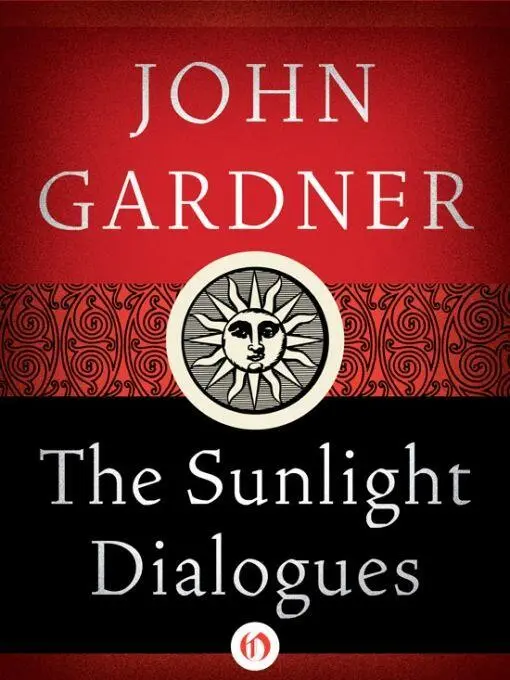
- Название:The Sunlight Dialogues
- Автор:
- Издательство:Open Road Media
- Жанр:
- Год:2010
- ISBN:нет данных
- Рейтинг книги:4 / 5. Голосов: 1
-
Избранное:Добавить в избранное
- Отзывы:
-
Ваша оценка:
The Sunlight Dialogues: краткое содержание, описание и аннотация
Предлагаем к чтению аннотацию, описание, краткое содержание или предисловие (зависит от того, что написал сам автор книги «The Sunlight Dialogues»). Если вы не нашли необходимую информацию о книге — напишите в комментариях, мы постараемся отыскать её.
Beautifully expansive and imbued with exceptional social insight,
is John Gardner’s most ambitious work andestablished him as one of the most important fiction writers in post — World War II America.
The Sunlight Dialogues — читать онлайн бесплатно полную книгу (весь текст) целиком
Ниже представлен текст книги, разбитый по страницам. Система сохранения места последней прочитанной страницы, позволяет с удобством читать онлайн бесплатно книгу «The Sunlight Dialogues», без необходимости каждый раз заново искать на чём Вы остановились. Поставьте закладку, и сможете в любой момент перейти на страницу, на которой закончили чтение.
Интервал:
Закладка:
VIII. The Kleppmann File
This know also, that in the last days perilous times shall come.
— II Timothy 3:11
Will Hodge Jr sat with the seat pushed back as far as it would go, fists squared on the steering wheel, shoulders and belly monumental, trousers drawn up a trifle to preserve the press, revealing lean bare shins as white as milk. He drove with authority and grace, head back, jaw thrown forward: an Assyrian king. He surveyed the city as though it belonged to him and he to it. The tall buildings threw angular shadows over the pavement, dignified and impersonal, as was fitting. He was home. During the absurd session at the police station, he’d been tormented by confused emotions, among them a momentary sense, unusual with him, that there was deep meaning in all of this. There was no specific cause behind this feeling he had, as far as he could tell — not his father’s storming past him without a word as he and Luke stood waiting for their turn with the Police Chief, not Clumly’s ridiculous accusations (not even Clumly took them seriously: a stall, an evasion, an explosion of senseless energy in what seemed for the moment a senseless universe), not the feeling of accomplishment Will Jr had had as he exploded Clumly’s ludicrous theories one by one, not Luke’s shame and indignation, not even the smell of the dead policeman’s blood. Perhaps simply this: sitting in Clumly’s office, soberly reasoning with a half-senile country cop on a case that would never have come up in a city like Buffalo, he had felt a burst of pleasure in his having escaped all that, having fled that cave of miscalculation and inevitable embarrassment that had once been his prison — the discomfiture summed up for him in his partnership with a small-town, old-fashioned attorney, Will Hodge Sr. It was almost frightening, when you thought about it. His father had been dealing with tax cases all his life and yet, compared to a first-rate tax man, knew nothing: his client was a helpless victim, and neither the client nor the lawyer was so much as aware of it. Will Jr knew it for a fact. He himself, as attorney for a small corporation — Flemming Construction, of North Tonawanda — had automatically been made an official of the company, a position in fact no more meaningful than, say, Head Custodian, but an “official,” nevertheless. So that when the Government had slapped a twenty-thousand-dollar fine on all responsible officials for the company’s failure to pay its taxes, Will Jr, though he had known nothing about the evasion of payment, had been held to be liable, like the others. Some of them, too, had known nothing about the thing. “There’s nothing you can do,” his father had said; “buy them off. Pay them ten thousand.” And he would have done it except that at lunch with Lou Solomon he had gotten, between two puffs from Solomon’s leather-covered pipe, a specialist’s opinion. “Show cause why you shouldn’t be considered a ‘responsible official.’ Stop by after lunch and I’ll show you what to do.” Obvious, and yet even he himself had missed it. It was a grand old ideal, the Jack-of-all-trades attorney, but like all grand old ideals, it didn’t work. He’d been amazed when his father had told him, long ago, that he couldn’t afford to run his office in Batavia if he didn’t get seven dollars an hour for every case. Here in Buffalo, with Hawley, Hawley Poacher, it was forty-five an hour. But the difference was important. Here they didn’t make mistakes, or anyway not obvious mistakes. Tax specialists, litigation specialists, labor specialists, merger specialists, the works. A murderous overhead — ten dollars a foot for office space, someone had said — and murderous hours, if you were the type who cared about the client’s pocketbook, but it was worth it, you could hold up your head.
Sitting in that small-town police station with that small-town chief, smelling the pungency of his small-town green cigar and hearing the twang of small-town reporters in the hallway — and more than that, yes: sitting in that green-treed town he’d more or less grown up in and loved the way he loved his own arms and legs — he had felt released: he had grown up, had finally broken free of the myth, the old hunger for the ancient south (or whatever the line was) — broken out of Eden, anyhow, released his childish clutch on the impossible: it was a transition place, an evolutionary stage he and his kind had broken out of for the world coming in: the city.
He drove to the office instead of home, moved his station wagon in and out of the Sunday afternoon traffic with confidence as ample as his belly, jaw thrown forward with comfortable superiority, and he looked up with satisfaction at the towering buildings of darkening concrete and brick, their upper reaches bright where the falling sunlight struck, their lower windows full, like abstracted eyes, with the reflected glory of neon and blue-gray smoke and the shining roofs of passing cars. He slowed with majestic benevolence for a brown dog wandering out in the street; stopped for the light when it was only yellow; and passing the old Methodist church he felt a warmth rushing up through his heart as though he were himself responsible for the lighted windows, the small pleasant crowd of idlers on the concrete steps preparing for the evening service.
There was a parking space waiting. There always was on a Sunday evening. He pulled his station wagon into it, got out and locked the doors. He bought a Buffalo Evening News with the air of a patron of the arts, though Louise would have a copy at the house already, and he unfolded it with the detached curiosity of a stockbroker as he let himself into the M&T lobby. He signed in, gave his usual polite greeting to the attendant-and-elevator-boy, and rode to the fourteenth floor. The old man — the “boy”—stared at the buttons Will Jr might have pushed for himself if things were done that way in the M&T Building, and Will Jr bowed his head and pretended to read. The old man had gray hair, huge spots on his neck, long spotted ears. One of the wrinkled hands folded behind him was missing two fingers. “Poor old Sam,” Will Jr thought, though he was unsure of the name, and shook his head. The elevator hung in space a moment, then settled level with the fourteenth floor, and when the door opened Will Jr stepped out. He observed that his shoes still shone like mirrors. He let himself into Hawley, Hawley & Poacher, allowed the door to click shut behind him, and walked to the seventh door on the left, his office, and turned on the lights. He phoned his wife.
“You’ll be late then?” she said. Her tone was an accusation.
“Something’s come up,” he said. “I’ll hurry, love. I give you my solemn assurance.” He smiled into the phone.
“Ok,” she said. After a moment: “Can you say hello to Danny?”
Will Jr wiped the sweat from his upper lip and smiled again. “Sure thing,” he said, “put him on.”
Then his son’s voice. “Hi.”
“Hoddy do-dee?” Will Jr said. A silence. “You doing everything your mommy tells you, honey?”
After a long silence the boy said, “Hi.”
The sweat was there again. Nevertheless he said jovially, “You and Sister been having lots of fun?” Then: “Is Mommy still there, honey?”
Again the boy said, “Hi.”
He said, “Can I talk to your mommy again, Danny?”
He heard the child say, forming the words carefully, “He wants to talk to you,” and then Louise was on again, and then Maddie, his six-year-old daughter. She said, “Hi, Daddy.” He could see her, standing with her blond head tipped, both hands on the telephone receiver.
“Hi!” he said.
“Bowser got out without his muzzle, Daddy,” she said.
Читать дальшеИнтервал:
Закладка:
Похожие книги на «The Sunlight Dialogues»
Представляем Вашему вниманию похожие книги на «The Sunlight Dialogues» списком для выбора. Мы отобрали схожую по названию и смыслу литературу в надежде предоставить читателям больше вариантов отыскать новые, интересные, ещё непрочитанные произведения.




Обсуждение, отзывы о книге «The Sunlight Dialogues» и просто собственные мнения читателей. Оставьте ваши комментарии, напишите, что Вы думаете о произведении, его смысле или главных героях. Укажите что конкретно понравилось, а что нет, и почему Вы так считаете.