John Gardner - The Sunlight Dialogues
Здесь есть возможность читать онлайн «John Gardner - The Sunlight Dialogues» весь текст электронной книги совершенно бесплатно (целиком полную версию без сокращений). В некоторых случаях можно слушать аудио, скачать через торрент в формате fb2 и присутствует краткое содержание. Год выпуска: 2010, Издательство: Open Road Media, Жанр: Современная проза, на английском языке. Описание произведения, (предисловие) а так же отзывы посетителей доступны на портале библиотеки ЛибКат.
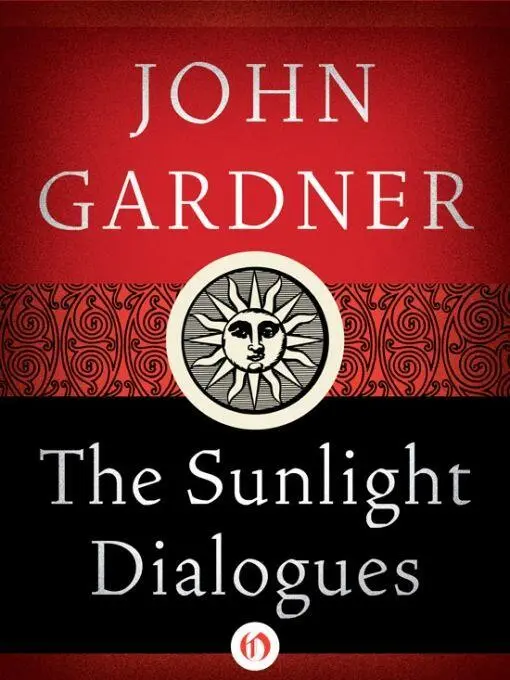
- Название:The Sunlight Dialogues
- Автор:
- Издательство:Open Road Media
- Жанр:
- Год:2010
- ISBN:нет данных
- Рейтинг книги:4 / 5. Голосов: 1
-
Избранное:Добавить в избранное
- Отзывы:
-
Ваша оценка:
The Sunlight Dialogues: краткое содержание, описание и аннотация
Предлагаем к чтению аннотацию, описание, краткое содержание или предисловие (зависит от того, что написал сам автор книги «The Sunlight Dialogues»). Если вы не нашли необходимую информацию о книге — напишите в комментариях, мы постараемся отыскать её.
Beautifully expansive and imbued with exceptional social insight,
is John Gardner’s most ambitious work andestablished him as one of the most important fiction writers in post — World War II America.
The Sunlight Dialogues — читать онлайн бесплатно полную книгу (весь текст) целиком
Ниже представлен текст книги, разбитый по страницам. Система сохранения места последней прочитанной страницы, позволяет с удобством читать онлайн бесплатно книгу «The Sunlight Dialogues», без необходимости каждый раз заново искать на чём Вы остановились. Поставьте закладку, и сможете в любой момент перейти на страницу, на которой закончили чтение.
Интервал:
Закладка:
But he had not come here to think about Kleppmann, and he wouldn’t.
Nevertheless, he was thinking about Kleppmann. Or rather, everything he thought had Kleppmann inside it like a cancer, the worm in whatever ripe apple-sweet thought he could summon from the cellar of his mind. Someday, chances were, R. V. Kleppmann would kill him, and Will was afraid. He reached out abruptly and turned the file over to keep himself from staring at the name.
“I should go home,” he thought. “What am I accomplishing, sitting here twiddling my fingers? Nothing.” He laughed sourly. “Eh bien. I submit to you then, Counsellor, you damn well ought to go home.” He did not stir.
2
“Rat race,” he thought.
“Perdu.”
But it wasn’t just himself. Something had gone wrong with all of them — his father and mother, his brother Luke, his sister, the times in general. It was no good fretting and whining about it, but just the same it was there, a fact. Somehow one had to escape it.
A specialist in collections. Who would have thought it!
They could have found no one less suited for the work — an idealist, sentimental, generous, fond of good music and books (he was a member of the Columbia Record Club and three different book clubs). He loved movies. He sang in the church choir — the Unitarian church four blocks from his house. He’d even tried cello lessons, six months ago now — had sat up late squinting heartsick at the page and clumsily laboring like an anxious dinosaur in glasses, Louise knitting in the semidarkness behind him. The cello would help him relax, he had said. In his childhood, living on Uncle Ben’s farm, he’d spent hours playing “Danny Boy” and “Old Man River,” playing and singing at the top of his voice. But it hadn’t relaxed him, of course. The opposite. He didn’t have time to practice, and going to his lesson unprepared made the sweat run down him in rivers. When he did get to practice, on the other hand, he felt guilty because he was using up time he should properly have spent with his family. Just the same, a strange man to be hunting down debtors, seizing bank accounts, property, wages, getting judgments from the courts. Three or four days a week at least he was off on the road somewhere, hunting through documents in Albany, chasing down stocks in New York or Pittsburgh or Kansas City, investigating the debtor’s associates and family. He, Will Hodge Jr, who had hated travel all his life and could get airsick merely by watching a big plane land.
There had been a kind of cruel inevitability about his becoming what he’d become. He was by nature a man who worked feverishly at whatever he did. It was that that had decided them on putting him into collection. The workload there was heavy and also vital, and the man who had done the job before him had been even less suited for the work, apparently, than Will. There were accounts six months old that hadn’t even been acted upon, and some of them were accounts with the firm’s most important clients. Mercantile Trust had collection accounts worth hundreds of thousands. To goof on them meant more than losing those accounts: it could mean losing their merger cases too — their tax cases, their suits, and on across the board. And so, much as he hated the work, he had thrown himself into it. He had tried at first to do everything in person — writing letters, pursuing examinations, chasing, demanding, seizing. It was all very well to throw injunctions around, seize property, put a man out of work by taking his wages and inconveniencing his employer, but one did not have to do it impersonally, brutally, so it had seemed to Will at the start. But then he’d begun to hear their stories, had begun to see what incredible lengths they’d go to, even under oath, to hide their unlawful nesteggs. He’d been fooled again and again and again, so that eventually whenever at the end of it all it appeared that he had for once been dealing with an honest man, he could not be sure at all of his opinion. Don’t fool around, became his motto, slap a judgment on him! He had begun to develop forms, convenient sheets which could be filled out by any secretary, so that judgments rolled off his assembly line like new refrigerators. It had altered his life. He’d been annoyed, in the old days, by those signs in corner grocery stores: No Credit— that is, No Belief. Now he understood the feeling. No Checks Cashed. No Installment Sales. Cash Is King. He saw how even his own family robbed him — his sister, his mother (he’d lent her the money for her car; he would never see a cent of it), even his wife, bringing out dresses she said she’d sewn herself but had really bought that morning and hadn’t even bothered to take the tags out of. Dominus! All right then. He would put up with their thievery, because they were his flesh and blood, but he need not stew about the others. Predictably, he’d become good at his work. He turned out the work so efficiently that his department expanded, in fact almost tripled its output. He made, now, very few mistakes about people. The few mistakes he did make were his errors in thinking honest debtors to be dishonest, but he did not let those errors trouble his sleep. It was only to be expected that there would be, here and there, an honest man (a fool, more like, given the harsh realities), but if you judged all men thieves you had statistics on your side. As for all his former nonsense about justice and goodness and the Legal Ground of the American Way of Life, well, this:
He’d been appointed by the State to serve as defense counsel. The boy was a hoodlum. Tall, curly-headed, with thick, sneering lips. All his life he’d been a troublemaker. The police knew him well. He was standing in a bar when two policemen arrived in answer to a call from the bartender, a complaint about some minor disturbance which was over by the time the police got there. The two cops went to the bar where the boy was standing and talked to the bartender. The boy said, reportedly, “Beat it, fuzz, you’re not wanted here.” One of the cops told him to mind his own business, and the boy, without further provocation, elbowed the cop in the stomach hard and said, reportedly, “Go fuck yourself.” He was promptly arrested, taken to the car, and shoved into the back seat. There, according to the boy’s version, one of the cops said, “You’re a wiseguy, ain’t you,” and struck him. The boy struck the cop with his handcuffed wrists. He was charged with and tried for disturbing the peace and resisting arrest.
Will Hodge Jr had spent forty-some hours researching the case — digging up witnesses, questioning the boy, the cops, the ten bystanders he could locate. What he learned, beyond any shadow of a doubt, was that the boy belonged in prison, all right, but the State had no case. The Buffalo ordinance against obscene language in a tavern did not qualify as disturbance of the peace, and beating a cop without any intention to escape did not qualify as resisting arrest. And so Will had won, ultimately. Had sweated out the ordeal of the trial, had awakened in the middle of the night with his heart pounding so badly he was afraid he was going to die, asking himself in terror Should I have objected? Did I ask the right question? But had won. A stupid and pointless victory of technicalities. And a victory, worse yet, that accomplished nothing but a return to the status quo — like all legal victories: a kind of high-falutin auto mechanics, a perpetual repairing of broken parts, bent fenders, leaky tubes. Poets, for instance, made poems that might — if the poet was lucky and talented and careful — endure for a thousand years. But what was it that a lawyer made, preparing a brief of, say, four hundred closely reasoned, meticulously researched, precisely stated pages? Did the poet put in any more of his heart’s blood, his brain’s electricity, torment of soul? At best the lawyer established a precedent: a man sentenced to life in prison instead of the chair because of “extenuating emotional circumstances.” At best. Where will I go? he had asked himself. What will I do? Nowhere. Nothing.
Читать дальшеИнтервал:
Закладка:
Похожие книги на «The Sunlight Dialogues»
Представляем Вашему вниманию похожие книги на «The Sunlight Dialogues» списком для выбора. Мы отобрали схожую по названию и смыслу литературу в надежде предоставить читателям больше вариантов отыскать новые, интересные, ещё непрочитанные произведения.




Обсуждение, отзывы о книге «The Sunlight Dialogues» и просто собственные мнения читателей. Оставьте ваши комментарии, напишите, что Вы думаете о произведении, его смысле или главных героях. Укажите что конкретно понравилось, а что нет, и почему Вы так считаете.