John Gardner - The Sunlight Dialogues
Здесь есть возможность читать онлайн «John Gardner - The Sunlight Dialogues» весь текст электронной книги совершенно бесплатно (целиком полную версию без сокращений). В некоторых случаях можно слушать аудио, скачать через торрент в формате fb2 и присутствует краткое содержание. Год выпуска: 2010, Издательство: Open Road Media, Жанр: Современная проза, на английском языке. Описание произведения, (предисловие) а так же отзывы посетителей доступны на портале библиотеки ЛибКат.
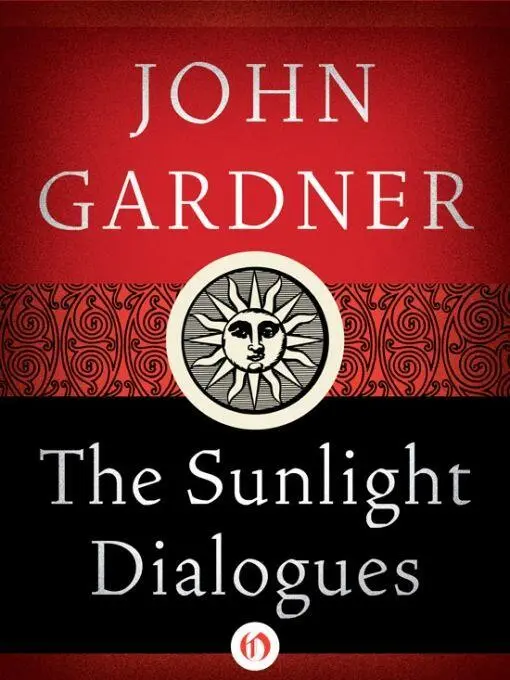
- Название:The Sunlight Dialogues
- Автор:
- Издательство:Open Road Media
- Жанр:
- Год:2010
- ISBN:нет данных
- Рейтинг книги:4 / 5. Голосов: 1
-
Избранное:Добавить в избранное
- Отзывы:
-
Ваша оценка:
The Sunlight Dialogues: краткое содержание, описание и аннотация
Предлагаем к чтению аннотацию, описание, краткое содержание или предисловие (зависит от того, что написал сам автор книги «The Sunlight Dialogues»). Если вы не нашли необходимую информацию о книге — напишите в комментариях, мы постараемся отыскать её.
Beautifully expansive and imbued with exceptional social insight,
is John Gardner’s most ambitious work andestablished him as one of the most important fiction writers in post — World War II America.
The Sunlight Dialogues — читать онлайн бесплатно полную книгу (весь текст) целиком
Ниже представлен текст книги, разбитый по страницам. Система сохранения места последней прочитанной страницы, позволяет с удобством читать онлайн бесплатно книгу «The Sunlight Dialogues», без необходимости каждый раз заново искать на чём Вы остановились. Поставьте закладку, и сможете в любой момент перейти на страницу, на которой закончили чтение.
Интервал:
Закладка:
He calmed himself.
It was the same man.
Yes.
“I was sorry to hear about the divorce,” Will had said on the phone.
Buz Marchant had laughed. “Life begins at alimony.”
“Ha.” It was a thing he’d forgotten, that eternal labor at joke-making. People laughed for him, though, because the voice was right, the cock of the eye; who cared if the joke was stupid? “I take it your heart’s not broken,” Will said.
“I’ll tell you all about it. ’Mon out.”
They were leaving the business district now. He held the cold pipe in his hand and closed his eyes again, thinking how good a martini would taste. He thought of Louise, who disapproved of martinis, and whose anger and distress when he drank filled him with fright like the fright he’d felt when he’d done wrong in his childhood. When he opened his eyes, much later, the taxi was gliding up a winding street with trees on each side. The houses were low and expensive and had diamond-shaped windowpanes. The driver slowed down, looking up at street numbers, then slowed more and pulled over. “That’s it,” he said. He nodded up at it. It was big, modern, and even from outside it had the look of an overpriced doctor’s waiting room. Will got out, paid the man, and — hitching up his trousers, straightening his coat — started up the flagstone steps. Before he reached the first step of the porch itself, the porch light went on. A moment later, when he reached for the doorbell, the button lit up before he touched it, and he heard the bell ring inside. Then Buz was there, beaming. “Dr. Harold Marchant at your service,” he said, and that too, his position in life, delighted Dr. Marchant. He’d gotten fatter since Will had seen him last, had grown a moustache, and had balded slightly. But he still seemed boyish — unnaturally so, now that he was in his thirties — short, pushy, a kind of bounce or dance in his step. He had a red and black paisley vest.
Will grinned, troubled, thinking of Louise.
There was folk music hooting from the stereo in the livingroom. It was ungodly — such was Will Jr’s opinion — a rattle of banjos and iron guitars and what might as well have been hammers banging oil drums. The singers sounded like owls. He thought of Luke.
“So come in,” Buz said. “Maid!” he howled above the music, “bring our guest a — a what?”
“A martini.” Blood prickled in his neck.
“A martini.” He caught Will’s hand and pulled him joyfully through the door. “Take the load off,” he said. “Look around. Make yourself ’t home.” He snapped his fingers and a light went on in the corner over the red leather chair. Buz beamed again.
“Pretty clever,” Will said. He should ask to use the phone.
Then the girl was there — the maid, as Buz called her — a short, dark-haired girl with a squeezed-shut face, huge bosoms, an excellent butt. She had a silky shirt, red as the furniture, and a black skirt with a slit.
“This is Caroline,” Buz said. “Caroline, my old friend Will Hodge. From college.”
Will nodded, taking the martini (clear and frosty-beautiful as a glass rose), and Caroline smiled. She had a second martini for Buz and one for herself.
“Caroline works at the hospital,” Buz said.
“I see.”
“She helps out. Straightens up and things, now that I batch it. All the girls have been great, just great.” He beamed and the girl smiled prettily again and, through her deep tan, blushed. “Have an M&M?”
The bowl had passed Will before he registered. The girl took a handful, her eyes bright, and shyly kissed the air.
“Well, well, well,” Will said heartily, terrified. His blood more than his brain remembered: So his mother had kissed the air in the direction of her lover once, old friend of the family, and his father had stared like a donkey at the floor. As soon as the memory came it shot away again, like a light glimpsed through the window of a hurtling train.
He forced a sardonic grin. If Mama Louise could only see him now!
“Hey!” Buz said. “You got to see the bedroom!”
The girl blushed and smiled again and then, as if because she too could find nothing to say, gave Will a wink. They were on their way there, by this time, Buz hustling Will by the arm, the girl following a step behind. “Let there be lights!” Buz said grandly, and the hall light went on by itself. He threw open the door at the end and said, “Now!” Slowly, a reddish light came on in the bedroom. Will glanced uneasily at the girl. She smiled, and her lashes dropped slightly on her brown, shining eyes. The bedroom walls were of red flocked wallpaper, and the bedspread was red and black. The bed was enormous, with a carved head and foot, and on the ceiling there were mirrors, round ones in the corners, full-length mirrors hung sideways along the sides of the ceiling. Over the head of the bed hung an obscene variation on the Buddha.
“Hmm,” Will said. “Well, well.”
“Like wow, eh?” He poked Will’s belly with his elbow.
Will laughed, experimental. “It’s got to be a joke.”
“No joke,” Buz said. He put his arm around Will and ushered him out again, and the girl stepped back smiling, sipping her martini, as they passed.
“Well, well, well,” Will said. He was filled with a strange annoyance, as though he had been — or someone close to him had been — insulted. But Buz was all kindness, unmistakably glad to see him. They came back in range of the music. “I’d say you two have quite a little pleasure palace here.” He closed his hand around the pipe in his suitcoat pocket and reflected on whether or not to get it out. He thought of his uncle and was momentarily racked by guilt.
“All the girls have been great.” He cocked his head, smiling, moustached like a cat, cat’s eyes humorously watching Will, and, nervously, Will smiled back.
At last Will said, “They … know about each other?”
Buz laughed, reaching around Will’s heavy shoulder to pat his back. “Know about each other? Sometimes we do it six in a bed — I bet you can’t believe that!”
Will cleared his throat, and still Buz was smiling.
“The sheer logistics of such an undertaking—” Will began.
“Come let us fix you another martini, and I’ll tell you the whole secret.”
“Do,” Will said. It came to him that his fingertips were numb already. He had a sudden, fierce hunger to tell him about Kleppmann and the tragic madness of his Uncle Tag. “Yes,” he said, “do. By all means! Yes!”
3
At the corner of the house, standing in the twilight shadow of hundred-year-old oaks and eight-year-old maples, in the cool perfection of pointlessly curving stone walls and wide slate shingles, the Senator paused and pointed across the broad, flawlessly mown and deeply shaded lawn toward a long stone building as handsomely gabled and ornately dressed as the house itself. “Old mews,” he said. “Left empty for years, but my son-in-law’s been fixing it up. He’s the City Manager in Ferguson. Great future ahead of him. Well, he’s got horses in it now. Thurbreds from Texas. Beautiful animals, horses!”
R. V. Kleppmann looked at the mews, and his expression of mournful patience and scorn did not change. “I was bitten by a horse once in Europe,” he said as if innocently.
“They’re known for that,” the Senator said. He grinned. “But I like an animal with spirit.”
Kleppmann went on staring, standing with his hands in the pockets of his cheap gray coat.
“My father kept Tennessee Walkers,” the Senator said. He had his hand on Kleppmann’s elbow again and was guiding him toward the long, wide, gracefully curving driveway where Kleppmann’s Ford was parked. “Beautiful animals. Beautiful. But every man to his taste, I say. De gustibus.” He laughed, orbicular by study. “Now this birdbath here,” he said abruptly, stopping and extending his arm toward it, “came over here from England over seventy years ago. Came from a church. Just the base is old, originally part of a cross or something. Chiseled out by hand, as you can see. Now that’s something! Notice the interlace. Proves its antiquity. Anglian, I think they said. You can tell it’s hand-carved because these squares here are all different sizes. They look pretty much the same, you see, but if you look there closer you can see there’s no two of ’em alike. Like snowflakes.”
Читать дальшеИнтервал:
Закладка:
Похожие книги на «The Sunlight Dialogues»
Представляем Вашему вниманию похожие книги на «The Sunlight Dialogues» списком для выбора. Мы отобрали схожую по названию и смыслу литературу в надежде предоставить читателям больше вариантов отыскать новые, интересные, ещё непрочитанные произведения.





Обсуждение, отзывы о книге «The Sunlight Dialogues» и просто собственные мнения читателей. Оставьте ваши комментарии, напишите, что Вы думаете о произведении, его смысле или главных героях. Укажите что конкретно понравилось, а что нет, и почему Вы так считаете.