John Gardner - The Sunlight Dialogues
Здесь есть возможность читать онлайн «John Gardner - The Sunlight Dialogues» весь текст электронной книги совершенно бесплатно (целиком полную версию без сокращений). В некоторых случаях можно слушать аудио, скачать через торрент в формате fb2 и присутствует краткое содержание. Год выпуска: 2010, Издательство: Open Road Media, Жанр: Современная проза, на английском языке. Описание произведения, (предисловие) а так же отзывы посетителей доступны на портале библиотеки ЛибКат.
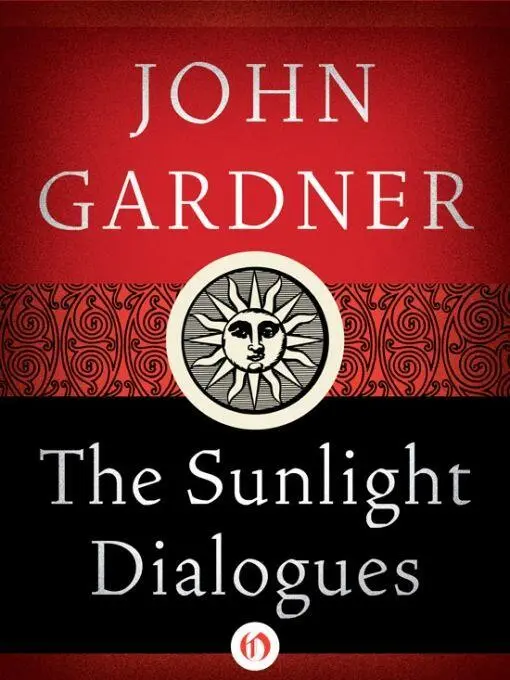
- Название:The Sunlight Dialogues
- Автор:
- Издательство:Open Road Media
- Жанр:
- Год:2010
- ISBN:нет данных
- Рейтинг книги:4 / 5. Голосов: 1
-
Избранное:Добавить в избранное
- Отзывы:
-
Ваша оценка:
The Sunlight Dialogues: краткое содержание, описание и аннотация
Предлагаем к чтению аннотацию, описание, краткое содержание или предисловие (зависит от того, что написал сам автор книги «The Sunlight Dialogues»). Если вы не нашли необходимую информацию о книге — напишите в комментариях, мы постараемся отыскать её.
Beautifully expansive and imbued with exceptional social insight,
is John Gardner’s most ambitious work andestablished him as one of the most important fiction writers in post — World War II America.
The Sunlight Dialogues — читать онлайн бесплатно полную книгу (весь текст) целиком
Ниже представлен текст книги, разбитый по страницам. Система сохранения места последней прочитанной страницы, позволяет с удобством читать онлайн бесплатно книгу «The Sunlight Dialogues», без необходимости каждый раз заново искать на чём Вы остановились. Поставьте закладку, и сможете в любой момент перейти на страницу, на которой закончили чтение.
Интервал:
Закладка:
Clumly came down the steps, glancing left and right. He came hurrying, bent forward at the waist, but he did not go around the side to the garage but continued walking, out to the Main Street sidewalk and then to the left, toward the center of town. It must be after eleven by now. Hodge watched him hurrying along, bent and suspicious, and not until he was nearly out of sight — beyond the darkened theater marquee, and beyond the blue light that fell across the sidewalk from the clock in Brenner’s Jewelry Store window — did Hodge start up his car. He pulled over again and switched off the headlights in front of Fargo’s Dairy Bar, dark except for the night-light. Clumly hurried on, his head down, his mind far, far away. Hodge started up the car again, then realized that the old man was turning toward the Presbyterian church. He switched off the ignition.
“We’ll walk it from here,” he said.
Sadly, Freeman shook his head.
“You can stay, you understand,” Hodge said.
“I’ll come,” the young man said. “Shoot.”
They started out. When they reached the corner Clumly was standing on the church steps, smoking his cigar. Hodge stepped back out of sight, drawing Freeman with him. Again, sadly, Freeman shook his head. When Hodge peeked around the corner, Clumly had vanished.
“He went in,” Freeman said.
“How you know?”
Freeman shrugged, infinitely sad.
Hodge nodded grimly and murmured, “Let’s go.”
And so they sat in the muggy darkness, peeking down out of the balcony, squinting unbelieving as spectators at a witches’ dance. Will Hodge sucked deep for air, as Paxton had done fifteen years ago and, like Paxton, could not get it. “They’re both stark raving mad,” he whispered. The boy’s face was frozen to a wince. Again Hodge sucked for air, but he was drowning. The church walls rang with Taggert’s voice as they would to a tolling of bells. Hodge had been grief-stricken enough at sight of the police photograph, but that had been, all the same, abstract. He had not recalled until this moment, his brother’s rich voice ringing sweetly and terribly in the darkness of the church, the unbearable pain of love. So, once, like Paxton, he had sucked for air in his bedroom, in the darkness, looking out on the brightly moonlit lawn where under the walnut trees Millie stood naked and beautiful and the boy he had hired three weeks ago, Raymond, stood six feet away from her, naked, erected, advancing slowly, like a dancer (a boy he too had known from the start to be gentle and wise in a boy’s way, graceful, not eager to cause him pain: whom Hodge had for three weeks watched her seducing, gently, gently, or he’d watched the boy seducing her — for who could say where the blame belonged, since each of them was playing the game by rules not clearly understood, playing it toward an outcome neither of them anticipated except in secret, an end they no doubt imagined would never come, not in life, could come only in books: so that only he, Will Hodge, had known the whole deadly process with certainty, by the knotting of his belly, and he’d done nothing, hadn’t known what to do — had barked “Millie!” once when she overleaped all the bounds of decorum (but overleaped only in play of course, play) — and had once said, “Millie, stop teasing that boy,” but she’d said, “Why not? Good God, I’m old enough to be his mother!” which wasn’t true, strictly, and he’d said so and had been made a fool of, as usual, because she was wrong by only—“Bald-headed Jesus!” she said—“three years!”—had had no choice but to do nothing because if he tried the only thing possible, an appeal to tradition, common decency, shame, it would make him appear just the stodgy fool he was: it was only play). When Raymond went to the movies after work — set off with some pretty, harmless girl from some neighbor’s farm — Millie would say lightly, “Give us a hug good-bye, Ray,” and laughing, playing, he would hug her, then he would come over blushing and would soberly, fondly, grip Will Hodge’s hand. Hodge stood at the window, his stomach gone lead, his chest so light he felt he was falling endlessly, and he knew himself helpless and moreover guilty and foul. He could shoot them, he thought ruefully, and he would have smiled if it weren’t for the pain at his heart. And wondered if there were really men so stupid and vicious as to shoot their unfaithful wives and their wives’ lovers. He understood that he hated them both fiercely, and fiercely loved them. He was overcome with sobbing. They clung to each other — Hodge stood watching the blurred white image — and then, gently, gently, went down on the grass.
He said nothing, afterward. She grew more loving and tender than before and he thought that it had been good for her, his own puritanical ideas were wrong and pernicious. Sometimes, after that, she would go walking with Raymond, or would ride into town with Raymond when he went for feed. Hodge walked gingerly, whenever they were gone, and was sick with jealousy and grief, and watched the clock. At supper Millie and Raymond would joke, their quick wits leaping, their eyes bright as stars, and Hodge would feel dizzy with love and joy that would fall away later like a stone down a well when he awakened in the middle of the night and found her gone. When he heard them talking in the kitchen he would creep up on them, heart hammering, convinced that they were doing it again. They never were. When he questioned her, as cautiously as possible, she was evasive, sometimes smiled. He had done nothing, could find no purpose, no justification except his pain, which perhaps was self-pity. He would close his fists on the pillow, full of tears.
Taggert seemed to explode. Something darted backwards. There was red light and smoke and then nothing, only poor old Clumly staggering to his feet and groping forward toward where the flash had been, Freeman leaning, far far forward, trying to make out where Taggert had gone; but he’d vanished. Clumly was at the pulpit now, moaning his outrage.
“Jesus,” Freeman said. “What do we do?”
“I don’t know,” Hodge said. It was not sufficient, he understood. It was what he’d been saying all his life — what he’d said when Taggert was first beginning to dip into the till, what he’d said with Millie, with Luke, with Will Jr, with Ben, with Mary Lou’s husband. One had to act, for better or worse, act. But act against whom? A pitiful policeman gone crazy? His own mad brother? “Well keep watching,” he said. Conviction flared up. “We’ll follow him.” Taggert would leave soon, yes; flee to some retreat. When he was gone, out of danger, they would go to the police, reveal the whole thing, put Clumly away where he belonged and bring Taggert back when the men at the police station were calmer, less likely to shoot and ask questions later.
Like an old Egyptian priest, Clumly came slowly down the aisle toward them, carrying a black box. Hodge ducked down and drew Freeman after him.
“That’s it,” Hodge said, knowing he was dangerously wrong, as usual, “we’ll keep an eye on him.” They heard the door open, below, then close. Hodge stood up. Freeman, almost invisible in his black hat and coat, went on sitting. “Are you coming?” Hodge whispered.
After a time Freeman said, “No. I’ll stay.”
“Why?” Hodge whispered. He realized that they were alone and said it aloud. “Why?”
Above the pulpit hung a cloud of dead gray smoke. The pale light of streetlamps shining through the stained-glass windows along the side wall threw shadows over the room. Nothing stirred. It was as if time had ended, and the world were not motion after all but an engine broken down.
“Don’t you believe in omens?” Freeman said.
“You were listening,” Hodge said. “You were watching when I talked to that fireman.”
Читать дальшеИнтервал:
Закладка:
Похожие книги на «The Sunlight Dialogues»
Представляем Вашему вниманию похожие книги на «The Sunlight Dialogues» списком для выбора. Мы отобрали схожую по названию и смыслу литературу в надежде предоставить читателям больше вариантов отыскать новые, интересные, ещё непрочитанные произведения.



Обсуждение, отзывы о книге «The Sunlight Dialogues» и просто собственные мнения читателей. Оставьте ваши комментарии, напишите, что Вы думаете о произведении, его смысле или главных героях. Укажите что конкретно понравилось, а что нет, и почему Вы так считаете.