Clarice Lispector - Selected Cronicas
Здесь есть возможность читать онлайн «Clarice Lispector - Selected Cronicas» весь текст электронной книги совершенно бесплатно (целиком полную версию без сокращений). В некоторых случаях можно слушать аудио, скачать через торрент в формате fb2 и присутствует краткое содержание. Год выпуска: 1996, Издательство: New Directions, Жанр: Современная проза, на английском языке. Описание произведения, (предисловие) а так же отзывы посетителей доступны на портале библиотеки ЛибКат.
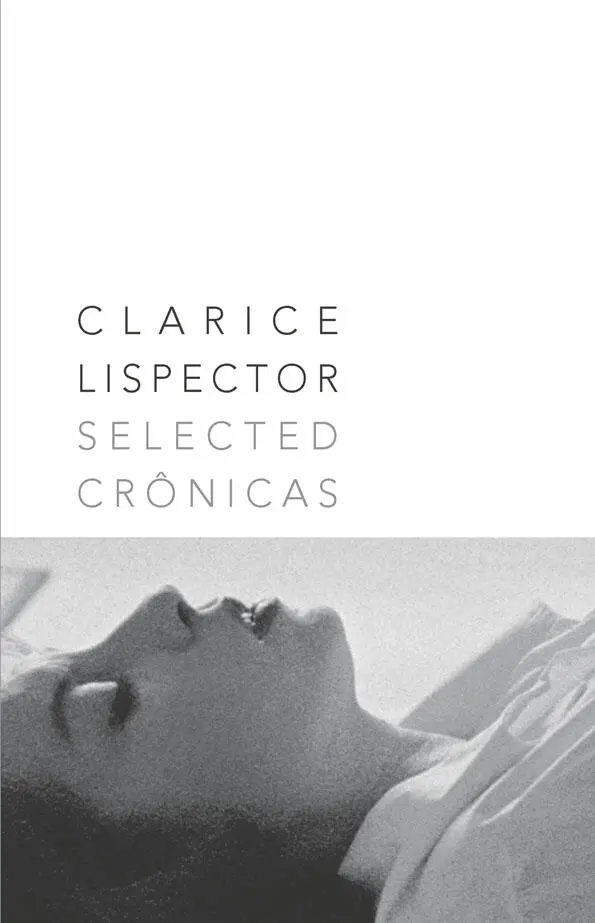
- Название:Selected Cronicas
- Автор:
- Издательство:New Directions
- Жанр:
- Год:1996
- ISBN:нет данных
- Рейтинг книги:4 / 5. Голосов: 1
-
Избранное:Добавить в избранное
- Отзывы:
-
Ваша оценка:
Selected Cronicas: краткое содержание, описание и аннотация
Предлагаем к чтению аннотацию, описание, краткое содержание или предисловие (зависит от того, что написал сам автор книги «Selected Cronicas»). Если вы не нашли необходимую информацию о книге — напишите в комментариях, мы постараемся отыскать её.
, is just as immediately stimulating today and ably reinforces her reputation as one of Brazil's greatest writers. Indeed, these columns should establish her as being among the era's most brilliant essayists. She is masterful, even reminiscent of Montaigne, in her ability to spin the mundane events of life into moments of clarity that reveal greater truths." —
Selected Cronicas — читать онлайн бесплатно полную книгу (весь текст) целиком
Ниже представлен текст книги, разбитый по страницам. Система сохранения места последней прочитанной страницы, позволяет с удобством читать онлайн бесплатно книгу «Selected Cronicas», без необходимости каждый раз заново искать на чём Вы остановились. Поставьте закладку, и сможете в любой момент перейти на страницу, на которой закончили чтение.
Интервал:
Закладка:
Before falling asleep, lying in bed in the dark. Through the window, on the white wall: the huge, swaying shadows of the branches, looking as if they belonged to.some enormous tree which did not actually exist in the patio. All that grew there was a straggly shrub: or perhaps it was the moon’s shadow. Sunday was always that immense, contemplative night which gave existence to all future Sundays and produced cargo ships and oily waters and produced a milky drink with froth and the moon and the gigantic shadow of a tiny fragile tree. Just like me.
MOTHER’S DAY. A PIOUS INVENTION
Location — Refuge for Abandoned Children; an old building in colonial style; innumerable pavilions with spacious rooms; high ceilings; barred windows.
Number of Children — Six hundred.
Age of Children — Varied.
History — Founded around 1778.
Founder — A Portuguese millionaire who owned the mansion and felt something must be done to rescue abandoned children.
Aims of the Refuge — To house, educate and bring up orphans or children abandoned by their parents.
Director — Sister Isabel, a nun of the Order of St Vincent: white habit; medium height; plump, smiling, imaginative, energetic and loquacious; an expressive face which becomes solemn when she is worried; she moves briskly and with remarkable agility in her white habit, which is always immaculate; a born leader; in no sense conventional; a lively creature who finds a ready solution to every problem. To all appearances oblivious of her own intelligence, she is open and spontaneous: she believes nothing is impossible and once she has made up her mind she acts without a moment’s hesitation. She never shrinks from hard work.
The Facts — Sister Isabel has just been appointed Sister Superior of the Refuge for Abandoned Children, in other words, the Director. She is gradually finding her way around the Refuge. There are six hundred files to be read, one for each child. She notices that in the majority of cases, the parents of the children are unknown. An average file reads: Joāo de Deus, born the tenth of December, 1965. Place of birth: State of Guanabara. Colour: black. Parentage: none. There is a blank space. She is gradually getting to know the children, one by one. Most of them ask her: Who is my mummy? To conceal her embarrassment, Sister Isabel changes the subject. But the children are insistent: Who is my mummy? Sister Isabel thinks hard. Much distressed, she searches for some impossible solution. For hours she stands lost in thought before that enormous filing cabinet, biting her lips.
Result — She reaches a decision. She goes through the cards one by one, undeterred by the fact that there are six hundred of them to be read. And wherever there is an empty space after the word Parentage she invents a mother for every parentless child. She writes in over and over again names like Maria, Ana, Virginia, Helena, Maddalena, Sofia, etc.
Conclusion — She sends for each child without parents and informs them: Your mummy’s name is Maria, or Ana, or Sofia, etc. The children are overjoyed: now they all have a mother and they are so happy that they do not even mind if she never comes to see them. Sister Isabel always finds some excuse to explain why their mother cannot be with them. A pure invention, those mothers are a fiction and non-existent. They only exist on paper yet they are somehow alive, caring and affectionate.
Finale — Here my story ends and there is nothing more to tell you.
WORDS FROM THE TYPEWRITER
I feel I have almost achieved my freedom. To the point of no longer needing to write. If I could, I would leave my space on this page blank: filled with the greatest silence. And readers, on seeing this blank space, would fill it with their own desires.
To be frank, this can scarcely be called a column. It is simply what it is. It does not correspond to any genre. Genre no longer interests me. What interests me is mystery. Is there some ritual attached to mystery? I believe there is. In order to adhere to the certainty of things. Meanwhile, I somehow already adhere to the earth. I am a daughter of nature: I want to hold things, feel them, touch them, I want to exist. And all this is part of a totality, of a mystery. I am but one being. Before there was a difference between the writer and me (or am I wrong? I cannot be certain). But no longer. I am but one being. And I leave you to be yourself. Does that frighten you? I believe it does. But it is worthwhile. Even if it hurts. For the pain soon passes.
And now I want to tell you about certain realities which leave me astonished. These refer to animals.
An acquaintance once told me that when you catch a crab by a claw, the claw comes away so that its body can escape. And a new claw soon grows to replace the one which has been discarded.
Another acquaintance was once staying with friends and she opened the fridge to get some iced water.
She saw something strange inside.
It was something white, stark white. Headless but breathing. Like a lung. Moving up and down, up and down. My friend got the fright of her life and slammed the door shut. And she stood there, paralysed, her heart pounding.
Then she discovered what it was. Her host was an experienced deep-sea diver. And he had caught a turtle. After removing its shell, he had cut the head off and put the turtle in the fridge, with the intention of cooking and eating it next day.
But until it was cooked, that headless, denuded turtle was in there wheezing away like bellows.
I have already written about turtles. I wrote the following: ‘I have little or nothing to say about the sluggish turtle with that rock-hard shell on its back, covered in dust. This dinosaur which dates from the Tertiary Period is of no interest to me (when I called it a dinosaur , I did not know that I was right. I was merely guessing). I find the turtle exceedingly stupid. It does not relate to anything, not even to itself. It is an abstraction. Sexual contact between two turtles must be devoid of any warmth or life. And while I am no scientist, I can confidently predict that the species will disappear within the next few thousand years.’
I forgot to add that I find the turtle completely immoral.
An acquaintance of mine, suspecting that my lack of interest in turtles was insincere, loaned me a little book about them which was written in English. Here is an extract I have copied out:
‘The turtle is any land or marine chelonian which is descended from a rare and ancient species of reptile. Its ancestors appeared for the first time two hundred thousand years ago, long before dinosaurs. While these large animals became extinct a long time ago, the turtle with its strange and ugly appearance, managed to survive and has remained relatively unchanged for at least the last one hundred and fifty thousand years.’
Without its shell, headless, and panting up and down. Alive.
How can one comprehend a turtle? How can one comprehend God?
The point of departure must surely be: ‘I do not know’. Which means total surrender.
My typewriter carries on typing. It types out the following: Anyone who achieves a high level of abstraction has reached the frontiers of madness. Perhaps those great mathematicians and physicians might be able to confirm this. I know a great man who is very abstract but acts as if he were just like everyone else: he eats, drinks, sleeps with his wife and has children. In this way he prevents himself from turning into an X or a square root. When I recall that as a girl I used to give private tuition in Mathematics and Portuguese to other children, I can scarcely believe it. Because now I could not work out a square root to save myself. As for Portuguese, I used to get terribly bored explaining rules of grammar. Fortunately for me, I eventually.
Читать дальшеИнтервал:
Закладка:
Похожие книги на «Selected Cronicas»
Представляем Вашему вниманию похожие книги на «Selected Cronicas» списком для выбора. Мы отобрали схожую по названию и смыслу литературу в надежде предоставить читателям больше вариантов отыскать новые, интересные, ещё непрочитанные произведения.




Обсуждение, отзывы о книге «Selected Cronicas» и просто собственные мнения читателей. Оставьте ваши комментарии, напишите, что Вы думаете о произведении, его смысле или главных героях. Укажите что конкретно понравилось, а что нет, и почему Вы так считаете.