Miljenko Jergovic - The Walnut Mansion
Здесь есть возможность читать онлайн «Miljenko Jergovic - The Walnut Mansion» весь текст электронной книги совершенно бесплатно (целиком полную версию без сокращений). В некоторых случаях можно слушать аудио, скачать через торрент в формате fb2 и присутствует краткое содержание. Год выпуска: 2015, Издательство: Yale University Press, Жанр: Современная проза, на английском языке. Описание произведения, (предисловие) а так же отзывы посетителей доступны на портале библиотеки ЛибКат.
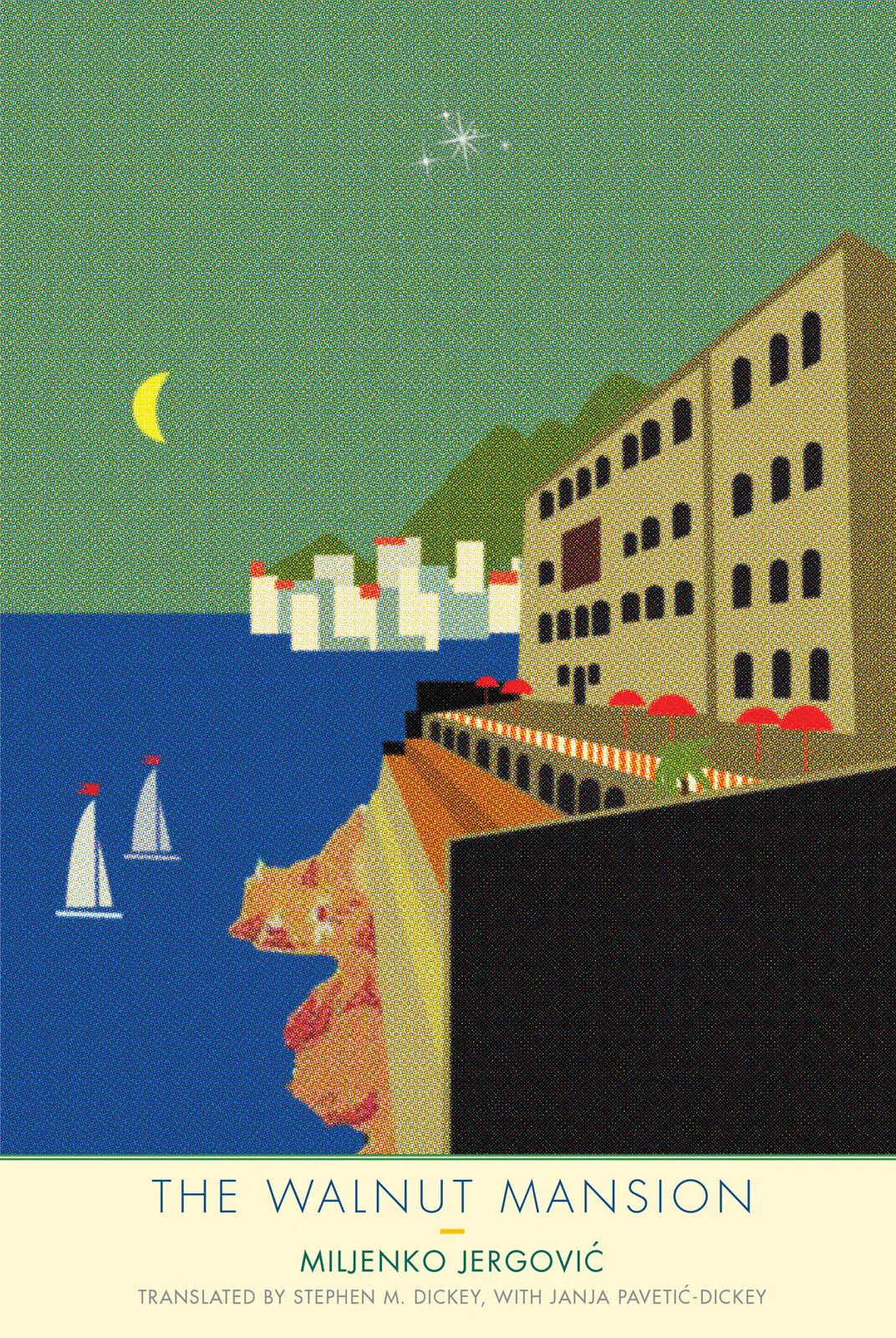
- Название:The Walnut Mansion
- Автор:
- Издательство:Yale University Press
- Жанр:
- Год:2015
- ISBN:нет данных
- Рейтинг книги:3 / 5. Голосов: 1
-
Избранное:Добавить в избранное
- Отзывы:
-
Ваша оценка:
The Walnut Mansion: краткое содержание, описание и аннотация
Предлагаем к чтению аннотацию, описание, краткое содержание или предисловие (зависит от того, что написал сам автор книги «The Walnut Mansion»). Если вы не нашли необходимую информацию о книге — напишите в комментариях, мы постараемся отыскать её.
What is it to live a life whose circumstances are driven by history? Jergovic investigates the experiences of a compelling heroine, Regina Delavale, and her many family members and neighbors. Telling Regina’s story in reverse chronology, the author proceeds from her final days in 2002 to her birth in 1905, encountering along the way such traumas as atrocities committed by Nazi Ustashe Croats and the death of Tito. Lyrically written and unhesitatingly told,
may be read as an allegory of the tragedy of Yugoslavia’s tormented twentieth century.
The Walnut Mansion — читать онлайн бесплатно полную книгу (весь текст) целиком
Ниже представлен текст книги, разбитый по страницам. Система сохранения места последней прочитанной страницы, позволяет с удобством читать онлайн бесплатно книгу «The Walnut Mansion», без необходимости каждый раз заново искать на чём Вы остановились. Поставьте закладку, и сможете в любой момент перейти на страницу, на которой закончили чтение.
Интервал:
Закладка:
If all Jews had to disappear and that was the way of the world, what factors might make him, just one of many Jews, an exception to that general rule? Hoping for that was like hoping that the force of gravity wouldn’t apply to him alone. It was easy to walk on water when you were a Catholic saint and hundreds of millions of people believed that you were really walking on water, but how could he do the same thing without anyone believing in it? He could only regret that he’d been born into the sons of Abraham so late, right at the time when it was decided that they were no longer supposed to exist. Had every generation of his forefathers going back two thousand years ago married and reproduced just a month earlier, he would be living in happier times, in the seventeenth or eighteenth century or even earlier. He would have had his own little shop and synagogue and would have died like a man. From the plague, cholera, or syphilis, without suffering on account of something for which he wasn’t to blame and wasn’t responsible.
Klein’s Jewishness, like every other group membership, was for him an unsolvable mathematical problem. There were probably people who’d figured out what it meant to be a Jew, a Catholic, a Muslim, or a Buddhist. Those were people who deserved an A-plus in arithmetic. They knew how to calculate differences in weight, height, and the depth of air. But Klein was a bad mathematician in those areas. If Jewishness was something that could be measured in register tones or monetary units, he wouldn’t have had a hard time with it and certainly wouldn’t have ended up in the attic of the Banja Luka prep school. True, he celebrated Hanukkah and Passover. But was that really a reason why he and the whole tribe of Abraham had to disappear from the face of the earth? He drank alcohol, worked on the Sabbath, and didn’t give alms to poor Jews, and now God was punishing him. But why was he punishing him along with those who hadn’t sinned against a single earthly or heavenly rule?
He couldn’t figure any of it out, but during the night of fasting that the janitor had imposed on him, Klein nevertheless came to an important conclusion. Of the two worries, his and that of his feeder, the second was more powerful, and he should try to accommodate it. Jumping off the roof and thereby causing harm to Franjo was out of the question. His conscience started bothering him and he felt guilty. The less a person’s circumstances offer him opportunities to be guilty, the stronger his feelings of guilt.
He could hardly wait for the next morning, the time when Franjo came for the potty. Franjo came in frowning, angry.
“I’ve got something to tell you,” he said and grabbed Franjo by the sleeve, but he pulled away. “I’ve got something to tell you,” he insisted. “Please, sit down!”
The janitor sat down on the ottoman, holding the chamber pot with Klein’s stool on his lap, as if it were a ceremonial chalice that he was going to present to the winners of the European Czech Handball championship. But the frown didn’t leave his face. Klein thought about telling him to put the potty down so the stench wouldn’t bother both of them. But he was afraid that this might anger Franjo and that he would leave again, and then he would have to wait until evening. So he decided not to pay attention to the shit for now.
“Forgive me; my nerves have given out. I won’t do what a chicken or a goat wouldn’t do,” he said.
“Are you messing with me?” Franjo asked him in an icy tone. He didn’t like his mentioning animals.
“I made a mistake,” Klein said.
“You made more than a mistake. You stuck a knife in my heart!” Franjo said more cheerily and raised the ceremonial chalice as if he wanted to emphasize his words.
From that morning onward there were no more misunderstandings of that kind between the two men. Klein no longer mentioned the contact who was to transfer him to Italian territory, and Franjo would only occasionally, once or twice a week, confirm that they weren’t coming and that it was bad that they weren’t coming. Just as it was bad when there was an unexpected snowfall or when it was cloudy when it was supposed to be sunny. He brought him food and water and took away his stools and urine. Klein lived to the rhythm of the sunrise and sunset, as the holy books of all monotheistic religions prescribe and how people had lived in distant times when they followed the changes of the day and the seasons. And so Klein lived like a chicken.
During the day he would sit on the ottoman, shifting from buttock to buttock, doze, and wait for the chickens to hatch, and at night he would sleep or go searching around the attic in the complete darkness for something that might give him a little bit of entertainment. By groping around, he recognized old school registers for the lower and higher grades of the prep school and placed them by the ottoman so that he would have something to read the next day. He had laid off the newspapers for a while, realizing that they made him more sick. And he’d already grown tired of the globe. He knew every state, city, and mountain by heart. And he’d studied the map of the Austro-Hungarian Empire so thoroughly that there wasn’t a single hamlet from Bratislava to Višegrad that he hadn’t visited in his fantasies.
After he learned everything there was to learn about places, he started studying people. Long-gone prep school pupils were lined up one after the other. Klein followed them from year to year, and from their grades he arrived at conclusions about their mental crises and loves, about their temperaments and characters, and about what had happened to those people after they had graduated. Could one conclude from the fact that someone had had a hard time with Latin in the first grade of prep school that he ended up a murderer? Or was it the straight-A students who became murderers? He developed a system of reading fates from school grades, according to which the consistent pupils — those who passed from start to finish with an “A” or a “C” (it didn’t matter which) — became people who would turn up any time a state needed anything done. But the pupils whose grades varied would become defenders of justice who wouldn’t acquiesce in a single crime. During the day he categorized them, and at night he assessed the previous day according to the results of his statistics. If the inconsistent pupils predominated, those who hadn’t become murderers or accessories to murder, the day was a good one. But if the straight-A students and lowlifes took the lead, then the day was assessed as bad. Klein played and remembered: all the countries, cities, mountain peaks, villages, rivers, streams, and all the pupils of the Banja Luka prep school from its foundation to 1934, the year of the last register. He wouldn’t forget a single name until his death in 1967 in Haifa, just as he wouldn’t forget any of hundreds of thousands of other, equally pointless, pieces of information that he’d collected in his head. Samuel F. Klein was one of those people whose miraculous and peculiar memory was the wonder of all who knew him, but he gained no benefit from it because it absorbed only useless things and classified them in a still more useless fashion. He was incapable of remembering three telephone numbers, but he memorized the school grades of people about whom he knew nothing else. He would forget the names of his own ships but not the names of all the little rivers and streams that flow into the Drina.
Maybe this was how he remembered the name of Ivo’s wife and recognized it in the contessa Regina Della Valle in her letter of 1951.
And so spring arrived in the alternation between the same morning and evening rituals, without anyone coming for Klein. He was sure that Franjo knew what was going on and why the contact had never showed up but wasn’t telling him so as not to upset him. However, the janitor didn’t know any more than the one he served. The letter that Husnija Hadžalić had given him along with Klein said to wait. Panther, the contact, was supposed to come in seven days at the latest. If he didn’t come by that time, he should keep waiting and taking care of the friend whom he’d entrusted to him. But Panther didn’t contact them, nor did he ever come, and Franjo didn’t ever see him in town. Before he had run into him every other day, if not on the street, then in those two or three city bars where people played dice. On account of their conspiracy Panther acted as if he didn’t know him, though over the course of six months he’d brought him fourteen men and one woman, some of whom were Jews from Sarajevo or Travnik and some of whom were communists. He always gave him money for the hotel in the attic, and Franjo would have enough left over for his own expenses.
Читать дальшеИнтервал:
Закладка:
Похожие книги на «The Walnut Mansion»
Представляем Вашему вниманию похожие книги на «The Walnut Mansion» списком для выбора. Мы отобрали схожую по названию и смыслу литературу в надежде предоставить читателям больше вариантов отыскать новые, интересные, ещё непрочитанные произведения.










Обсуждение, отзывы о книге «The Walnut Mansion» и просто собственные мнения читателей. Оставьте ваши комментарии, напишите, что Вы думаете о произведении, его смысле или главных героях. Укажите что конкретно понравилось, а что нет, и почему Вы так считаете.