Miljenko Jergovic - The Walnut Mansion
Здесь есть возможность читать онлайн «Miljenko Jergovic - The Walnut Mansion» весь текст электронной книги совершенно бесплатно (целиком полную версию без сокращений). В некоторых случаях можно слушать аудио, скачать через торрент в формате fb2 и присутствует краткое содержание. Год выпуска: 2015, Издательство: Yale University Press, Жанр: Современная проза, на английском языке. Описание произведения, (предисловие) а так же отзывы посетителей доступны на портале библиотеки ЛибКат.
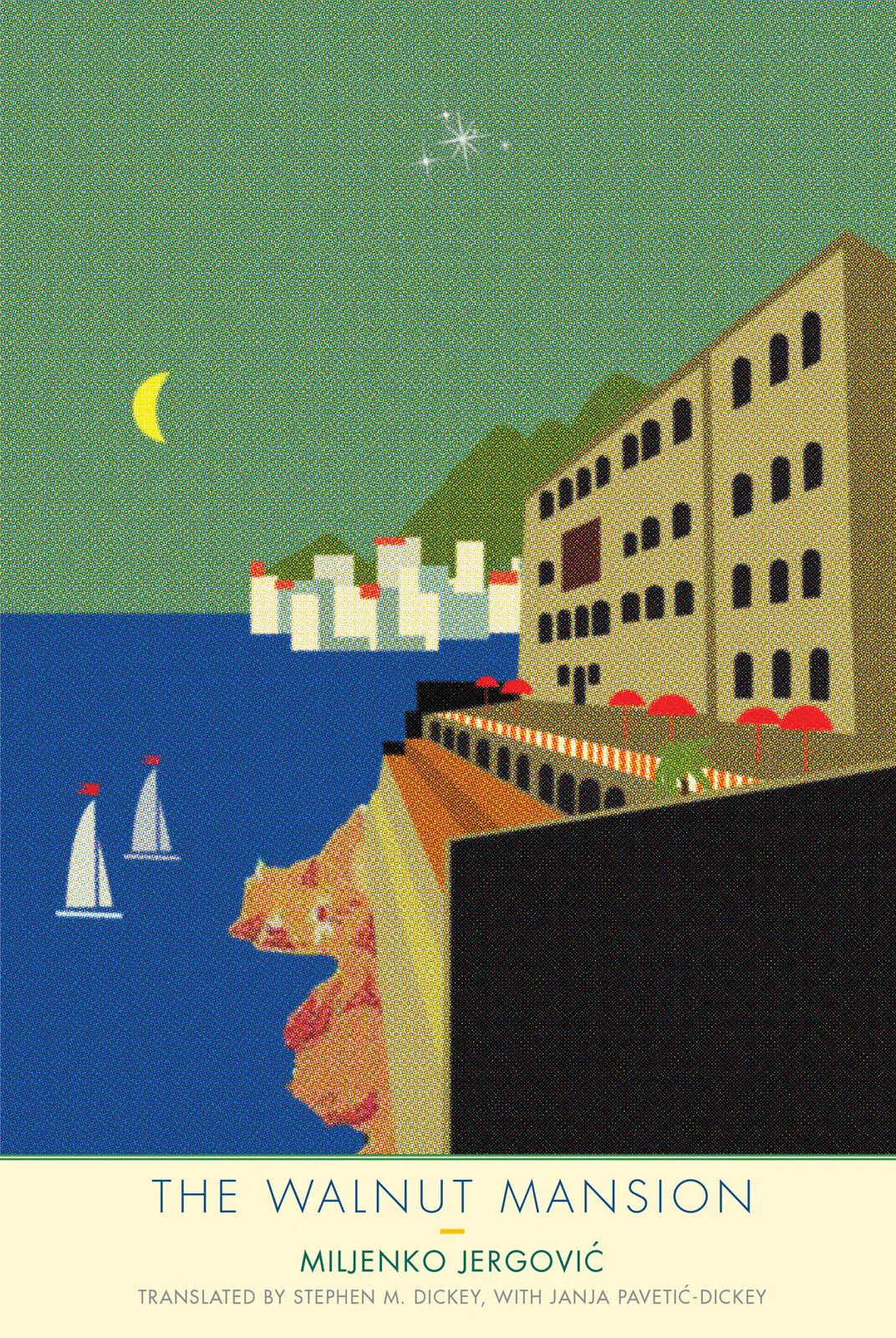
- Название:The Walnut Mansion
- Автор:
- Издательство:Yale University Press
- Жанр:
- Год:2015
- ISBN:нет данных
- Рейтинг книги:3 / 5. Голосов: 1
-
Избранное:Добавить в избранное
- Отзывы:
-
Ваша оценка:
The Walnut Mansion: краткое содержание, описание и аннотация
Предлагаем к чтению аннотацию, описание, краткое содержание или предисловие (зависит от того, что написал сам автор книги «The Walnut Mansion»). Если вы не нашли необходимую информацию о книге — напишите в комментариях, мы постараемся отыскать её.
What is it to live a life whose circumstances are driven by history? Jergovic investigates the experiences of a compelling heroine, Regina Delavale, and her many family members and neighbors. Telling Regina’s story in reverse chronology, the author proceeds from her final days in 2002 to her birth in 1905, encountering along the way such traumas as atrocities committed by Nazi Ustashe Croats and the death of Tito. Lyrically written and unhesitatingly told,
may be read as an allegory of the tragedy of Yugoslavia’s tormented twentieth century.
The Walnut Mansion — читать онлайн бесплатно полную книгу (весь текст) целиком
Ниже представлен текст книги, разбитый по страницам. Система сохранения места последней прочитанной страницы, позволяет с удобством читать онлайн бесплатно книгу «The Walnut Mansion», без необходимости каждый раз заново искать на чём Вы остановились. Поставьте закладку, и сможете в любой момент перейти на страницу, на которой закончили чтение.
Интервал:
Закладка:
“Well, this is going to be hard without ‘or rather.’ But let’s try. The three of them got together in that stable, and each one had a magic stone. Those were stones that looked like ordinary stones but weren’t ordinary because you could see through them like glass, but they weren’t glass but stones. Don’t ask anything else about the stones because I don’t know anything else myself. If I knew, I’d find one myself. You can do everything with one of those stones. You can decide how long the night will last, and how long the day will last, whether people will walk on their hands or on their legs, and whether houses will sprout up from their roofs or their foundations. Well, there was a problem because each one of those three men had one of the stones, and they had to decide how things were going to be. It wouldn’t work if one of them decided the day would be sixteen hours long and the other decided it would be only five hours long and the third one said there wouldn’t be any day at all. People had to know how things were going to be and what to expect,” he explained.
Dijana frowned. She didn’t understand why one of the uncles would want the day to last sixteen hours and the other for it to last only five hours. “But were their magic stones exactly the same?” she asked.
“I have to say that they were. Except they were slightly different colors, but everything else was just the same,” Luka said.
“And each was as powerful as the others?” she asked.
“Right! That was what was worst; all three stones were equally powerful. Well, the three of them sat down at that Yalta and didn’t come out for three days and three nights.”
“And how long did those three days and three nights last?” Dijana asked, whereupon he got confused. He didn’t know what to tell her: which one of the uncles had decided how long the days and nights in Yalta would be?
“That’s a very good question, a good question,” he said, trying to extricate himself, “but they shut themselves up in Yalta so they wouldn’t see when it was day and when it was night but just let the sun go up and go down whenever it wanted until the three stones made an agreement. And they decided that one of the stones would tell the other two, ‘You are the prettiest,’ and the other one would say, ‘You are the smartest,’ and the third would say, ‘You are the strongest.’ Since there were three of them and each one was going to say something to the other two, no one knew any more which one was the prettiest, the smartest, or the strongest. So they decided to divide the world up into three equal parts, and each would decide everything in its part. That’s why it’s nighttime in America when it’s day over here, and that’s why some people are rich and others are poor. Those three men agreed on all of it in Yalta,” he said, disappointed that his fable hadn’t come off.
It had simply slipped away from him at one moment and turned into something that he hadn’t wanted to tell her and didn’t understand himself.
“Did they decide in Yalta that mother would be angry and have it bad?” Dijana asked just when the tavern keeper appeared in the doorway.
He watched them with scorn in the corners of his mouth and nodded. “I know everything,” he said. “Now I understand everything! I understand everything!” he repeated and wiped unseen dust off the tables with a rag.
“Let’s go,” Luka whispered to Dijana.
“Just go; go and farewell!” the tavern keeper said, who’d caught Luka’s words; “you don’t even need to pay! Just don’t ever come back here again! It’ll be better for you, you old pig!”
They went toward their house in silence. Luka was ashamed because he hadn’t stood up to the man in front of the little girl, and she was happy that they’d gotten out of there. That man was certainly one of the three men in Yalta, she concluded. Uncle Luka just didn’t want to tell her that, and she wasn’t going to ask him, so he wouldn’t have to lie to her or he wouldn’t have to see what she saw — that Uncle Luka was afraid of that man. For all she cared, he could be afraid; they’d be afraid of the man together. Dijana would be more afraid, just so that Uncle Luka would have it easier. Luka was worried about what the tavern keeper might have heard about him since he came back like that. And who might he have heard it from? He wouldn’t get an answer, but he never went back to any of the taverns in Kuna with Dijana. He would remain like that until their last trip together.
That was the only bad thing that happened on Luka’s and Dijana’s adventures. Otherwise there was only tenderness and happiness, for him as much as for her. In those crazy years they were each other’s guardian angels. He’d saved her from Regina’s crazy obsession with that other Dijana. The girl had become the apogee of a lie, but she’d saved Luka from years of partisan revenge, love and hatred for Stalin, and everything else that might have cost him his head if he hadn’t played Robinson Crusoe, hadn’t had a guardian angel for his gambling, and hadn’t gone off with her to Kuna. They would have continued protecting one another if Dijana hadn’t gone off to school and Regina hadn’t decided at that time to take Dijana’s life into her own hands. As long as someone needed to feed and dress her, teach her her first words, and create images of a happy childhood for her, Regina had left her child in Luka’s care, but the moment the little girl had to go out among other children and thus find herself before the eyes of the city, Regina tore her out of her brother’s arms. It was enough that he wasn’t like ordinary people and that he was the shame of the family. She wasn’t going to let him shape and knead her daughter according to his own standards. And besides, what would a female Luka be like? A little whore that would smile at everyone and be everyone’s crazy entertainment and delight. Maybe a man could be like that, but thank you very much, a woman couldn’t! Especially not a woman from the Delavale line who already bore wickedness within herself.
After the first days of September in 1951 Regina never again let Dijana go play cards with her Uncle Luka or play Robinson Crusoe. It didn’t matter whether it was a weekday or Sunday; she forced her to sit next to the stove and study, in the same wooden chair in which she would grow old and which would burn up along with everything else in the wartime blaze in 1991. She told Luka not to interfere with her child and not to do any harm if he couldn’t be of any use. He pulled back, partly because he believed his older sister and partly because he didn’t think he could save anyone besides himself. Right until he fled to Italy, he watched calmly as Dijana’s mother raised her, barely saying anything and forgetting the promises that he’d made to her and about the secret brotherhood that he’d created with her. That was his only sin, but no one even remembered it.
Regina made inquiries about Diana Vichedemonni for another ten years after she’d buried the rusty can with the inscription Santos and the picture of a laughing black woman. She wrote the owners of the ships on which Ivo had sailed since the ’30s, asking them to please send the lists of sailors. She lied, saying that she was searching for her brother, with whom she was supposed to divide a great inheritance. She promised money if they found him, made up stories about Swiss bank accounts, signed her name as the Contessa Regina Della Valle, and went to Professor Svitić to have her letters translated into Italian, French, German, and English. She ordered a stamp with her name and monogrammed stationery, until she’d spent the family gold and sold all their vineyards on Pelješac. This obsession with an unknown woman, the only person who could extinguish the fire of Regina’s rage at life, was too expensive in every sense. Besides the family estate, the value of which was better expressed in memories than in the fluctuations in the price of gold on the world markets, Regina put everything else up for auction. What belonged to her and what didn’t. Diana Vichedemonni became her only thought, the center of the cosmos, a black sun in her heliocentric experience of the world. Everything that did and didn’t exist revolved around that name, around its own axis, and around Diana. No one would be able to escape the gravitational pull of that black sun, nor could anything that Regina heard, saw, sniffed, touched, or felt, no matter in which way. A whole half-century later the whole family would come flying apart because of Diana Vichedemonni, and a new chain of misfortunes would begin, in which Regina’s death would involve people who’d never had any prior connection to her. The heliocentric systems of misfortune repeated in cycles. They were the only living history, a history that didn’t die away but was passed from generation to generation and from age to age. They existed even hundreds of years later. Just as Hitler’s crimes were still alive for the wider world and caused suffering for children who were born after the collapse of the Third Reich, so for small worlds, familial microcosms, and romantic unions such small crimes, completely insignificant from the perspective of historiography, were eternal.
Читать дальшеИнтервал:
Закладка:
Похожие книги на «The Walnut Mansion»
Представляем Вашему вниманию похожие книги на «The Walnut Mansion» списком для выбора. Мы отобрали схожую по названию и смыслу литературу в надежде предоставить читателям больше вариантов отыскать новые, интересные, ещё непрочитанные произведения.








Обсуждение, отзывы о книге «The Walnut Mansion» и просто собственные мнения читателей. Оставьте ваши комментарии, напишите, что Вы думаете о произведении, его смысле или главных героях. Укажите что конкретно понравилось, а что нет, и почему Вы так считаете.