Miljenko Jergovic - The Walnut Mansion
Здесь есть возможность читать онлайн «Miljenko Jergovic - The Walnut Mansion» весь текст электронной книги совершенно бесплатно (целиком полную версию без сокращений). В некоторых случаях можно слушать аудио, скачать через торрент в формате fb2 и присутствует краткое содержание. Год выпуска: 2015, Издательство: Yale University Press, Жанр: Современная проза, на английском языке. Описание произведения, (предисловие) а так же отзывы посетителей доступны на портале библиотеки ЛибКат.
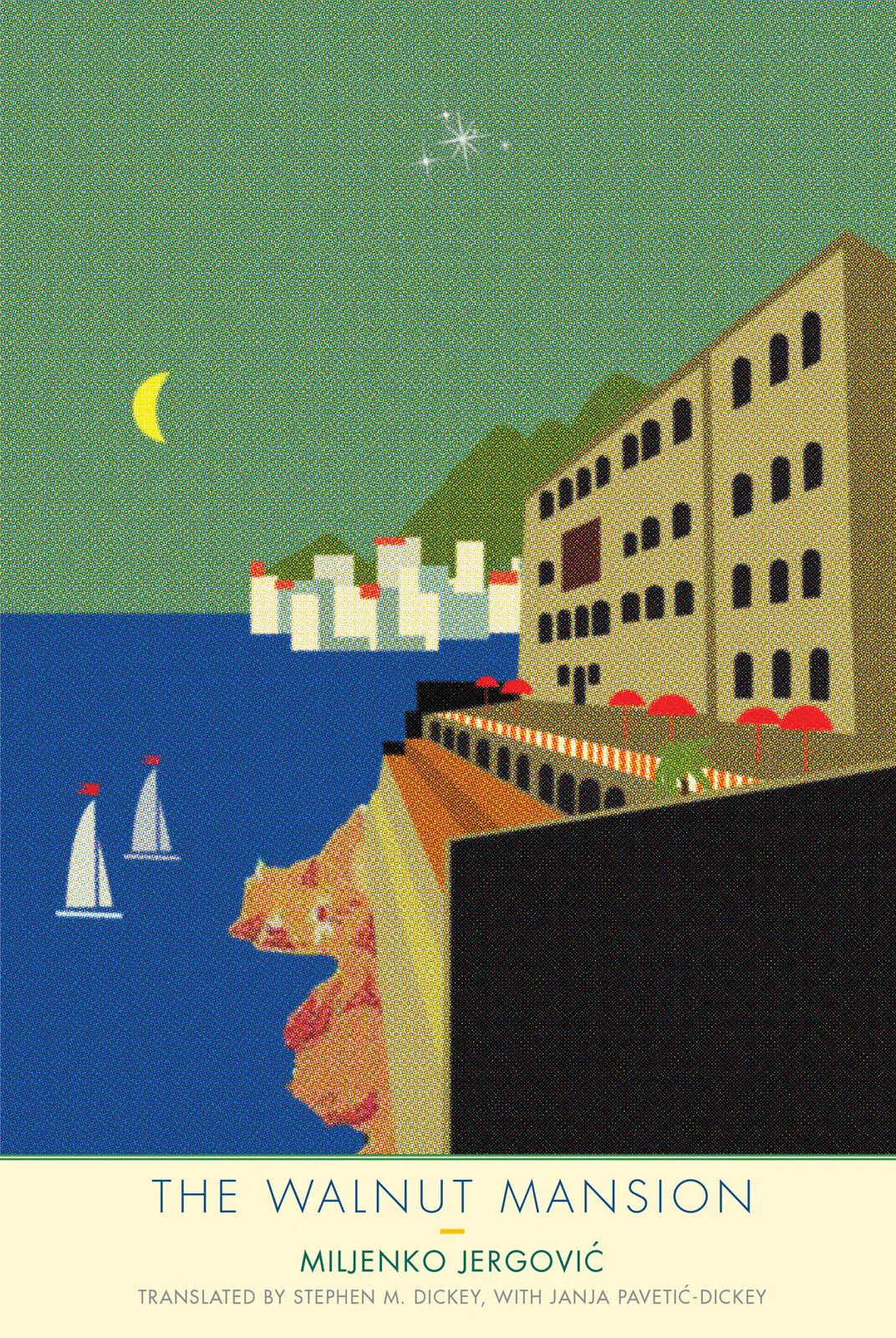
- Название:The Walnut Mansion
- Автор:
- Издательство:Yale University Press
- Жанр:
- Год:2015
- ISBN:нет данных
- Рейтинг книги:3 / 5. Голосов: 1
-
Избранное:Добавить в избранное
- Отзывы:
-
Ваша оценка:
The Walnut Mansion: краткое содержание, описание и аннотация
Предлагаем к чтению аннотацию, описание, краткое содержание или предисловие (зависит от того, что написал сам автор книги «The Walnut Mansion»). Если вы не нашли необходимую информацию о книге — напишите в комментариях, мы постараемся отыскать её.
What is it to live a life whose circumstances are driven by history? Jergovic investigates the experiences of a compelling heroine, Regina Delavale, and her many family members and neighbors. Telling Regina’s story in reverse chronology, the author proceeds from her final days in 2002 to her birth in 1905, encountering along the way such traumas as atrocities committed by Nazi Ustashe Croats and the death of Tito. Lyrically written and unhesitatingly told,
may be read as an allegory of the tragedy of Yugoslavia’s tormented twentieth century.
The Walnut Mansion — читать онлайн бесплатно полную книгу (весь текст) целиком
Ниже представлен текст книги, разбитый по страницам. Система сохранения места последней прочитанной страницы, позволяет с удобством читать онлайн бесплатно книгу «The Walnut Mansion», без необходимости каждый раз заново искать на чём Вы остановились. Поставьте закладку, и сможете в любой момент перейти на страницу, на которой закончили чтение.
Интервал:
Закладка:
Instead of turning on the radio, he began to turn over in his mind all the matches that he could remember between Hajduk and Red Star over a long period of thirty or so years, during which there had been a dozen generations of soccer players. They came and went; talented players were born only to collapse in the face of their initial success; the greatest players wore the number 9 or 10 on their jerseys, Jurica Jerković for Hajduk and Jovan Aćimović for Red Star. Then there were farewell matches, bouquets of roses, crystal and silver cups, tears and chants. Džajić, who was good at moving up along the left wing and the greatest player that Vid had seen in his life. The Hajduk goalie Mešković, who suffered from night-blindness and played poorly in nighttime matches. The finale of the Tito Cup, with the president’s emissaries in the VIP seats, tears of joy, the oldest player kissing the cup, the speaker repeating his words ten times — the most precious trophy, the second-string players who went into the game from the bench in the last ten minutes of the game — Mijač, Matković, Dramičanin, Boško Kajganić. .
Athletic careers are like human lives, with births and deaths, only they don’t last as long as life, so that a whole century fits into thirty years, and one can think about it while he’s driving like this through the night, on the empty roads alongside the Bosna and Vrbas Rivers, past little Bosnian villages, none of which have more than twenty or so houses and a mosque at the base of a hill. When he drove, he always had the same feeling, no matter what he was thinking about: the people who lived behind those windows built their houses at a safe distance from one another, so that they could breathe the same air and be friends to one another, and not as on the coast, where houses are piled up on top of one another, anyone can peer into his neighbors’ bedroom, and there’s no place except the sea where you can escape others’ eyes. This was why the Dalmatians were seafarers and it wasn’t hard for them to leave their towns and cities for years, leaving for Australia and New Zealand and never returning. Whereas the Bosnians stayed where they were; they didn’t change for centuries and provoked mild disdain in the eyes of others, sometimes even open hatred, because they were stupid and backward people who never saw the world and going twenty kilometers from their homes was too far — that is, going far enough to where they couldn’t see the roofs of their houses. They didn’t care whether they were in another district or on the other end of the world; all they ever wanted was to return home. They were happy because they were far enough away from one another.
Even in soccer stadiums they didn’t all cheer together but shouted out jeers to the opposing players individually, told jokes, mocked bowlegged forwards and a center half with a low forehead, but you always knew who said what, and for every word said a hundred years and a thousand matches ago, you knew whose it was and who’d said it first.
If he’d lived there, he wouldn’t have photographed crabs but hundreds of old slippers and worn-out shoes arranged on concrete landings in front of Bosnian houses. One would think that there are as many Bosnians as Chinese, but this is only because old shoes are never thrown out but are left out in front of the front door so they’ll be easy to find when one goes out into the yard or to the store across the street.
As his thoughts strayed from soccer players to Bosnians and the bluish lights in their windows, Vid Kraljev saw a policeman holding up an illuminated stop sign. He slowed down and pulled off onto the gravel shoulder of the road. Pardžik opened his eyes and didn’t know where he was. Vid rolled down the window, and the swarthy, mustached policeman bent down toward him, opened his mouth to say something, and then swallowed it.
“What happened?” Vid asked.
“Nothing, just please drive carefully,” the policeman said through his teeth as tears streamed down his cheeks.
“Yes, of course, it’s dark,” he answered confusedly, and they drove on.
“Everyone’s gone crazy today,” he said and looked at Pardžik, who gave a melancholy smile.
“He thought we know, but you see, we don’t know a thing. .”
“What are you talking about. .?”
“I’m not completely sure, my boy, but I think my last king and emperor has died.”
Only then did it hit Vid, and something shot through his knees. All these months he hadn’t had time to think about what would happen if Tito died, but he must have sensed, the way one does the night before a sirocco, that everyone was thinking about it.
“Oh, no, it can’t be!” he exclaimed with the sincerity of a housewife at market.
“You think it’s impossible? Of course, I thought the same when they killed King Aleksandar. I photographed the arrival of his dead body at the Split quay. And you know what I captured in my photographs? Fear! Nothing else. Only fear. People were crying but were actually only afraid, just as this policeman is afraid. He wanted us to help him; that’s what he really wanted. You should have gotten out of the car, hugged him, and said, ‘Hey, whiskers, everything’ll be okay!’ And then he’d tell you that he has a wife and three kids but that Tito means more to him than they do. And do you know what the strangest thing is? He really thinks that. He’d let his kids perish just so Tito would live. Only later would he realize that he hadn’t done it out of love but out of fear, and then he’d lose his mind. You see, that’s the way it is. And don’t say now, ‘Forget old Petar; he doesn’t know what he’s talking about,’ because I really do know about this. It’s been verified many times. People are strange and become savages easily. Yes, my young colleague, Tito has died, my last king! I’m not afraid; I’m just sad. And that’s because he’s my last. It’s an accident that he’s died and not me. That’s about the size of it, and it’s up to you to find your way. You’re young and you’ll live to see more such nights.”
Vid wanted to believe that what Pardžik said was just a continuation of the idiocy he’d displayed that morning, but it didn’t help. He turned on the radio. There was some somber music playing, filled with dark strings and the distant echoes of large theater drums. He changed the channel, but each was playing the same requiem. Only on one, through the crackling ebb and flow of electromagnetic waves that bounded across the mountains of Bosnia, did he hear a distant female voice babbling something in Italian.
“See, I was right,” said Petar Pardžik, and those were the last words uttered in the official white Volkswagen Golf of the Commission for Information of the Bosnian and Herzegovinian Central Committee.
Either the car hit a gasoline slick on the road or it spun out of control because of a pothole; it was never established because the police investigation was conducted very hastily, which was justified by the objective circumstances and the confusion on account of the death of Marshal Tito. To make a long story short, the Golf slid into the other lane, in which at that moment a bus was heading from Zenica to Teslić. The driver, Stipo Valjan, was unable to brake in time and struck the passenger’s side of the car; the bus pushed the Golf around twenty meters before it stopped. Stipo Valjan’s head smashed into the windshield, and for a minute or two he was unconscious. Then he got out, his head bleeding, all alone, because he wasn’t driving a single passenger. He’d asked the station chief whether he was going to cancel the buses and was told that at this moment it was most important for the buses to run normally and to be on time, as if it should be the holy duty of every working man and citizen to honor the memory of their greatest son. And how are memories honored? By honoring the deeds of great men for the living.
Читать дальшеИнтервал:
Закладка:
Похожие книги на «The Walnut Mansion»
Представляем Вашему вниманию похожие книги на «The Walnut Mansion» списком для выбора. Мы отобрали схожую по названию и смыслу литературу в надежде предоставить читателям больше вариантов отыскать новые, интересные, ещё непрочитанные произведения.





Обсуждение, отзывы о книге «The Walnut Mansion» и просто собственные мнения читателей. Оставьте ваши комментарии, напишите, что Вы думаете о произведении, его смысле или главных героях. Укажите что конкретно понравилось, а что нет, и почему Вы так считаете.