Andre Aciman - Eight White Nights
Здесь есть возможность читать онлайн «Andre Aciman - Eight White Nights» весь текст электронной книги совершенно бесплатно (целиком полную версию без сокращений). В некоторых случаях можно слушать аудио, скачать через торрент в формате fb2 и присутствует краткое содержание. Год выпуска: 2010, ISBN: 2010, Издательство: Farrar, Straus and Giroux, Жанр: Современная проза, на английском языке. Описание произведения, (предисловие) а так же отзывы посетителей доступны на портале библиотеки ЛибКат.
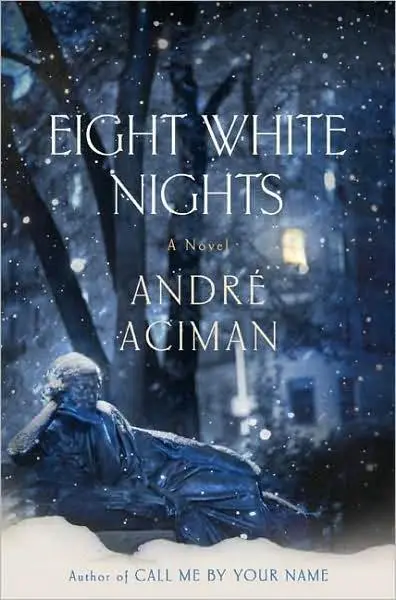
- Название:Eight White Nights
- Автор:
- Издательство:Farrar, Straus and Giroux
- Жанр:
- Год:2010
- ISBN:9780374228422
- Рейтинг книги:3 / 5. Голосов: 1
-
Избранное:Добавить в избранное
- Отзывы:
-
Ваша оценка:
Eight White Nights: краткое содержание, описание и аннотация
Предлагаем к чтению аннотацию, описание, краткое содержание или предисловие (зависит от того, что написал сам автор книги «Eight White Nights»). Если вы не нашли необходимую информацию о книге — напишите в комментариях, мы постараемся отыскать её.
Eight White Nights is an unforgettable journey through that enchanted terrain where passion and fear and the sheer craving to ask for love and to show love can forever alter who we are. A man in his late twenties goes to a large Christmas party in Manhattan where a woman introduces herself with three words: "I am Clara." Over the following seven days, they meet every evening at the same cinema. Overwhelmed yet cautious, he treads softly and won’t hazard a move. The tension between them builds gradually, marked by ambivalence, hope, and distrust. As André Aciman explores their emotions with uncompromising accuracy and sensuous prose, they move both closer together and farther apart, culminating on New Year's Eve in a final scene charged with magic and the promise of renewal. Call Me by Your Name, Aciman's debut novel, established him as one of the finest writers of our time, an expert at the most sultry depictions of longing and desire. As The Washington Post Book World wrote, "The beauty of Aciman’s writing and the purity of his passions should place this extraordinary first novel within the canon of great romantic love stories for everyone." Aciman’s piercing and romantic new novel is a brilliant performance from a master prose stylist.
Eight White Nights — читать онлайн бесплатно полную книгу (весь текст) целиком
Ниже представлен текст книги, разбитый по страницам. Система сохранения места последней прочитанной страницы, позволяет с удобством читать онлайн бесплатно книгу «Eight White Nights», без необходимости каждый раз заново искать на чём Вы остановились. Поставьте закладку, и сможете в любой момент перейти на страницу, на которой закончили чтение.
Интервал:
Закладка:
Was this her way of asking me not to go yet?
The question spoke so many good things.
It’s been a rather long day, I said. And I think I may be coming down with something. Bad, bad day.
He didn’t ask why. His reticence and the haste with which he wanted to return to what they were discussing told me she might have told him about my incident at Mount Sinai and he didn’t even want to pretend he wasn’t aware of it.
Nice work, Clara.
“Plus I really shouldn’t drink,” I added, remembering the young doctor’s recommendation.
“Stay a bit. You don’t have to drink.” It sounded very off-the-cuff, almost like a polite afterthought, but I knew that, with Clara, casual did not mean perfunctory. She was speaking in code. The informality was aimed at him, not me. She might have been pleading with me to stay. I, instead, chose to take her nonchalant tone to the letter. I was operating in bad faith, until I realized that the casual accent of her request might have been intended for me as well: she wanted me to stay, because it would look better if I did, but it made no difference — one way or another.
What I wanted all along became instantly clear to me as soon as I stood up to leave. I had expected her to change her mind and not order anything once she saw me stand and put my coat on. She’d leave with me, and I’d walk her home, as was our habit. The bakery. Straus Park. This time I’d ask to come upstairs even if she didn’t.
“I hope you feel better,” she said. She was pretending this was all about not feeling well and about catching up on sleep. I looked at her to mean, So you’re really not coming? “I think I’ll stay awhile and have another drink,” she said.
I shook his hand, and Clara and I kissed goodbye on both cheeks.
I’m never having anything to do with her again. Never seeing her again. Never, never, never.
This had been one of the worst days of my life. The worst, actually. It would take a few days, maybe another week, then I’d put the whole thing behind me. Or was I underestimating the damage? Give it a year, until next Christmas Eve — the soul holds its own anniversaries and all that. .
Instead of walking downtown, I walked up to Straus Park. No more, no more, no more, I thought. This is the last time I’m coming here. I remembered the candlelit statue filled with votive tapers standing upright, and the crystallized twigs, and the bleeding for love, and the walk to and from the cathedral as she drifted away from her friends and brought me to this quiet spot and, just as we were getting very, very close, said she wanted a strong, ice-burning shot of vodka. She’ll pass by, and each time she’ll think of me, and be with me, and one day, with her husband, when they stare out of her living-room window at the snow falling over the Hudson, she’ll break down and say, Sad is his voice that calls me, and she’ll turn old and wizened and nodding toward life’s close and be filled with gall and remembrance, telling the first beggar she’ll find in Straus Park, He loved me once in the days when I was fair.
This cruel and spectral city. Manattàn Noir. All of it was noir. The snow was just a screen, a lie — for it too was noir. Snow hurts because it deceives you. With gleaming asphalt you know you’re dealing with dark, hard stuff and beaten-down slate underneath and shards of glinting glass mixed in. Snow is like pith and like molten tar, except it’s soft on the outside, like velvet and bread, and the good things that yield as soon as you just touch them. But underneath, it’s black, blunt, and bituminous, and that’s how everything felt tonight. Black, blunt, and bituminous.
I stood around a moment, hoping she’d have second thoughts and come after me. But no one was coming this way. The area around Straus Park was deserted. Everyone was gone. The stranded Magi with their heads ablaze were gone, Phildonka Madamdasit was gone too, Rahoon and the beggar woman had probably come and gone. Just our shadows now, or just mine. Leopardi, the poet, was right. Life is bitterness and boredom, and the world is filth.
SEVENTH NIGHT
I hoped she’d ask one day, when none of this mattered, Why did you leave that night? Because I was angry. Because I grew to hate myself. Because I didn’t know what to do. I didn’t want to sit quietly and go on struggling with him, with you. I was losing you, and sitting in a bar watching the loss unfold before me unleashed more bitterness yet, because you seemed determined to speed up its course. I felt ridiculous, weak, ineffectual. I hated you, and I hated you for making me hate myself. I was pissed. Pissed that you never once let me catch my breath on those nights when all I did, it seemed, was watch the torrent of missed opportunities race past us. I blamed you for inhibiting impulses that had nothing wrong with them, then for holding these very same inhibitions against me. I blamed myself for thinking it was your fault. It was mine, always mine.
All I saw that night was the lightness with which you turned a new leaf and were letting yourself off ever so easily— see, one hand, one hand —while fate in the form of a jack-in-the-box waved a broomstick over my head. Yes, we could have gone somewhere with this, but see, we all change. You made me find solace in self-pity. I could never forgive this.
I’d thought of waiting for you inside the park. I was even tempted to send you a text message and say something either funny or obscene about Monsieur VFC, or so cruel that it would burn all bridges between us if I hadn’t already burned them at the bar. But you’d pick up your phone and, on the pretext of not wearing glasses, hand it to VFC, ask him who the caller was, then grab it from his hand and shove it back into your coat pocket. Printz!
I stood in a pool of white light trying to feel enchanted and cleansed as I’d felt on my first night here. But it didn’t work. I recited more verses by Leopardi to myself, squeezing out some comfort, knowing that if no solace came, then beauty might come in its place, and that beauty on this most sullen noir night in December would be good enough. But nothing came. Then I saw a yellow cab. I hailed it, got in, and was welcomed by the comforting warmth of old upholstery, and the vague acrid smell of curry and cumin. I was in a noir, black-and-white world, and I wasn’t being let out of it.
No sooner in the cab, though, than I asked the driver to take me to Riverside and 112th Street. He’d have to go all the way down to 104th Street, he said, then turn around and head uptown. Did I mind? No, I didn’t mind. All I wanted was to return to the spot where I’d stepped off the bus and gotten lost on the night of the snowstorm. The blizzard had lasted all through the party and hadn’t quite cleared when she walked outside with me hours later. Now I was going back to where things seemed safe no matter how clueless my steps that night. Just me and two silly bottles walking up the stairs by the statue of Samuel J. Tilden.
As the cab passed by her building, I looked up at her window to see if she might be home already. But the car came too close, and it was impossible to look up.
I got off right at the spot where I’d seen the St. Bernard. Or had I imagined the dog while thinking of medieval Weihnachten towns that turn dark and gray and then empty faster than the last grocer can pull down his roller shutters in the winters of pandangst? Who walks alone in the dead of night in Saint-Rémy but madmen and seers and those longing for otherpeoples?
Longing for others. What a concept!
I walked east on 112th Street, aiming for Broadway, but enjoying the suspense, because I knew where I was headed but didn’t quite want to admit it yet. This, by the way, is what I’d do in two days if I decided to go to Hans’s New Year’s party: walk up toward the cathedral, turn right on Broadway, walk down another six blocks, and finally turn right on 106th. Is this what I was planning to do tonight as well? Or was all this a roundabout ploy to pass by her building or, better yet, run into her as she’s heading home on her way back from the bar?
Читать дальшеИнтервал:
Закладка:
Похожие книги на «Eight White Nights»
Представляем Вашему вниманию похожие книги на «Eight White Nights» списком для выбора. Мы отобрали схожую по названию и смыслу литературу в надежде предоставить читателям больше вариантов отыскать новые, интересные, ещё непрочитанные произведения.








Обсуждение, отзывы о книге «Eight White Nights» и просто собственные мнения читателей. Оставьте ваши комментарии, напишите, что Вы думаете о произведении, его смысле или главных героях. Укажите что конкретно понравилось, а что нет, и почему Вы так считаете.