Andre Aciman - Eight White Nights
Здесь есть возможность читать онлайн «Andre Aciman - Eight White Nights» весь текст электронной книги совершенно бесплатно (целиком полную версию без сокращений). В некоторых случаях можно слушать аудио, скачать через торрент в формате fb2 и присутствует краткое содержание. Год выпуска: 2010, ISBN: 2010, Издательство: Farrar, Straus and Giroux, Жанр: Современная проза, на английском языке. Описание произведения, (предисловие) а так же отзывы посетителей доступны на портале библиотеки ЛибКат.
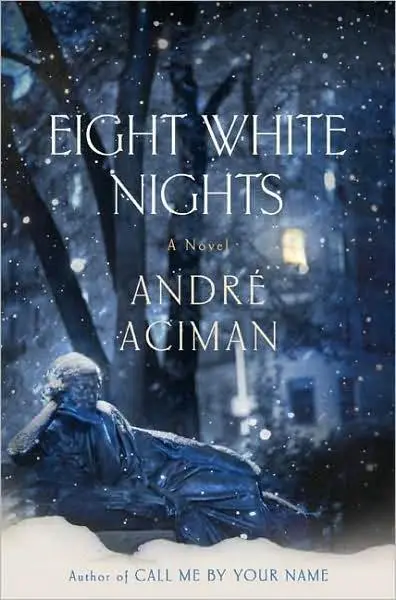
- Название:Eight White Nights
- Автор:
- Издательство:Farrar, Straus and Giroux
- Жанр:
- Год:2010
- ISBN:9780374228422
- Рейтинг книги:3 / 5. Голосов: 1
-
Избранное:Добавить в избранное
- Отзывы:
-
Ваша оценка:
Eight White Nights: краткое содержание, описание и аннотация
Предлагаем к чтению аннотацию, описание, краткое содержание или предисловие (зависит от того, что написал сам автор книги «Eight White Nights»). Если вы не нашли необходимую информацию о книге — напишите в комментариях, мы постараемся отыскать её.
Eight White Nights is an unforgettable journey through that enchanted terrain where passion and fear and the sheer craving to ask for love and to show love can forever alter who we are. A man in his late twenties goes to a large Christmas party in Manhattan where a woman introduces herself with three words: "I am Clara." Over the following seven days, they meet every evening at the same cinema. Overwhelmed yet cautious, he treads softly and won’t hazard a move. The tension between them builds gradually, marked by ambivalence, hope, and distrust. As André Aciman explores their emotions with uncompromising accuracy and sensuous prose, they move both closer together and farther apart, culminating on New Year's Eve in a final scene charged with magic and the promise of renewal. Call Me by Your Name, Aciman's debut novel, established him as one of the finest writers of our time, an expert at the most sultry depictions of longing and desire. As The Washington Post Book World wrote, "The beauty of Aciman’s writing and the purity of his passions should place this extraordinary first novel within the canon of great romantic love stories for everyone." Aciman’s piercing and romantic new novel is a brilliant performance from a master prose stylist.
Eight White Nights — читать онлайн бесплатно полную книгу (весь текст) целиком
Ниже представлен текст книги, разбитый по страницам. Система сохранения места последней прочитанной страницы, позволяет с удобством читать онлайн бесплатно книгу «Eight White Nights», без необходимости каждый раз заново искать на чём Вы остановились. Поставьте закладку, и сможете в любой момент перейти на страницу, на которой закончили чтение.
Интервал:
Закладка:
She liked things improvised; I liked design.
“And what does this room correspond to on the ground floor?” I asked. “The lobby.” “And below that?” “Storage room, superintendent’s digs.” “And below that?” I asked, as if trying to determine where fate might take me if I were to roam from floor to floor like a flying Dutchman trapped for eternity in the freight elevator. “Bicycle room. Laundry room. China,” she replied.
Here I am trying to determine that there is no below after rock bottom, no after-omega, that beyond the person I see in Clara there is no other person, and yet how like her to tell me that rock bottom does not exist, that there are as many Claras as there are buried tiers and legends on our planet. And how about me?
“Man thinking about first night, wondering what would have happened had he gotten off on wrong floor and gone to a different party.”
“Man would have met different Dutch lady.”
“Yes, but what does present Dutch lady think of that?”
“Man is fishing, so Dutch lady says Go fish.”
How I loved her mind. To every north, my south, to every secret, its sharer, to every glove the partner.
“Printz,” she said. She had stood up to put away our two cups in the kitchen and had momentarily looked out to the darkling view of the Hudson from one of the other large windows in the living room.
“What?” I asked.
“I think you should come and have a look. Here,” she said, producing to my complete surprise a pair of what looked like World War II binoculars. “Look over there.” She pointed toward the George Washington Bridge.
“Is it what I think it is?” I asked.
“I think it might be.”
“Let’s give it five minutes. Maybe it will pass by.”
We waited in suspense, listening to the closing segment of the Beethoven.
But the ship was not drawing any closer, and for all we knew, it might have been stationary; it was already too dark to make out its name. It was also late, and unless we hurried, we’d miss the movies. So she tied her shawl, told me where to find my coat. From the bathroom, I heard her strum a few bars of the Handel on her piano. It meant — or so I wished to think — we could stay indoors, we could order in, we could sit still till it got dark, yet never budge to turn on the lights, because just moving a muscle would break the spell. We should take a cab, I suggested. Absolutely not, we’re walking, she replied.
“So this was you,” she said in the elevator. It took me a moment to realize she was still harping on the Beethoven.
“This was me,” I said almost shyly, without conviction, as though held to an admission I’d made without thinking earlier in the day and now wished I could take back.
“Next time I’ll play you a few sarabandes on the piano. They too have me written all over them.”
“What do you mean?”
“Sarabandes are fast and slow. Someone once said sarabandes are danced two steps forward and three steps back — story of my life, if you ask me.”
•
We took a shortcut down West End Avenue, which, unlike Riverside, had already been plowed, with the snow gathered in high banks along the curbs. The walk was all downhill, and when we got there, the ticket holders’ line was longer than we’d anticipated. Someone said they weren’t sold out. When we got our tickets, all I hoped was that we wouldn’t be separated. And if we were? We walk out, she said. We recognized some faces from the previous evenings. Clara, as became her habit, said she’d try to get something from a nearby Starbucks. We liked the slice of lemon cake she had bought last night. In line, I started talking with a couple standing in front of us. She had seen many Rohmer films; he had seen only a few. They had come the night before as well, but he wasn’t convinced. She thought that tonight’s films might actually persuade him of the director’s genius. Did I think he was a genius? He could be, I said. But real people never behaved, much less talked, that way in the real world, he said. “Well,” interrupted Clara, who had gathered the gist of the man’s objections as soon as she joined me on line, “Monet’s paintings look nothing like the real world, nor would we want them to. What’s the real world got to do with art, anyway?”
That seemed to shut him up.
Perhaps the poor man was trying to make conversation. They were so clearly on their second date.
“I wonder where seven-ten with the sloping crew cut is tonight. Oh, there he is.”
I gave him our tickets, and she smiled at him. “Danko, filo donka,” she said in mock-German, a clownish simper on her face. He growled in silence as he had done two nights before. He could sense she was making fun of him.
“I don’t like your attitude,” he finally said. “I love yours,” she retorted. She didn’t know whether to call him Fildanko or Fildenko. So she decided to call him Phildonka, with a ph. She was laughing all to herself, until we saw Phildonka’s face peer at the audience through the slit in the thick, dark curtain and, with the beam of his flashlight, point to an empty seat behind us. “Madam, the seat,” he said, which Clara instantly parodied into madamdasit. “Can you see?” I asked when the credits came on. “Not a bit.” Then she repeated Phildonka madamdasit, and neither of us could stop laughing.
Midway through the Le rayon vert the situation became totally untenable. She opened her purse and produced a nip, which she twisted open and pressed on me to drink from. “What is it?” “Oban,” she whispered. My neighbor turned his head to me, then looked at the screen, as though determined never to look our way again. “I think we got caught,” she whispered. “He tell Phildonka, you watch, Phildonka get furious.” Suppressed laughter.
Later, the film stopped rolling. At first people sat quietly in their spots, then they began to grow impatient, finally erupting in hisses and taunts that grew louder and louder, as in a high school auditorium. I told her that Phildonka was all at once ticket collector, usher, popcorn maker, and projectionist, which sent her roaring out loud, shouting, “Phildonka, fixitdamovie!” Everyone was now staring at us, and the more they stared, the more she laughed. “Fixitdamovie,” she hollered, everyone joining in the laughter. This the woman who leaned against her kitchen counter a few hours ago and looked so uneasy during an awkward silence between us that all she could do was speak in pidgin English. Same Clara, new Clara, old Clara, the Clara who shut people up and put them in their place, the Clara who stares and weeps, the Clara who, on weekday afternoons after school, would dash out of her building on 106th Street and scamper down the stairway by the Franz Sigel memorial statue to join the other children and sled down the hill or head toward Straus Park, where they all sat on one bench, ratting on their parents — Clara who mourned her parents in silence when she heard the news, but then changed clothes and went to a party — Clara never outgrew the comfort of those hours when her parents drank tea with friends by the large bay of windows facing the Hudson and all she had to do was sneak in among them with a book, and all, all was well and safe in this medieval town along the Rhine which her parents and grandparents had resurrected this side of the Atlantic. Was there a periodic table for her, as she floated her way up, down, and across her various little squares, her Folía and her solemn sarabande wrapped in one and put under a panino press like a sandwich cubano sold on the corner of her block? Or was she like me — but so much better than me?
“What do we do now?” I asked. “I dunno. What do you want to do?” “I think we should have a real drink.” In our rush to leave the theater before something might make us change our minds, she barely had time to throw her scarf over her head or tie her knot. “What happened to the complicated knot?” I asked. Leave the complicated knot alone, she said as she snuggled under my arm, then under my armpit, before I could even put my arm around her. “Let’s catch a cab,” I said. “Usual place?” “Absolutely.”
Читать дальшеИнтервал:
Закладка:
Похожие книги на «Eight White Nights»
Представляем Вашему вниманию похожие книги на «Eight White Nights» списком для выбора. Мы отобрали схожую по названию и смыслу литературу в надежде предоставить читателям больше вариантов отыскать новые, интересные, ещё непрочитанные произведения.









Обсуждение, отзывы о книге «Eight White Nights» и просто собственные мнения читателей. Оставьте ваши комментарии, напишите, что Вы думаете о произведении, его смысле или главных героях. Укажите что конкретно понравилось, а что нет, и почему Вы так считаете.