Andre Aciman - Eight White Nights
Здесь есть возможность читать онлайн «Andre Aciman - Eight White Nights» весь текст электронной книги совершенно бесплатно (целиком полную версию без сокращений). В некоторых случаях можно слушать аудио, скачать через торрент в формате fb2 и присутствует краткое содержание. Год выпуска: 2010, ISBN: 2010, Издательство: Farrar, Straus and Giroux, Жанр: Современная проза, на английском языке. Описание произведения, (предисловие) а так же отзывы посетителей доступны на портале библиотеки ЛибКат.
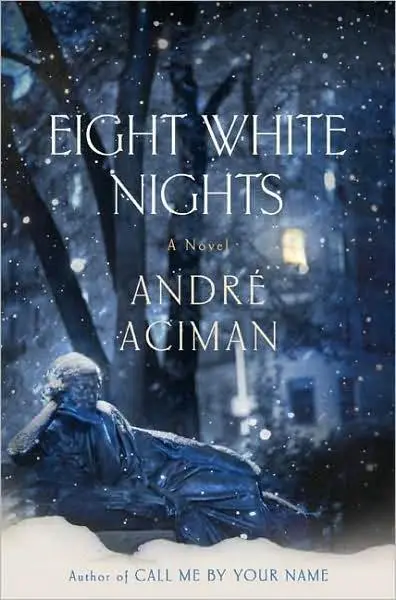
- Название:Eight White Nights
- Автор:
- Издательство:Farrar, Straus and Giroux
- Жанр:
- Год:2010
- ISBN:9780374228422
- Рейтинг книги:3 / 5. Голосов: 1
-
Избранное:Добавить в избранное
- Отзывы:
-
Ваша оценка:
Eight White Nights: краткое содержание, описание и аннотация
Предлагаем к чтению аннотацию, описание, краткое содержание или предисловие (зависит от того, что написал сам автор книги «Eight White Nights»). Если вы не нашли необходимую информацию о книге — напишите в комментариях, мы постараемся отыскать её.
Eight White Nights is an unforgettable journey through that enchanted terrain where passion and fear and the sheer craving to ask for love and to show love can forever alter who we are. A man in his late twenties goes to a large Christmas party in Manhattan where a woman introduces herself with three words: "I am Clara." Over the following seven days, they meet every evening at the same cinema. Overwhelmed yet cautious, he treads softly and won’t hazard a move. The tension between them builds gradually, marked by ambivalence, hope, and distrust. As André Aciman explores their emotions with uncompromising accuracy and sensuous prose, they move both closer together and farther apart, culminating on New Year's Eve in a final scene charged with magic and the promise of renewal. Call Me by Your Name, Aciman's debut novel, established him as one of the finest writers of our time, an expert at the most sultry depictions of longing and desire. As The Washington Post Book World wrote, "The beauty of Aciman’s writing and the purity of his passions should place this extraordinary first novel within the canon of great romantic love stories for everyone." Aciman’s piercing and romantic new novel is a brilliant performance from a master prose stylist.
Eight White Nights — читать онлайн бесплатно полную книгу (весь текст) целиком
Ниже представлен текст книги, разбитый по страницам. Система сохранения места последней прочитанной страницы, позволяет с удобством читать онлайн бесплатно книгу «Eight White Nights», без необходимости каждый раз заново искать на чём Вы остановились. Поставьте закладку, и сможете в любой момент перейти на страницу, на которой закончили чтение.
Интервал:
Закладка:
“So, did you think of me last night?” I tossed the question back at her.
“Did I think of you?” she repeated, seemingly puzzled, with the air of an unspoken How totally inappropriate! “Maybe,” she finally replied. “I don’t remember.” Then, after a pause, “Probably not.” But the look of guile that I myself had affected a moment earlier told me she meant the exact opposite as well: “Probably not. I don’t remember.” Then, after a pause, “Maybe.”
In this game, which had once again erupted between us, did one score more points by feigning indifference? Or by feigning to feign indifference? Or by showing she had cleverly spotted but sidestepped what was an obvious trap and, in doing so, had managed to throw it back at me war-in-the-trenches style just before it exploded in midair? Or did she score higher points by showing that she was, yet once more, the bolder and more honest of the two, if only because scoring points was the farthest thing from her mind?
I looked at her again. Was she counterfeiting a repressed grin now? Or was she simply grinning at the scoreboard I was busily checking in my desperate attempt to catch up to her?
I held out a piece of muffin for her, meaning, Peace. She accepted. There was now less to say than when there’d been tension between us. So I stared out at the river till I caught sight of a large, stationary cargo ship anchored right in the middle of the Hudson, with the words Prince Oscar painted in large mock-Gothic red-and-black script.
“Prince Oscar!” I said to break the silence.
“I’ll have another piece of Prince Oscar,” she replied, thinking I had for some reason decided to call the muffin Prince Oscar.
“No, the ship.”
She looked to her left.
“You mean Printz Oskár!”
“Who is he?”
“Never heard of him. An obscure royal cadet in a Balkan country that no longer exists.”
“Except in Tintin books,” I added. Or in old Hitchcock movies, she countered. Or he’s a short, stubby, monocled South American dictatór-emperadór type who tortures prepubescent girls in front of their fathers, then rapes their grandmothers. Neither of us was succeeding in making the joke come alive. We were speeding along the Drive when a car suddenly swerved into our lane from the right.
“Printz Oskár up your mother’s,” she yelled at the car.
Her BMW swooped over to the fast lane and sped up to the car that had cut in front of us. Clara stared at the driver in the adjacent car and mouthed another insult: Preeeeentz-os-kááááááááááár!
The driver turned his face to us, leered, and, exhibiting his left palm, flicked and then waved his middle finger at us.
Without wasting another second, Clara smirked back and, out of the blue, shook her hand and made a totally obscene gesture. “Printz Oskár to you, dickhead!” The man seemed totally trounced by the gesture and raced ahead of us.
“That’ll teach him.”
Her gesture left me more startled than the driver. It seemed to come from an underworld I would never have associated with her or with Henry Vaughan or with the person who’d spent months poring over Folías and then in the wee hours sang Monteverdi’s “Pur ti miro” for us. I was shaken and speechless. Who was she? And did people like this really exist? Or was I the weirdo, so easily shocked by such a gesture?
“Any Printz Oskár left?” she queried, holding out her right hand.
What on earth did she mean?
“Un petit Printz muffín.”
“Coming up.”
“I think there might be another Printz left,” she said.
“Already eaten up.”
She stared at the two cups of coffee.
“Mind putting one more sugar in my Oskár?”
She must have sensed her gesture had upset me. Calling everything Printz Oskár was her way of defusing my remaining shock over her gesture. But it also reminded me how easy it was to create a small world of our own together, with its own lingo, inflections, and humor. Another day together and we’d add five new words to our vocabulary. In ten days we wouldn’t be speaking English any longer. I liked our lingo, liked that we had one.
Just ahead of us another large barge came into view. It reminded me of the giant barge anchored among the floes off 106th Street on the night of the party. I’d been thinking of the word worship back then.
“Another Printz Oskár,” I said, my turn to speak our lingo.
“This is more like King Oskár,” she corrected as we watched what turned out to be a dinosaur barge with a very tiny, cocky head jutting at its very, very back, immense, ugly, brainless. There was no way such a thing could have crossed the Atlantic on its own. Probably came down another river. Clara sipped her coffee. “You stirred it good.”
She removed the Handel.
“Bach?” she said, as if to ask whether I minded Bach.
“Bach is good.”
She slipped the CD in. We listened to the piano. “We’ll be hearing this very piece again when we get there, so get ready.”
“You mean at Herr Knöwitall’s house?”
“Don’t be a Printz, will you. You’ll like him, I promise, and I know he’ll like you too.”
“We’ll see,” I said, seemingly absorbed by the Bach and all the while pretending I was struggling to withhold a dismissive comment about Herr Knöwitall.
“What if he turns out to be a total bore?” I finally said, unable to hold back.
“What if you turn out to like him? I just want you to know him. Not too much to ask. Stop being so difficult.”
I liked being told to stop being difficult. It brought us closer, as though she had thrown five or six sofa cushions at me before laying her head on me. What I liked wasn’t just the air of familiarity and reproof that brought us closer; it wasn’t even the sarcasm with which she finally said “You’re a terrible Printz Oskár!” meaning a terrible snob, terribly childish, obtuse — but because “Stop being so difficult” is precisely what everyone had always said to me. She was speaking my language from way back. It was like finding the sound of one’s childhood in an emptied apartment, or the scent of cloves and grandmother spices in the muffin bag Clara had brought this morning.
“Here, take this piece,” I said, on finding a small, hidden muffin.
“You have it.”
I insisted. She thanked me exactly as she had the first time, by nodding her head in front of her.
Clara liked speeding in her sports car. The Saw Mill Parkway in the light fog suddenly opened up, an endless stretch to places unknown and unseen and that I wished might remain so forever.
“Are you good at math?”
“Not bad.” Why was she asking?
“Finish this sequence then: one, two, three, five, eight. .”
“Easy. It’s the Fibonacci sequence. Thirteen, twenty-one, thirty-four. .”
A few moments later. “How about this one: one, three, six, ten, fifteen. .”
It took a while.
“Pascal’s triangle: twenty-one, twenty-eight, thirty-six. .”
Always curt and snappy. “Now try this sequence: fourteen, eighteen, twenty-three, twenty-eight, thirty-four. .”
I thought hard for a moment. But I couldn’t solve it.
“Can’t.”
“It’s staring you in the face.”
I tried all sorts of hasty calculations. Nothing. Why was she always good at making me feel so clumsy and clueless?
“Can’t,” I repeated.
“Forty-two, fifty, fifty-nine, sixty-six. .” She was giving a few hints.
“How do you figure?”
“The stops on the Broadway local. You don’t see what’s right in front of you, do you?”
“Seldom do.”
“Figures.”
Clara Brunschvicg, I wanted to say, what is the Brunschvicg sequence? “Clara, I didn’t call last night because I chickened out, okay? I’d even taken out my télyfön, but then thought you wouldn’t want me to. So I didn’t.”
Читать дальшеИнтервал:
Закладка:
Похожие книги на «Eight White Nights»
Представляем Вашему вниманию похожие книги на «Eight White Nights» списком для выбора. Мы отобрали схожую по названию и смыслу литературу в надежде предоставить читателям больше вариантов отыскать новые, интересные, ещё непрочитанные произведения.






Обсуждение, отзывы о книге «Eight White Nights» и просто собственные мнения читателей. Оставьте ваши комментарии, напишите, что Вы думаете о произведении, его смысле или главных героях. Укажите что конкретно понравилось, а что нет, и почему Вы так считаете.