Andre Aciman - Eight White Nights
Здесь есть возможность читать онлайн «Andre Aciman - Eight White Nights» весь текст электронной книги совершенно бесплатно (целиком полную версию без сокращений). В некоторых случаях можно слушать аудио, скачать через торрент в формате fb2 и присутствует краткое содержание. Год выпуска: 2010, ISBN: 2010, Издательство: Farrar, Straus and Giroux, Жанр: Современная проза, на английском языке. Описание произведения, (предисловие) а так же отзывы посетителей доступны на портале библиотеки ЛибКат.
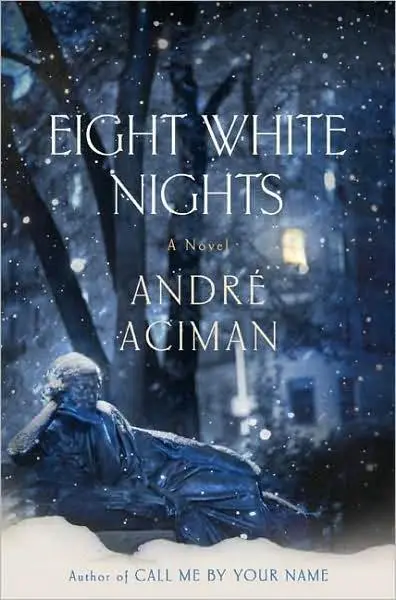
- Название:Eight White Nights
- Автор:
- Издательство:Farrar, Straus and Giroux
- Жанр:
- Год:2010
- ISBN:9780374228422
- Рейтинг книги:3 / 5. Голосов: 1
-
Избранное:Добавить в избранное
- Отзывы:
-
Ваша оценка:
Eight White Nights: краткое содержание, описание и аннотация
Предлагаем к чтению аннотацию, описание, краткое содержание или предисловие (зависит от того, что написал сам автор книги «Eight White Nights»). Если вы не нашли необходимую информацию о книге — напишите в комментариях, мы постараемся отыскать её.
Eight White Nights is an unforgettable journey through that enchanted terrain where passion and fear and the sheer craving to ask for love and to show love can forever alter who we are. A man in his late twenties goes to a large Christmas party in Manhattan where a woman introduces herself with three words: "I am Clara." Over the following seven days, they meet every evening at the same cinema. Overwhelmed yet cautious, he treads softly and won’t hazard a move. The tension between them builds gradually, marked by ambivalence, hope, and distrust. As André Aciman explores their emotions with uncompromising accuracy and sensuous prose, they move both closer together and farther apart, culminating on New Year's Eve in a final scene charged with magic and the promise of renewal. Call Me by Your Name, Aciman's debut novel, established him as one of the finest writers of our time, an expert at the most sultry depictions of longing and desire. As The Washington Post Book World wrote, "The beauty of Aciman’s writing and the purity of his passions should place this extraordinary first novel within the canon of great romantic love stories for everyone." Aciman’s piercing and romantic new novel is a brilliant performance from a master prose stylist.
Eight White Nights — читать онлайн бесплатно полную книгу (весь текст) целиком
Ниже представлен текст книги, разбитый по страницам. Система сохранения места последней прочитанной страницы, позволяет с удобством читать онлайн бесплатно книгу «Eight White Nights», без необходимости каждый раз заново искать на чём Вы остановились. Поставьте закладку, и сможете в любой момент перейти на страницу, на которой закончили чтение.
Интервал:
Закладка:
But as I sat there, worrying about this, I knew that worrying was also my way of paying token tribute to unfounded fears before admitting that tonight I was indeed happy. Waiting for her made me happy. Coddling the thought she’d even spurn my way of waiting for her made me happy. Rehearsing her abrupt goodbye as soon as we’d leave the movie theater in two hours made me happy. And what made me happier yet wasn’t just that we were together again after scarcely spending the day apart, but that her presence made me like the way the day had turned out, made me like my life and the way I lived it. She was the face of my life and how I lived it, my eyes to the world staring back at me. The people in the theater, the people I had known, the books read, lunch with Olaf, who bad-mouths his wife, the places I’d lived in, my life on ice, and all the things I still wanted, all had suddenly turned a dearer and more vulnerable face under her spell — for this was a spell, and struck like a spell, and, like all spells, ushered in new colors, new people, new scents, new habits, unveiling new meanings, new patterns, new laughter, a new cadence to things — even if, all along, a small unseen, untapped part of me was perfectly willing to suspect, as though for good measure, that I could just as easily have preferred the spell more than the person who cast it, the coded sparring between us more than the person I was sparring with, the me-because-of-Clara more than Clara herself.
Clara had left her coat on her seat. I let my hand rest on her coat, stared at its lining, touched the inner lining. Clara. It was also my way of remembering I was not alone, that she would very shortly come back and take up her seat again and tell me — or perhaps not — why she had taken so long. Sometimes just placing my coat next to my seat when I am alone in a movie theater is itself a way of conjuring a presence in the dark, of imagining that someone has stepped out for a second and will any moment come back — which is what happens in the dead of night, when those who have left our lives suddenly lie next to us no sooner than we’ve whispered their name into our pillow. Clara, I thought, and there she’d be, taking the seat next to mine.
And as I listened to the violin sonata by Beethoven, which always appears in this theater as soon as the intermission lights come on, I remembered that no more than three winters ago I had done the very same with someone else’s coat while she had gone to buy sodas at the concession stand. I’d pretended we had broken up or that she had never even existed, only to be surprised when she returned and pushed down the seat next to mine. Afterward, we had left the movie theater and had bought the Sunday paper and ambled home in the snow, speaking of Maud and of Chloé, improvising dinner somewhere after visiting a bookstore. It seemed so long ago. And I thought back to a much younger I who had come to this very theater alone one Saturday night and, while looking for a seat without disturbing too many people, had overheard a man ask a woman, “Do you like Beethoven?” The woman, who had let her coat hang on the backrest of her seat, slouched over it and, turning to him, had replied something like “Yes, very much, but this sonata I hate.” They were, even I could tell, on their first date.
That night I’d hurled a hopeful and mystified glance to the future, asking who would the woman be in my life who’d sit next to me and listen to this piece by Beethoven and say, Yes, but this sonata I hate. They knew so little about each other that the man needed to ask whether she liked Beethoven. It had never occurred to me until now that all he was trying to do was make conversation.
Yes, but this sonata I hate, I had repeated to myself, as though the mildly miffed tone of her words held a key that might unlock a passageway to where I wished my life to go one day — words that seemed fraught with intimations that were as stirring and reckless as a compliment I had never heard before and desperately wished to have repeated. Yes, but this sonata I hate meant , I can say anything to you. It’s good to be together on this cold night. Move closer and we’ll touch elbows. Now, reexamining her unguarded response years later, I realized that I knew no more about the shoals between men and women than I did then; nor did I even know what my mystified wish had been that night when I sat alone thinking ahead of myself, hoping to trace the pattern my life might take, and never for a moment realizing that the questions I had asked of life then would come bobbing back to me years later in the same bottle, unanswered.
All those years, and all I’m still trying to do is make conversation!
All those years, and all I want to show is that I’m not scared of silence, of women.
I thought of the lovers again. I had caught sight of them once more outside the theater as everyone waited for the rain to stop. Then the years went by. Then someone came along, and perhaps on our first date I too had asked what she thought of Beethoven and, by so doing, put a check mark next to the question that signaled entrance to the rose garden. We too had waited for the rain to subside. Then I went alone to the movie theater. Then with others. Then alone. Then with others again.
Had I seen more films alone or with others? And which had I liked more? I wondered.
Would Clara say alone was better, but then, just when I was about to agree with her, turn around and say that, in the dark, she still needed otherpeoples, an elbow to rub against?
The road once traveled seemed filled with potholes now.
Perhaps I would tell her all this.
The pleasure of peeling back the years and laying myself bare before her aroused me. The pleasure of telling her anything about me aroused me.
To tell her: For a moment I made myself fear that I was only imagining you were with me tonight. Want to know why?
I know why.
Would I tell her I’d thought about her the whole day, or would I suggest something a bit tamer, that our meeting outside the theater seemed lifted from every film I’d seen and presaged the course of many a Rohmer tale? I could tell her I’d walked many blocks in search of open stores, and all I could think of was her, looked for her, stopped somewhere for coffee, almost certain I had spotted her, but, knowing better than to hope, had given each place a cursory glance, then walked away, just as she was calling me a million times? Should I tell her that I’d rehearsed telling her all this?
I remembered the failing late-afternoon sun and how gradually it began to spell loneliness and dejection after I’d lunched with Olaf, its waffling light taking me down with it as I watched the day put an end to its misery — and yet, in the background always that unwieldy hope that the clock would turn back twenty-four hours and take me to exactly where I’d been yesterday evening, before boarding the uptown M 5 bus, before buying two bottles of Champagne, before leaving my mother’s home on my way to the liquor store. .
I’d been heading uptown all afternoon. Scoping out her territory, on the fringes of her territory. You always run into the one person you’d give anything to run into, baiting them with desire, your own.
But, then, fearing she might run into me and guess why I’d wandered so far uptown, I decided to head home instead. By the time I left again and arrived at the movie theater, the show was sold out. I should have known. Christmas.
•
When she finally sat down next to me, the lights were already dimming. She wasn’t her jovial self any longer. She seemed agitated. “What’s wrong?” “Inky’s crying,” she said. Did she want to leave? No. He always cried. Why had she called him, then? Because he was leaving too many messages on her voice mail. “I shouldn’t have called.” Someone again shushed us from behind. “Shush yourself!” she snapped.
Читать дальшеИнтервал:
Закладка:
Похожие книги на «Eight White Nights»
Представляем Вашему вниманию похожие книги на «Eight White Nights» списком для выбора. Мы отобрали схожую по названию и смыслу литературу в надежде предоставить читателям больше вариантов отыскать новые, интересные, ещё непрочитанные произведения.









Обсуждение, отзывы о книге «Eight White Nights» и просто собственные мнения читателей. Оставьте ваши комментарии, напишите, что Вы думаете о произведении, его смысле или главных героях. Укажите что конкретно понравилось, а что нет, и почему Вы так считаете.