André Alexis - Fifteen Dogs
Здесь есть возможность читать онлайн «André Alexis - Fifteen Dogs» весь текст электронной книги совершенно бесплатно (целиком полную версию без сокращений). В некоторых случаях можно слушать аудио, скачать через торрент в формате fb2 и присутствует краткое содержание. Год выпуска: 2015, ISBN: 2015, Издательство: Coach House Books, Жанр: Современная проза, на английском языке. Описание произведения, (предисловие) а так же отзывы посетителей доступны на портале библиотеки ЛибКат.
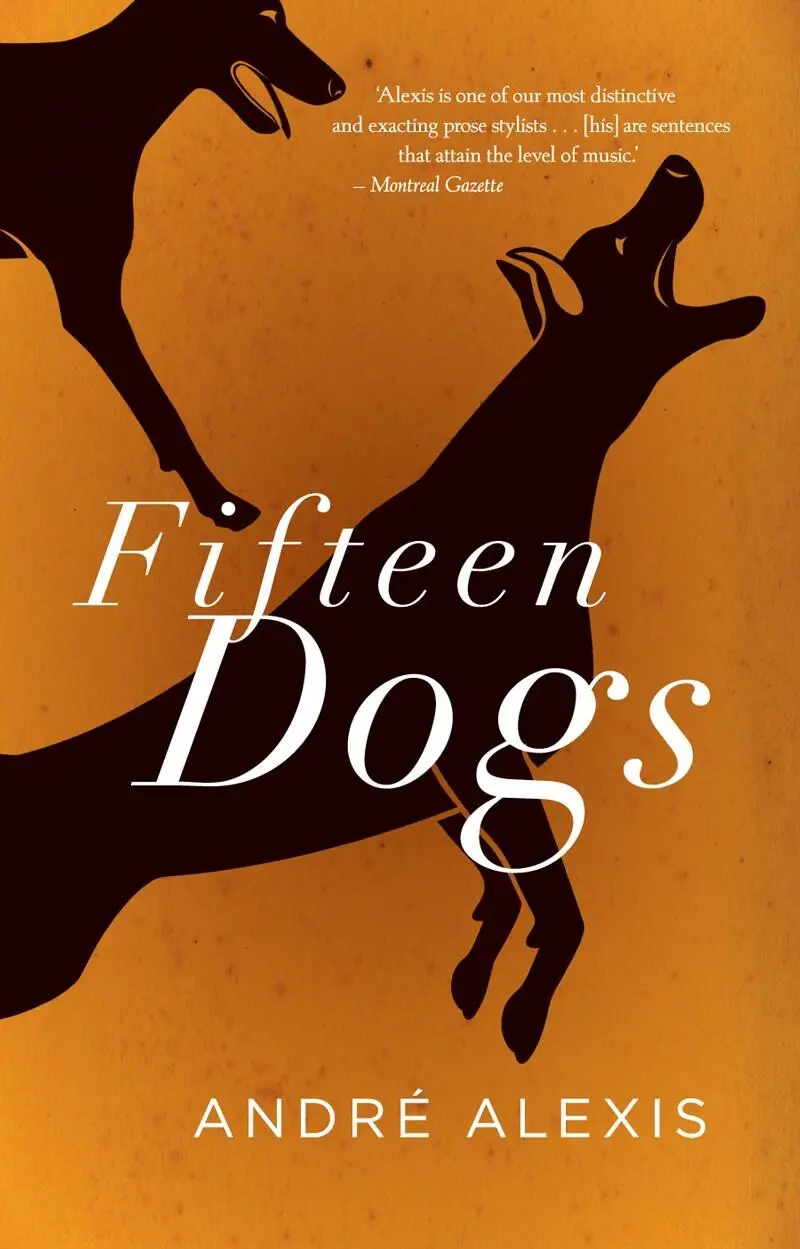
- Название:Fifteen Dogs
- Автор:
- Издательство:Coach House Books
- Жанр:
- Год:2015
- ISBN:9781770564039
- Рейтинг книги:4 / 5. Голосов: 1
-
Избранное:Добавить в избранное
- Отзывы:
-
Ваша оценка:
Fifteen Dogs: краткое содержание, описание и аннотация
Предлагаем к чтению аннотацию, описание, краткое содержание или предисловие (зависит от того, что написал сам автор книги «Fifteen Dogs»). Если вы не нашли необходимую информацию о книге — напишите в комментариях, мы постараемся отыскать её.
And so it begins: a bet between the gods Hermes and Apollo leads them to grant human consciousness and language to a group of dogs overnighting at a Toronto veterinary clinic. Suddenly capable of more complex thought, the pack is torn between those who resist the new ways of thinking, preferring the old 'dog' ways, and those who embrace the change. The gods watch from above as the dogs venture into their newly unfamiliar world, as they become divided among themselves, as each struggles with new thoughts and feelings. Wily Benjy moves from home to home, Prince becomes a poet, and Majnoun forges a relationship with a kind couple that stops even the Fates in their tracks.
André Alexis's contemporary take on the apologue offers an utterly compelling and affecting look at the beauty and perils of human consciousness. By turns meditative and devastating, charming and strange,
shows you can teach an old genre new tricks.
Fifteen Dogs — читать онлайн бесплатно полную книгу (весь текст) целиком
Ниже представлен текст книги, разбитый по страницам. Система сохранения места последней прочитанной страницы, позволяет с удобством читать онлайн бесплатно книгу «Fifteen Dogs», без необходимости каждый раз заново искать на чём Вы остановились. Поставьте закладку, и сможете в любой момент перейти на страницу, на которой закончили чтение.
Интервал:
Закладка:
It was during this time that Atticus began to pray.
He already had a notion of what an ideal or pure dog might be: a creature without the flaws of thought. As time went on, he attributed to this pure being all the qualities he believed to be noble: sharp senses, absolute authority, unparalleled prowess at hunting, irresistible strength. Somewhere, thought Atticus, there must be a dog like this. Why? Because one of the qualities his ideal canine possessed was being . An ‘ideal’ dog that did not exist could not be truly ideal. Therefore, the dog of dogs, as Atticus conceived it, had to exist. It had to be . (Atticus imagined this dog existing without red; that is, without the colour the dogs had gained with their change in thinking.) More: if Atticus’s pure dog existed — as it must — why should it not feel his longing for guidance? Why should it not find him?
Atticus followed his feelings. He humbled himself before his pure dog. He found a place away from the den. It was on the other side of Grenadier Pond, among the tall grass and trees. He cleared the ground of leaves and, every evening, he brought a portion of the things he had caught or scavenged. Every evening at the same time: mice, pieces of bread, bits of hot dog, rats, birds, whatever he had saved from his share of the pack’s food. And, speaking the forbidden language, every evening he asked for guidance from the one leader he was prepared to follow.
The gods are compelled by rhythm — as is the universe, as are all the creatures in it. And so, Atticus’s regular prayers and repeated ritual at length caught Zeus’s attention. The father of the gods heard the dog’s wishes and was moved by its sacrifices and faith. Appearing to Atticus in a dream, Zeus took the form of a Neapolitan mastiff: his coat rumpled as the skin of an elephant, his jowls a grey cascade. And Zeus spoke to Atticus in the new language of the pack.
— Atticus, said the god, I am the one to whom you sacrifice.
— I knew you would come, said Atticus. Tell me how I may be a better dog.
— You are no longer a dog, said Zeus. You are changed. But you are mine and I pity you your fate. I cannot intervene in your life. I have myself forbidden it. But I will grant you a wish at your death. Whatever you wish for at the moment before your spirit ascends, I will grant.
— But, Great Dog, what good is a wish if I must die for it?
— I can do no more, said Zeus.
And at these words, the father of the gods turned to ash in Atticus’s dream and drifted above a bright green field where a thousand small, dark creatures ran.
In the months that followed, Atticus maintained his shrine and continued to speak to Zeus, comforted that the Great Dog had heard his pleas, grateful for what he imagined to be the god’s attention. His prayers did not prevent the tragedies that beset the pack, however. First, Frick and Frack wounded Max and he (Atticus) was forced to finish the dog off. Then, Frick, Frack and he himself killed the small dog (Dougie) on his return. An accident: the bigger dogs were fired by blood lust, angry for the trouble the dog’s departure had caused. (Atticus asked Zeus’s forgiveness for this transgression, but, really, it was something of a miracle that they had not killed Benjy as well. In the grip of what felt like instinct but was only anger, they might have killed any number of dogs. The lesson, painfully acquired with Bobbie, then learned again at Dougie’s death: violence has reasons that reason itself cannot know.) Finally, there came the poisoning.
On the pack’s first foray into the garden of death, Atticus followed Frick and Frack into the garden, convinced the ground’s bounty was a gift from the one who’d come to him in a dream. His first premonition of death came while he was eating a piece of chicken: flesh that tasted as certain dog toys smell. It was not the way anything should taste, but it also tasted of chicken and it was good. Shortly thereafter, death stepped out from behind its curtain. Atticus’s nose began to bleed. He could not drink enough water. His insides burned. He had eaten more than the others. His symptoms were the first to appear.
It was after his second feast in the garden of death that Atticus knew for certain something was not right. Though he couldn’t tell how his pack had been done, he knew it had been. Some thing or some being had got to them. And he, their leader, had done nothing. So, while the others made their way back to the coppice to die, Atticus went to his shrine. By then, thirst was like a fire that ravaged the kindling of his bones and sinews. Death was on him and he knew it.
With his last words, Atticus asked that the one responsible for his pack’s demise be punished. Then, the dog died, ever-faithful, filled with the hope that his unseen enemy would suffer at the hands of his god.
+
Having escaped Majnoun’s anger, Benjy did not know where to go or what to do. He had imagined himself living with Miguel, Nira and Majnoun, staying and mastering human language. Though he knew otherwise, he convinced himself that Majnoun had overreacted, that his (that is, Benjy’s) manoeuvring — his courting of Miguel’s favour, for instance — had been innocent or, at worst, experimental. As far as Benjy was concerned, he hadn’t given Majnoun cause to bite him. Majnoun would come to his senses and allow him back. He was certain of it, but, in the meantime, where would he stay?
It was spring, the third week in April. There was still snow on the ground, especially in tree-shaded yards and in High Park. It was not the worst time to find oneself outdoors. During the day, the streets were dry and warm. Benjy, of course, knew the area around the park well. If he stayed in Parkdale or High Park, there would be dogs to be avoided but he could usually spot those quickly, so he was not afraid. (The white dogs with black spots were the worst. It wasn’t so much their aggression; other dogs were sometimes even more aggressive. It was that they were — without question — the stupidest creatures on earth, and that was even if one included cats. It was useless to try reasoning with them, whatever language one chose. Worse, you could never tell when one of them would come at you. It was not in his nature to hate other dogs, but Benjy disliked Dalmatians the way some humans dislike men named Steve or Biff.)
He was at the corner of Fern and Roncesvalles, trying to decide where he should go, when a ruddy-faced old man bent down and scooped him into his arms, saying
— Who’s a pretty doggy? Who’s a pretty boy?
This was most unpleasant. Benjy squirmed as if he were helplessly sinking into a pond of foul-smelling wool. From out of a pocket in his overcoat, the man extracted a biscuit that smelled of sugar, fish, carrots, lamb and rice. Suspicious, but captivated by the smell of the biscuit, Benjy stopped wriggling. He sniffed at the biscuit again, taking in the hints of salt, canola oil, rosemary, human sweat and apple.
— What is it? Benjy asked, speaking English.
As if it were natural for dogs to address him, the old man said:
— It is a biscuit. I was told dogs like them. Do you not want it?
Sniffing again at the air close to the biscuit, Benjy decided that the thing was what the man said it was: food. He took the biscuit from the man’s hand and, crunching it with the teeth on one side of his mouth, he allowed himself to eat what was, in the end, a memorable treat.
— Thank you, said Benjy.
The man put him down and absent-mindedly rubbed the fur along his back.
— You’re welcome, he said. I’m glad you liked it. I’ve got to go, now, Benjy. See you later.
It was a moment before Benjy realized the man had used his secret name. Did the human know him, then? He looked in the direction the man had gone and, almost instinctively, followed him. This was not as easy as it should have been. In Benjy’s experience, the humans that smelled as the old man had — that is, of wool, sugary urine, sweat and some indefinable decay — were slower than others. Not this one. He walked quickly. Then, too, it was a busy day along Roncesvalles. There were any number of obstructions: women with baby strollers, other dogs, and — worst of all — ambling humans who were always a threat to step on you or kick you out of the way. Then there were the distractions: post boxes, lampposts, garbage bins, telephone poles, the sour milk and roast chicken smell of the Sobey’s, the raspberry jam from a bakery, the sausage and cheese from the delis along the street … so many things that made you want to stop and smell them. Keeping up with the man was a task. Yet, Benjy did keep up, the grey of the man’s pants — the colour of ash — always before him.
Читать дальшеИнтервал:
Закладка:
Похожие книги на «Fifteen Dogs»
Представляем Вашему вниманию похожие книги на «Fifteen Dogs» списком для выбора. Мы отобрали схожую по названию и смыслу литературу в надежде предоставить читателям больше вариантов отыскать новые, интересные, ещё непрочитанные произведения.







Обсуждение, отзывы о книге «Fifteen Dogs» и просто собственные мнения читателей. Оставьте ваши комментарии, напишите, что Вы думаете о произведении, его смысле или главных героях. Укажите что конкретно понравилось, а что нет, и почему Вы так считаете.