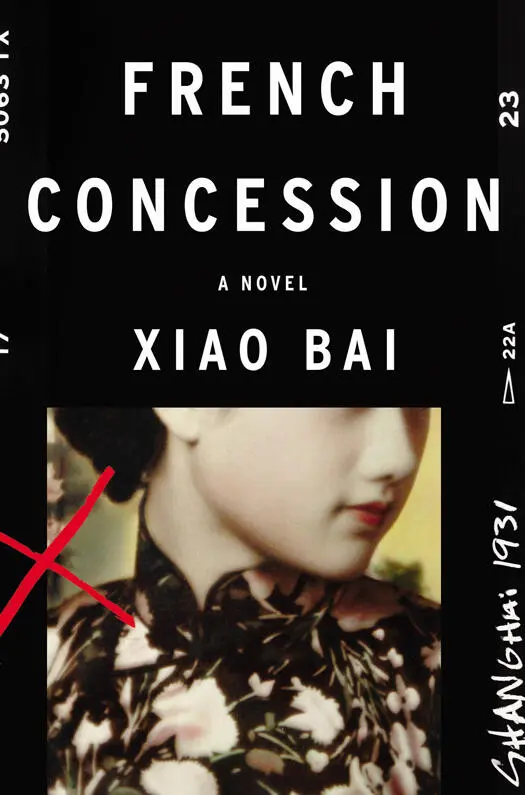
Xiao Bai - French Concession
Здесь есть возможность читать онлайн «Xiao Bai - French Concession» весь текст электронной книги совершенно бесплатно (целиком полную версию без сокращений). В некоторых случаях можно слушать аудио, скачать через торрент в формате fb2 и присутствует краткое содержание. Год выпуска: 2015, Издательство: HarperCollins, Жанр: Современная проза, на английском языке. Описание произведения, (предисловие) а так же отзывы посетителей доступны на портале библиотеки ЛибКат.
- Название:French Concession
- Автор:
- Издательство:HarperCollins
- Жанр:
- Год:2015
- ISBN:нет данных
- Рейтинг книги:3 / 5. Голосов: 1
-
Избранное:Добавить в избранное
- Отзывы:
-
Ваша оценка:
French Concession: краткое содержание, описание и аннотация
Предлагаем к чтению аннотацию, описание, краткое содержание или предисловие (зависит от того, что написал сам автор книги «French Concession»). Если вы не нашли необходимую информацию о книге — напишите в комментариях, мы постараемся отыскать её.
A boat from Hong Kong arrives in Shanghai harbor, carrying an important official in the Nationalist Party and his striking wife, Leng. Amid the raucous sound of firecrackers, gunshots ring out; an assassin has shot the official and then himself. Leng disappears in the ensuing chaos.
Hseuh, a Franco-Chinese photographer aboard the same boat, became captivated by Leng’s beauty and unconcealed misery. Now, she is missing. But Hsueh is plagued by a mystery closer to home: he suspects his White Russian lover, Therese, is unfaithful. Why else would she disappear so often on their recent vacation? When he’s arrested for mysterious reasons in the French Concession and forced to become a police collaborator, he realizes that in the seamy, devious world of Shanghai, no one is who they appear to be.
Coerced into spying for the authorities, Hseuh discovers that Therese is secretly an arms dealer, supplying Shanghai’s gangs with weapons. His investigation of Therese eventually leads him back to Leng, a loyal revolutionary with ties to a menacing new gang, led by a charismatic Communist whose acts of violence and terrorism threaten the entire country.
His aptitude for espionage draws Hseuh into a dark underworld of mobsters, smugglers, anarchists, and assassins. Torn between Therese and Leng, he vows to protect them both. As the web of intrigue tightens around him, Hsueh plays a dangerous game, hoping to stay alive.
French Concession — читать онлайн бесплатно полную книгу (весь текст) целиком
Ниже представлен текст книги, разбитый по страницам. Система сохранения места последней прочитанной страницы, позволяет с удобством читать онлайн бесплатно книгу «French Concession», без необходимости каждый раз заново искать на чём Вы остановились. Поставьте закладку, и сможете в любой момент перейти на страницу, на которой закончили чтение.
Интервал:
Закладка:
CHAPTER 54
JULY 14, YEAR 20 OF THE REPUBLIC.
9:25 A.M.

Li Pao-i stopped at Hsieh-t’ai Money Exchange, a small money changer and tobacco shop run on Rue Vouillemont by a man from Ningpo. His takings from the night before were in his pocket, in the form of a ten-yuan note issued by the Chinese Agricultural Bank and printed by Waterloo and Sons. It was covered with foreign writing and had the bank general manager’s ornate signature on the back, an anticounterfeiting device. An entire batch of banknotes had once been stolen from a bank before signatures could be printed onto them, and as a result, banknotes with faded counterfeit signatures still turned up every now and again.
He pushed his banknote through the iron railing to the man behind the counter.
“Nine silver coins, and change the last yuan into cents, please.” He liked hearing them jingle in his pocket.
Then he bought a bag of fried dumplings at the steamed bun shop next door. He knew it was a fake Ta-hu-ch’un, not a real branch of the well-known dumpling restaurant, but who cared?
He put the small change in his other pocket. He was about to go over to the Morris Teahouse to catch up on the gossip. It was Bastille Day, and the Race Club had organized an extra Champagne Stakes race in honor of the occasion. Last night had been a good night for him at poker, thanks to his new strategy. So he decided not to keep playing that morning. Instead, he would stop by Peach Girl’s place to take a nap on her bed around noon, and then continue with his winning streak.
While he was waiting for his dumplings, he could hear the radio playing at the money changer’s next door. He heard a name that caught his attention: People’s Strength. He’d never forgotten the last time he’d heard those words.
He went along Avenue Édouard VII. It was early, the road was empty, and there were no cars. He was walking right in the middle of the road. Race Course Road arced toward Avenue Édouard VII, which just touched the top of the arc. The two swathes of houses where the roads met spread toward the Race Course like a woman’s thighs. A narrow alley between the houses led toward the Race Course, about twenty yards away. To the left of the alley lay a kidney clinic that dispensed traditional Chinese medicine, and a public toilet stood awkwardly in the middle of the road. Li had heard tell that the Race Course’s longtime gamblers would all come here to touch the doorframe leading to the female toilets because its feng shui gave it especially powerful yin luck.
At the tip of that promontory of houses was Morris Teahouse. Li Pao-i went straight up to a window seat on the second floor, and sat on a drum-shaped little stool. He had the waiter make him a pot of jasmine tea, and tore open the oil-drenched wax paper in which his dumplings were wrapped. Then he asked the waiter for a small plate of vinegar.
He was a regular customer here, and even had a tab. But today he wouldn’t need his tab. He could even pay it off — in silver yuan coins, no less, playing the high roller. He took out his silver yuan and inspected the bill that the waiter had brought him. He was about to pay with a coin when he realized that he had almost forgotten about his lucky coin, which was jumbled up with all the others. He couldn’t just get rid of the coin that had helped him to make good on his losses this morning. He stacked up the coins and sniffed them one by one until he caught a whiff of the familiar smell.
Paying the bill made him feel great. He had the waiter bring him a newspaper. One headline caught his attention, and he read the article carefully, noticing the familiar name it alluded to as its source: an experienced journalist at a French newspaper in the Concession, Mr. Weiss Hsueh. Li spat tea leaves into his cup, irritated that Hsueh hadn’t told him about such a big scoop. Ordinary crooks indeed, he spat. He’d known all along that those people weren’t Communists. He remembered the questions Hsueh had asked him that night in Moon Palace Dancing Hall.
When he flipped to the racing post, he forgot about the article. Today was the day of the Champagne Stakes, a big race, and all the most famous racehorses would be there. Unusually, bets could be placed up to a week in advance. But Li was in no hurry to place his bet.
For the race with Aussie horses, he had already settled on Bullet, a horse belonging to the British businessman Gordon. It was the kind of horse that always shot to the front of the pack. Horses like that sometimes lost steam and lagged behind, but Bullet wasn’t like them. Even in a long one-and-a-quarter-mile race, he knew it would come out ahead. The jockey was well chosen too. Captain Sokoloff was the Concession’s only real master of riding with short stirrups, where you had to almost be squatting on the saddle. For Mongolian horses, jockeys usually used longer stirrups, and kicked the horse in the belly to make it go faster. But Aussie horses were taller, and a jockey would need the aid of his reins and whip. Riding with short stirrups would give him more flexibility.
Li decided that he would simply buy a win ticket for the race with Aussie horses. Any fool could guess what would happen in that race, and the betting odds were low. Easy money. But he was going to win big in the race with Mongolian horses by placing a triple bet, going all in. There, an upset would allow him to win dozens of times his wager. In fact, if he was lucky and the horse racing dailies spent a few more inches raving about Mahler’s white mare, he stood to win hundreds of times his wager. For a week now, he had inspected the horses at Mohawk Road every day. The gray horse, Illusion, was sure to surprise everyone. It was no longer as timid as it used to be. They said it was startled by hurdles as they sprang up, and that it sweated too much. But he had seen the stable hands wave a net in its face without making it flinch. He’d even seen a groom splash water on its belly before leading it out to the practice track, so that the gamblers clustered by the railing would think it was sweating.
Today would be Illusion’s day. Old Mahler had slyly arranged for his own son to ride that mare. Mahler Jr. was fat and too heavy, and with him for a jockey, even the renowned horse could only come second. Illusion would come first, and Mahler’s “White Rose” would come second. No one else would have worked this out, and the triple bet only made his bet even riskier and the payoff bigger. He would win hundreds of times his wager because the odds were so long.
He had to go back to Peach Girl’s around lunchtime. The previous night he had had the idea of stuffing two silver coins into her drawers. She was fast asleep, and even the two hard coins he wedged right into that sticky cleft didn’t wake her. They had absorbed all her female yin energy and brought him good luck. He was going to do it again — but with more than ten yuan this time, so that he’d be sure to make a killing.
He gazed confidently around the teahouse, at all the sorry gamblers who were about to lose their shirts, and at the Race Club journalists who thought they knew their stuff. Then he saw a pair of eyes, and panicked.
Yes, he’d seen this man before. His name was — Li racked his brains for the name. He’d only just read it in the papers. The man had sent a bullet in a brown paper envelope to his newspaper office. He’d kidnapped Li, and forced him at gunpoint to print a certain manifesto. His name was Ku Fu-kuang. It was all coming back to him, the name in the news report, the Green Gang gossip, the leak attributed to Hsueh. He thought he could see the man looking at him, and he didn’t dare meet his gaze. He lowered his eyes, as though he couldn’t be seen by Ku if he couldn’t see him.
Читать дальшеИнтервал:
Закладка:
Похожие книги на «French Concession»
Представляем Вашему вниманию похожие книги на «French Concession» списком для выбора. Мы отобрали схожую по названию и смыслу литературу в надежде предоставить читателям больше вариантов отыскать новые, интересные, ещё непрочитанные произведения.










Обсуждение, отзывы о книге «French Concession» и просто собственные мнения читателей. Оставьте ваши комментарии, напишите, что Вы думаете о произведении, его смысле или главных героях. Укажите что конкретно понравилось, а что нет, и почему Вы так считаете.