Bill Morris - Motor City Burning
Здесь есть возможность читать онлайн «Bill Morris - Motor City Burning» весь текст электронной книги совершенно бесплатно (целиком полную версию без сокращений). В некоторых случаях можно слушать аудио, скачать через торрент в формате fb2 и присутствует краткое содержание. Год выпуска: 2014, Издательство: Pegasus, Жанр: Современная проза, на английском языке. Описание произведения, (предисловие) а так же отзывы посетителей доступны на портале библиотеки ЛибКат.
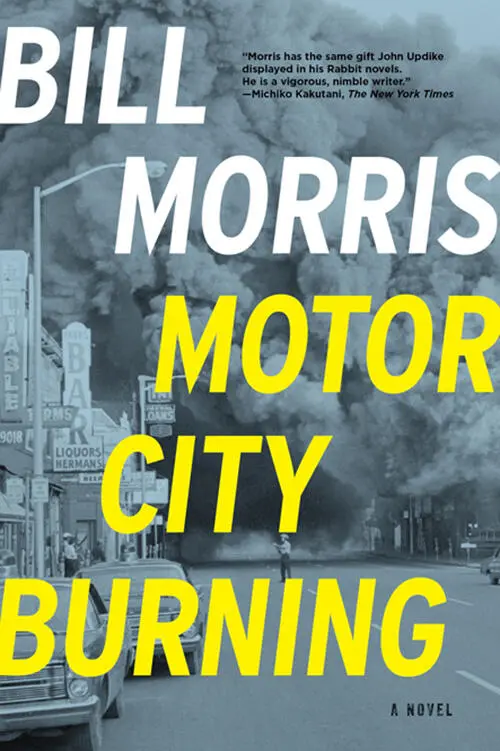
- Название:Motor City Burning
- Автор:
- Издательство:Pegasus
- Жанр:
- Год:2014
- ISBN:нет данных
- Рейтинг книги:3 / 5. Голосов: 1
-
Избранное:Добавить в избранное
- Отзывы:
-
Ваша оценка:
Motor City Burning: краткое содержание, описание и аннотация
Предлагаем к чтению аннотацию, описание, краткое содержание или предисловие (зависит от того, что написал сам автор книги «Motor City Burning»). Если вы не нашли необходимую информацию о книге — напишите в комментариях, мы постараемся отыскать её.
The surprise return of his Vietnam veteran brother in the spring of 1967 gives Willie a chance to drive a load of smuggled guns to the Motor City — and make enough money to jump-start his stalled dream of writing his movement memoir. There, at Tiger Stadium on Opening Day of the 1968 baseball season — postponed two days in deference to the funeral of Martin Luther King, Jr. — Willie learns some terrifying news: the Detroit police are still investigating the last unsolved murder from the bloody, apocalyptic riot of the previous summer, and a white cop named Frank Doyle will not rest until the case is solved. And Willie is his prime suspect.
Motor City Burning — читать онлайн бесплатно полную книгу (весь текст) целиком
Ниже представлен текст книги, разбитый по страницам. Система сохранения места последней прочитанной страницы, позволяет с удобством читать онлайн бесплатно книгу «Motor City Burning», без необходимости каждый раз заново искать на чём Вы остановились. Поставьте закладку, и сможете в любой момент перейти на страницу, на которой закончили чтение.
Интервал:
Закладка:
“Whatsamatter?” Jimmy Robuck said, making a show of checking his watch. He had his white bucks propped on his desk and a big shit-eating grin on his face. “Couldn’t sleep?”
“I was here all night working that Brewster stabbing. Got a confession a little after sunup.”
“Congratulations. Whodunit?”
“Nobody you’d know. Fifteen-year-old kid with no priors named Cliff Robinson. A cousin of Smokey’s, believe it or not.”
“I believe it if you say it.”
Doyle sat at his desk, sipping coffee. Jimmy was still beaming. Doyle said, “The fuck’re you so happy about?”
“Come have a look.”
Doyle walked over to Jimmy’s desk, which was immaculate, as always. Only when he got close did Doyle see that there was something on the desk other than the telephone and the empty In/Out basket.
Nine pieces of shiny metal.
“Looky what I found,” Jimmy said.
Doyle was staring at the pieces of metal like he thought they might jump up and fly out the window. “What is it?”
“Shell casings.” Jimmy pointed to the three on his left. “These bad boys are thirty-aught-six, out of a Remington 700 with a heavy barrel.”
“Where’d they come from?”
“Roof of the Larrow Arms. Same as the three in the middle — seven point six-two millimeter.”
“How do you know all this shit?”
“Cause Sid Wolff told me so.”
“You’ve already run them through ballistics?”
“Some people been workin while you been sleepin.”
“Fuck you, Jimmy.”
“And last but not least, over here on the right, we got us three thirty-cals out of a Winchester Model 70.”
“Did you say thirty-caliber?”
“Is what I said.”
“Jimmy, this is great!”
They had both read the Helen Hull autopsy report so many times they could recite it from memory, especially the faint ray of hope the medical examiner held out when she wrote that the fatal bullet was a.30-caliber and there was a possibility of comparison if the gun it was fired from was found.
“Now for the best part,” Jimmy said. “According to Sid, all three of these types of ammo’s got one thing in common. Care to guess what it is?”
“Goddammit, Jimmy, you know I don’t know shit about guns.”
Jimmy’s smile stretched wider. “Sid says all three of these types of ammo’s commonly used by military snipers in Vee-yet-nam.”
“I’ll be damned. How’d you get up on the roof?”
“The super let me up there. A brother name of—”
“Anthony Thompson.”
Now it was Jimmy’s turn to be impressed. “How you know that?”
“I went out and talked to the landlord last week, remember? He told me Anthony did some time, he didn’t know what for. I’ll check that out today. The landlord seemed to think he and Anthony are the only ones with keys to the top floor and the roof.”
“Yes and no. There’s only one key to the top floor in the building. Anthony leaves it on a nail in the mop closet downstairs, says everybody in the building knows about it case they want to get any of they things out of storage. Sort of an honor system. And the doors that let onto the roof have inside dead bolts, no key. So thee-retically anyone in the building can get out on the roof.”
“Shit.”
“It gets worse. Our man Anthony claims he spent the entire riot week at his cousin’s crib on Burlingame, behind the Dexter Theater. Says they drank looted Johnnie Walker scotch like it was tap water, played cards, TV’ed it. Paid fifty cents a fifth for that top-shelf booze.”
“His story check out?”
“Fraid so. Anthony’s not going to be able to help us beyond what we already got from the roof. So how’d it go with the landlord?”
“Good question,” Doyle said, yawning into his fist, sipping coffee. “He didn’t give me all that much. Nice enough guy, but he’s about as likely to help us as he is to join the Black Panthers, you catch my drift.”
“I catch your drift. Man’s all the way boor-zhwa-zee.”
“Yeah. But when I asked him if any of his tenants had served in Vietnam, I know he lied.”
“How you know?”
“Because it was written all over his face. I just know. I got some more good news. After I talked to him, while I was driving back down the Lodge, I remembered a traffic stop Jerry Czapski and I made last spring, my last night in a uniform — an older model car with lots of chrome and red seats, a lot like the one Charlotte Armstrong says she saw the night of the shooting. I looked up the run sheet and — you ready?”
“Course I’m ready.”
“The driver’s middle name was Brewer, same as the landlord’s last name, and his driver’s license had a Tuskegee, Alabama address. The landlord told me he grew up in a little town called Andalusia, halfway between Tuskegee and Mobile.”
“You reckon the landlord and this Buick dude related somehow?”
“Don’t know for sure, but I intend to find out.”
“Where this Buick dude stay?”
“He gave Zap the Algiers Motel as his local address—”
“You mean the Desert Inn.”
“Right. I’ll swing by there this afternoon. I don’t expect them to be able to give me anything, but I’ll check it out anyway. Then I’ll swing by the Tenth and have a chat with Czapski. I think I remember stopping a pink car, but I want to double-check it with Zap. At the very least I’ve got some more questions next time I go see the landlord.”
Jimmy was nodding, taking it all in. “One other thing I forgot to mention. Sides the casings, there was some malt liquor cans on the roof. I got Anthony to padlock the door and told him not to let nobody up there. An evidence team’s on the way over there now to dust the place, take pictures.”
They could both feel it, the electrical charge that comes when a cold case suddenly gets a pulse. It was the kind of rush they lived for.
Jimmy got out a legal pad and they made a list of the fresh leads they needed to check out. They knew it was important to become very methodical now. Miss nothing. Play by the book. They knew that all of a sudden they had a chance.

As Doyle expected, the May 1967 guest log at the Desert Inn, formerly the Algiers Motel, yielded no guest named Bledsoe. Dives like that were why the name Smith was invented.
Next he checked out Anthony Thompson’s criminal history, which was another disappointment. The super at the Larrow Arms was an undistinguished breed of bad-ass. His sheet contained nothing terribly sexy: a few drunk-and-disorderlies, aggravated assault, soliciting a prostitute, and six months at Jackson for breaking and entering. Not exactly the profile of a revolutionary Doyle was hoping for. Plus the guy had the air-tight Johnnie Walker alibi.
Doyle’s next stop was his old stomping ground, the Tenth Precinct house on Livernois. He stood in front of the building in a warm, greasy drizzle and studied the modern, state-of-the-art piece of shit that went up during Jerome Cavanagh’s first term as mayor. The walls were made of panels covered with gravel, like vertical slabs of somebody’s driveway. Doyle was on hand the day the mayor cut the ribbon and proclaimed the building a fitting symbol of the city’s progressive spirit, etc., etc., while every cop on the force grumbled that the money wasted on that building should have gone toward pay raises. If there hadn’t been a pay freeze there might not have been an epidemic of “blue flu” on the eve of the riot, nearly a quarter of the police force out “sick” when the city could least afford it. But that was hindsight, and police work had taught Doyle there’s no future in hindsight.
There were dozens of divots in the gravel facade of the precinct house, reminders that a bunch of drunk brothers had opened fire from the roof of the Earl Scheib shop across Livernois on the fourth day of the riot. Police stations and firefighters under siege by armed civilians. It had been a total breakdown, Doyle thought, a real civil war.
Читать дальшеИнтервал:
Закладка:
Похожие книги на «Motor City Burning»
Представляем Вашему вниманию похожие книги на «Motor City Burning» списком для выбора. Мы отобрали схожую по названию и смыслу литературу в надежде предоставить читателям больше вариантов отыскать новые, интересные, ещё непрочитанные произведения.





Обсуждение, отзывы о книге «Motor City Burning» и просто собственные мнения читателей. Оставьте ваши комментарии, напишите, что Вы думаете о произведении, его смысле или главных героях. Укажите что конкретно понравилось, а что нет, и почему Вы так считаете.