Bill Morris - Motor City Burning
Здесь есть возможность читать онлайн «Bill Morris - Motor City Burning» весь текст электронной книги совершенно бесплатно (целиком полную версию без сокращений). В некоторых случаях можно слушать аудио, скачать через торрент в формате fb2 и присутствует краткое содержание. Год выпуска: 2014, Издательство: Pegasus, Жанр: Современная проза, на английском языке. Описание произведения, (предисловие) а так же отзывы посетителей доступны на портале библиотеки ЛибКат.
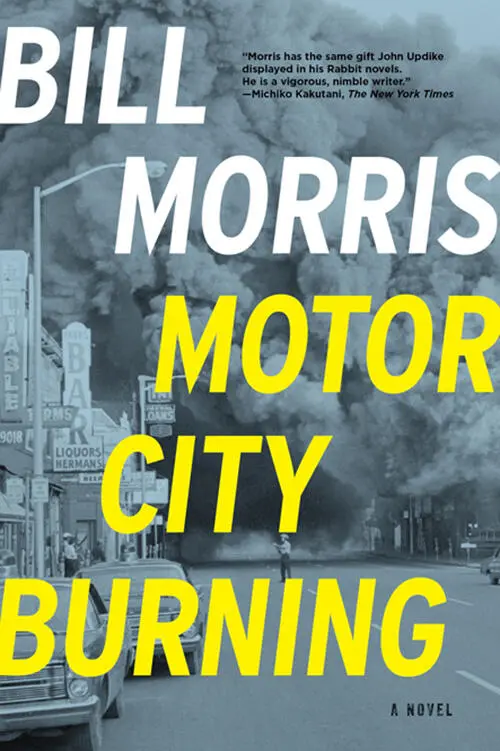
- Название:Motor City Burning
- Автор:
- Издательство:Pegasus
- Жанр:
- Год:2014
- ISBN:нет данных
- Рейтинг книги:3 / 5. Голосов: 1
-
Избранное:Добавить в избранное
- Отзывы:
-
Ваша оценка:
Motor City Burning: краткое содержание, описание и аннотация
Предлагаем к чтению аннотацию, описание, краткое содержание или предисловие (зависит от того, что написал сам автор книги «Motor City Burning»). Если вы не нашли необходимую информацию о книге — напишите в комментариях, мы постараемся отыскать её.
The surprise return of his Vietnam veteran brother in the spring of 1967 gives Willie a chance to drive a load of smuggled guns to the Motor City — and make enough money to jump-start his stalled dream of writing his movement memoir. There, at Tiger Stadium on Opening Day of the 1968 baseball season — postponed two days in deference to the funeral of Martin Luther King, Jr. — Willie learns some terrifying news: the Detroit police are still investigating the last unsolved murder from the bloody, apocalyptic riot of the previous summer, and a white cop named Frank Doyle will not rest until the case is solved. And Willie is his prime suspect.
Motor City Burning — читать онлайн бесплатно полную книгу (весь текст) целиком
Ниже представлен текст книги, разбитый по страницам. Система сохранения места последней прочитанной страницы, позволяет с удобством читать онлайн бесплатно книгу «Motor City Burning», без необходимости каждый раз заново искать на чём Вы остановились. Поставьте закладку, и сможете в любой момент перейти на страницу, на которой закончили чтение.
Интервал:
Закладка:
He could see that there was a word for what he had to do if he ever hoped to be free. He had to repudiate the world that made him — his parents’ world, the world of the movement, the world of the black striver — and then he had to learn to live by his own rules. That was the only path to true freedom.
He thought of the scene awaiting him back in the Quarters — the dice and the playing cards, the empty beer bottles and crushed cigarette butts of men who’d done what they had to do to make it through another night. As Willie had known for years, and as the author of Black Like Me discovered during his travels in the Deep South, those men understood that they had no options. They had to dull their senses with whatever was available and they had to laugh, had to laugh as hard as they knew how because if they ever stopped laughing they would start sobbing, and once they started sobbing they would be as good as dead. That would be the end of them, admitting how close they lived to despair. But at least those snoring men had never bought into the illusion that Willie once bought into and that his parents and his Uncle Bob still bought into — that education or religion or a change of scenery or political activism or the right president could possibly change the way their lives were destined to play out. There wasn’t a romantic or an idealist among those sleeping men. Much as he loathed Hudson and Wiggins, Willie had to admit he admired their toughness and their fatalism. They reminded him of his Aunt Nezzie, the toughest and most fatalistic — the bravest — person he’d ever known. She knew for a fact that there would never be anything new under the sun, and that suited her just fine. She wouldn’t dream of registering to vote or going to church, of admitting that some politician or some preacher or some new law might be her salvation. She had no desire to be saved. She was content to live by her own lights. Yes, Aunt Nezzie was the bravest person Willie had ever known.
Again he smelled his hands and thought of the lie he’d just told Blythe Murphy out on the parking lot. She was not his first white woman. Nancy Fegenbaum was his first white woman, his dark secret and, until this night, the source of a scalding shame.
Nancy Fegenbaum was a sophomore at Vassar, a stunning Jewish girl from Westchester County outside New York City, one of the volunteers who came south in droves from the best northern colleges for the Freedom Summer of 1964. Like most Snick veterans, Willie viewed these new arrivals as a bunch of anarchists, dopers and floaters. He dismissed the occasional Negro among them as nothing more than a freedom-high nigger.
But Nancy was different. She truly believed they could change the world. She truly believed the races could, and should, live in harmony. She did menial jobs without complaint, and she didn’t make fun of southern accents or boss people around the way so many of the northern students did. She was also a knockout with olive skin who wore her hair in long, thick henna-colored ringlets and believed a brassiere was an unnecessary encumbrance in the Mississippi heat. Willie couldn’t take his eyes off her, and every time she caught him staring she gave him an asking look, followed by a smile. Never in his life had he gazed so brazenly at a white woman, and he found it both terrifying and thrilling. Thrilling because it was terrifying. Terrifying because it could get him killed.
They taught typing and American history together in one of the Freedom Schools in McComb, Mississippi. One day they got sent over to Alabama to post voter-registration drive flyers in and around Tuskegee. Such long-distance jobs usually fell to Willie because his Buick was one of the most dependable cars in the Sojourner Motor Fleet. After he and Nancy worked into the early evening posting the flyers, they decided it would be unwise to risk driving the 300 miles back to Mississippi in the dark. The three volunteers who’d disappeared while driving at night near Meridian were still missing. Willie suggested they spend the night in his apartment in Tuskegee, which was doubling as a safe house for Freedom Summer volunteers. There was no one staying there that night, and he offered to sleep on the sofa and let her have the bedroom.
Nancy was on him as soon as the door clicked shut. Willie didn’t put up much of a fight, and neither of them did a whole lot of sleeping that night.
And neither of them said a word about it afterwards. In fact, Nancy hardly spoke to him at all the rest of the summer. He realized he’d performed his function and was no longer of any use to her. If he felt anger, it was at himself for allowing himself to be so casually used. She’d flipped the tables and he never saw it coming. But his shame was real: he had taken the bait, he’d fallen into the very trap his mother had warned him about, the one the white man so badly wanted him to fall into. For reasons he never would have been able to imagine in the spring of 1964, he was glad when the volunteers packed up at the end of the summer and went back up north where they belonged. He had survived that bloody summer with nothing worse than a bruised ego and a guilty conscience.
Now, four long years after that night with Nancy Fegenbaum, he had finally overcome his guilt and his shame. He understood that this was a first step, a giant step, on the road to repudiating the world that made him. But even as he congratulated himself for taking this step, he could see that he had also stepped into yet another world of worry. Chick Murphy was not a man to fuck with. He was rich and powerful, he was white, and he had a temper and a gun. The thing that had been so thrilling to Willie just a few hours ago — the danger of being with such a man’s wife — now looked like exactly what it was: stone craziness. Thrills, by nature, are fleeting things, but this one had not even survived the night. Willie had a terrifying vision of Blythe Murphy, in a drunken rage, screaming at Chick how much she adored Willie Bledsoe’s black cock. .
He heard the chugging of a motor coming toward him. It was a member of the Oakland Hills grounds crew driving a cart full of rakes and tools across the golf course. It looked like one of those carts the traffic cops drove in Detroit. The sun was out of the trees now and the sky’s blue was giving way to a harsh white glare. The coming day was going to be hot — not Alabama hot, but still hot and gummy. Willie turned back toward the clubhouse, keeping to the trees.
On the long walk back, he forced himself to quit thinking about Nancy Fegenbaum and the Murphys and start thinking about the bigger danger — the detective who’d visited his Uncle Bob. Willie took the visit as a sign. The cops knew a lot more than he thought they knew, and he had done almost nothing to cover his tracks. It was time to quit fucking around.
As soon as he got through the lunch shift today, he would get the Buick out of the garage and drive it to that Earl Scheib shop on Livernois and get a twenty-dollar paintjob. Then, on his next day off, he would drive to Murphy Buick and swap it for whatever the Surf offered. Just get rid of the damn thing.
After that he would have to sit tight and wait for his brother to call from Denver. He told himself that once he got rid of the Buick and found out what had happened to those last three guns, he would be in the clear.
Unless, of course, the cops were somehow able to prove that the unthinkable had happened that night on the roof of the Larrow Arms. That was still the one great unknown piece of this puzzle. That was still the thing that terrified him the most.
14
THE DAY AFTER HE TALKED TO BOB BREWER AND MADE THE pickup about the traffic stop, Doyle got sent out on a fatal stabbing at the Brewster projects. He didn’t want to get distracted from the Helen Hull case — again — but fresh homicides always took precedence over old ones, so he followed Sgt. Harry Schroeder’s orders and worked the Brewster case non-stop for a week, until he got a confession after grilling a scared teenager all night in the yellow room. After a few hours of sleep at home, Doyle walked into the squad room shortly before noon and went straight to the Bunn-O-Matic, yawning like an alligator.
Читать дальшеИнтервал:
Закладка:
Похожие книги на «Motor City Burning»
Представляем Вашему вниманию похожие книги на «Motor City Burning» списком для выбора. Мы отобрали схожую по названию и смыслу литературу в надежде предоставить читателям больше вариантов отыскать новые, интересные, ещё непрочитанные произведения.









Обсуждение, отзывы о книге «Motor City Burning» и просто собственные мнения читателей. Оставьте ваши комментарии, напишите, что Вы думаете о произведении, его смысле или главных героях. Укажите что конкретно понравилось, а что нет, и почему Вы так считаете.