Arnon Grunberg - The Jewish Messiah
Здесь есть возможность читать онлайн «Arnon Grunberg - The Jewish Messiah» весь текст электронной книги совершенно бесплатно (целиком полную версию без сокращений). В некоторых случаях можно слушать аудио, скачать через торрент в формате fb2 и присутствует краткое содержание. Год выпуска: 2008, Издательство: Penguin Group US, Жанр: Современная проза, на английском языке. Описание произведения, (предисловие) а так же отзывы посетителей доступны на портале библиотеки ЛибКат.
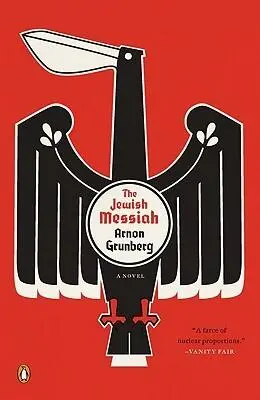
- Название:The Jewish Messiah
- Автор:
- Издательство:Penguin Group US
- Жанр:
- Год:2008
- ISBN:нет данных
- Рейтинг книги:4 / 5. Голосов: 1
-
Избранное:Добавить в избранное
- Отзывы:
-
Ваша оценка:
The Jewish Messiah: краткое содержание, описание и аннотация
Предлагаем к чтению аннотацию, описание, краткое содержание или предисловие (зависит от того, что написал сам автор книги «The Jewish Messiah»). Если вы не нашли необходимую информацию о книге — напишите в комментариях, мы постараемся отыскать её.
) Arnon Grunberg is one of the most subtly outrageous provocateurs in world literature.
, which chronicles the evolution of one Xavier Radek from malcontent grandson of a former SS officer, to Jewish convert, to co- translator of Hitler's
into Yiddish, to Israeli politician and Israel's most unlikely prime minister, is his most outrageous work yet. Taking on the most well-guarded pieties and taboos of our age,
is both a great love story and a grotesque farce that forces a profound reckoning with the limits of human guilt, cruelty, and suffering. It is without question Arnon Grunberg's masterpiece.
The Jewish Messiah — читать онлайн бесплатно полную книгу (весь текст) целиком
Ниже представлен текст книги, разбитый по страницам. Система сохранения места последней прочитанной страницы, позволяет с удобством читать онлайн бесплатно книгу «The Jewish Messiah», без необходимости каждый раз заново искать на чём Вы остановились. Поставьте закладку, и сможете в любой момент перейти на страницу, на которой закончили чтение.
Интервал:
Закладка:
Xavier threw himself on top of Awromele and pushed his Yiddish teacher’s head against the ground. There were streaks on Awromele’s face, even a little blood on his throat, where Xavier had sunk his nails into his flesh without thinking about it, the way the mother went looking for pain in the kitchen, concentrating only on the deed itself, no more outside world, no bridge club, no memories, only the bread knife and the thigh, a glorious vacuum.
“Awromele,” Xavier said. “Awromele, what are you doing?”
The most important thing is to know what can’t be taken from you, and Xavier had decided that Awromele could not be taken from him. They could take everything else, father, mother, home, nourishment, the roof over his head, but not Awromele.
“What are you running away for?” Xavier asked. He had his hands around the throat of the boy they couldn’t take from him, and he pressed gently against Awromele’s Adam’s apple. It had to hurt. It definitely had to hurt — he wanted a confession, and confessions do not come without pain. He wanted the truth, no more games. As though the truth ruled out games.
“Why did you run away?” Xavier asked again. “You don’t have to be afraid of me.” He let go of Awromele’s throat. Awromele still didn’t say a word. He lay there looking at Xavier’s face, at the head he had held in his hands not so long ago and then quickly let go of, the way you let go of a hot casserole.
“You don’t feel anything?” Awromele asked quietly. His throat still hurt where Xavier’s fingers had squeezed it. He had a stitch in his side, his mouth was dry, his head was pounding. There was disbelief in his voice, as though he feared that Xavier might feel something that shouldn’t be felt. As though it couldn’t be possible. As though it were too good to be true, a lie, meant to take you in and then, once you’ve been taken in, to cough you up again, to gobble you up, to make you a prisoner and a slave, because there’s nothing harder than letting go of the lies for which you’ve sold yourself.
“What do you mean?”
“You don’t feel anything?” Awromele asked.
“No,” Xavier said. “I don’t feel anything. Not now, and not ever. I’ve never felt anything.” He brought his face down closer to Awromele’s; he pressed his lips against Awromele’s, roughly, the way a plumber presses together two lengths of pipe before welding them together. He stuck his tongue in Awromele’s mouth; his tongue ran in circles around that mouth like a mouse in a plastic bag.
That is how their lives looked, that’s how they lay there. They were experiencing all kinds of things, but because there was no time to think about it, because there was no way they could possibly think about it, because he was there but at the same time not — not enough, in any case — Xavier had the idea that, if only for a second, he was experiencing nothing all over again. That he was still waiting for something more real; something inevitable, something you couldn’t refuse. That’s why he thrust his tongue even deeper into Awromele’s mouth, as far as it could go — to experience something, to find out what that was like.
Then he realized what a richness it was, Awromele’s mouth, and his tongue was a richness, too, but a strange, stupefying richness. One too good to be true, and therefore probably just another lie.
Xavier pulled his tongue out of Awromele’s mouth. “I don’t feel anything,” he said again. “That’s the truth. Never in my life have I felt anything. I don’t know what it is.” He pulled on Awromele’s hair, but not hard enough to tear it out. He tugged on it playfully, as though Awromele were a little animal.
Awromele wriggled out from under Xavier. His clothes were wet and dirty and torn here and there. There were mud spots on his gym socks. But Xavier pushed Awromele back onto the ground, onto half-decayed pinecones that animals had gnawed on, onto the peels, the apple cores, a ballpoint someone had lost or thrown away.
“We mustn’t feel anything,” Awromele said after Xavier had sat down on him again. “That’s the most important thing.” He was still short of breath. From running, from Xavier’s weight, from the glimpse he had caught of himself. He never wanted to see himself like that again. As a stranger.
“We won’t feel anything,” Xavier said. “I promise, in my family almost no one feels a thing; it isn’t hard to do, it happens by itself. We’ll never feel anything.”
Again he pressed his mouth to Awromele’s like a plumber; he took Awromele’s head in both hands like a sink that needs to be installed. He wasn’t sure where aggression ended and tenderness began, he didn’t know where death began and life ended, he no longer knew whom he hated more, himself or the boy lying on the moist ground and the apple cores. All he knew, but that he knew for sure, was that Awromele could not be taken from him. He was as certain of that as he was that he would comfort the Jews.
He licked the mud and the blood from Awromele’s face, like a cat cleaning its kittens. He ran his tongue across Awromele’s skin as though he wanted to taste everything, and couldn’t stop tasting now. Tasting — maybe that was the same thing as experiencing.
Awromele closed his eyes, because Xavier’s tongue was gliding over his eyelids. When he opened them again he said: “If we start feeling anything, we have to stop. As soon as we feel anything, we should never see each other again; then it will be like we’ve never known each other; then we have to forget each other completely; and then we have to tear up and burn every shred of evidence that shows we ever met.”
“Absolutely,” Xavier said. “But it’s not going to happen. We’ll never feel a thing, believe me.” He tugged at Awromele’s black plastic belt, he unbuttoned the black trousers. Awromele’s father had trousers just like these. A pair of white underpants peeked out at him. The sturdy kind, underpants that had seen the inside of a washing machine on hundreds of occasions. He slid the underpants down carefully and murmured: “Never will we feel a thing, Awromele, believe me. We can’t feel a thing. Where feeling starts, we end.”
Awromele’s sex wasn’t stiff, but it was circumcised. Circumcised differently from Xavier’s — better, more carefully, not as roughly, more neatly healed, that above all. Xavier stuck it in his mouth like a meatball, greedily but not too fast.
Xavier sucked, but tasted nothing. No taste, no skin, no special texture. And he thought, just as he had while lying on Mr. Schwartz’s bed: Accept, O Lord, this humble sacrifice.
That was how Xavier lay there, in the park, between Awromele’s legs, and at the same time he was somewhere else. On Bettina’s bed. He remembered how he had adopted the two villages in India. Why did he have to think about that now? It disgusted him; he should stop making those donations. Otherwise he’d think of India every time he put a weenie in his mouth.
Awromele’s sex gradually stiffened in Xavier’s mouth. That was pleasant. The satisfaction of having someone else’s sex expanding in his own mouth, the sensation, the hardness, he never wanted to forget that. He sucked harder.
“Ow,” Awromele shouted. “You’re biting me.”
Xavier stopped sucking. He climbed up from between Awromele’s legs and sat on his stomach again. “Sorry,” he said. “I’m sorry. It was an accident. I wanted to taste you — I’m just as inquisitive as you are — that’s all. I want to taste everything, too. Everything, everything. Everything.”
He leaned down to kiss Awromele, and for a second, perhaps only a fraction of a second, it seemed as though he was finally able to forget who he was. His father’s death, Marc’s love, his mother’s knife, nothing existed anymore, only Awromele’s mouth.
Читать дальшеИнтервал:
Закладка:
Похожие книги на «The Jewish Messiah»
Представляем Вашему вниманию похожие книги на «The Jewish Messiah» списком для выбора. Мы отобрали схожую по названию и смыслу литературу в надежде предоставить читателям больше вариантов отыскать новые, интересные, ещё непрочитанные произведения.





Обсуждение, отзывы о книге «The Jewish Messiah» и просто собственные мнения читателей. Оставьте ваши комментарии, напишите, что Вы думаете о произведении, его смысле или главных героях. Укажите что конкретно понравилось, а что нет, и почему Вы так считаете.