Arnon Grunberg - The Jewish Messiah
Здесь есть возможность читать онлайн «Arnon Grunberg - The Jewish Messiah» весь текст электронной книги совершенно бесплатно (целиком полную версию без сокращений). В некоторых случаях можно слушать аудио, скачать через торрент в формате fb2 и присутствует краткое содержание. Год выпуска: 2008, Издательство: Penguin Group US, Жанр: Современная проза, на английском языке. Описание произведения, (предисловие) а так же отзывы посетителей доступны на портале библиотеки ЛибКат.
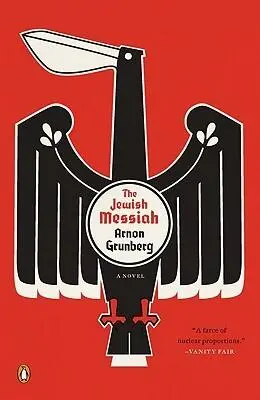
- Название:The Jewish Messiah
- Автор:
- Издательство:Penguin Group US
- Жанр:
- Год:2008
- ISBN:нет данных
- Рейтинг книги:4 / 5. Голосов: 1
-
Избранное:Добавить в избранное
- Отзывы:
-
Ваша оценка:
The Jewish Messiah: краткое содержание, описание и аннотация
Предлагаем к чтению аннотацию, описание, краткое содержание или предисловие (зависит от того, что написал сам автор книги «The Jewish Messiah»). Если вы не нашли необходимую информацию о книге — напишите в комментариях, мы постараемся отыскать её.
) Arnon Grunberg is one of the most subtly outrageous provocateurs in world literature.
, which chronicles the evolution of one Xavier Radek from malcontent grandson of a former SS officer, to Jewish convert, to co- translator of Hitler's
into Yiddish, to Israeli politician and Israel's most unlikely prime minister, is his most outrageous work yet. Taking on the most well-guarded pieties and taboos of our age,
is both a great love story and a grotesque farce that forces a profound reckoning with the limits of human guilt, cruelty, and suffering. It is without question Arnon Grunberg's masterpiece.
The Jewish Messiah — читать онлайн бесплатно полную книгу (весь текст) целиком
Ниже представлен текст книги, разбитый по страницам. Система сохранения места последней прочитанной страницы, позволяет с удобством читать онлайн бесплатно книгу «The Jewish Messiah», без необходимости каждый раз заново искать на чём Вы остановились. Поставьте закладку, и сможете в любой момент перейти на страницу, на которой закончили чтение.
Интервал:
Закладка:
Awromele tidied himself and his bed, drank two cups of tea without sugar at a nearby coffeehouse, and, purely out of nervousness, ate a bar of chocolate. Then he read Xavier’s letter three more times. He felt like writing back right away, he felt like writing: “I’ll be there, Xavier, I’ll be there. From now on, on the Mittlere Rheinbrücke, any hour of the day, even on Yom Kippur.”
He felt like calling Xavier to shout that same message through the phone, but he remembered his friend’s admonition and realized that he should keep a low profile. It wasn’t a good idea to seem too eager. It would be better for him to hide his eagerness.
He waited for Thursday the way other Jews wait for the Messiah. Never before had waiting made him so happy. To make the waiting even more pleasant, he bought himself a white shirt and a pair of gym socks. He still looked like an Orthodox Jew, but when it came to his socks he was already pretty well assimilated.
He also placed a call to the publisher who had expressed interest in the Yiddish translation of Mein Kampf . Awromele thought it would be a good idea to give his meeting with Xavier at least a semblance of something businesslike. And he would urge Xavier to resume his Yiddish lessons, he resolved. Xavier hadn’t learned the future and past tenses yet, and it would be a waste to stop so soon.
This time, it was Awromele, not Xavier, who arrived early at the bridge. He had washed his hair; he was wearing his gym socks and his new shirt. He paced in circles on the bridge like a leopard in a zoo.
One hour before they were to meet, Xavier had launched into a new painting of the mother with testicle in hand. He now had three mothers with testicle, but it seemed wise to him to create an entire series. The creative energy that coursed through his veins knew no moderation, and he considered that to be his strength. Once he’d decided to have himself circumcised, he’d had himself circumcised; once he came up with the plan to paint a whole series of mothers with testicle, he painted a series, and having come up with the brilliant idea of comforting the Jews, there would now be a whole lot of comforting going on.
The time did not seem ripe, however, for a series of mothers mutilating themselves in the kitchen. For all his immoderacy, he was a practical being.
The mother was sitting perfectly still in her chair. “Use me for your art,” she had told her son.
Xavier was looking forward to his rendezvous with Awromele, but he had other things on his mind as well. His newly discovered talent for painting; the mother, who got up in the middle of the night to do strange things in the kitchen; the rat poison she had once mixed with his milk. Strangely enough, though, that only made him love her more. Even though he couldn’t help wondering, each night at dinner, whether she might have sprinkled poison on the rice, or whether the croutons floating in the soup might not actually be chunks of rat poison. That made life more exciting, more intense.
The idea that each night could be his last, even if it was only an illusion, gave his life something he had missed in his parents’ house: Vitality. Tragedy. Redemption from the desperate sense that this was nothing but a pointless game.
But the mother had no intention of sprinkling poison: that period of her life was behind her now. She had found happiness in the arms of the bread knife. Her son had no way of knowing that — her son didn’t want to know that, not really. In that respect he was like so many others: it was all right to see something, all right to catch a glimpse of the abhorrent, the unspeakable, but not to let it get through to you, no, that would not help.
“I’m going out in a minute,” Xavier said. “We’ll finish this painting another time, okay, Mama?”
He had asked her to look at the jar while she was posing, and she had done so. She had kept looking at it, too, even while he was trying to talk to her. He took King David out of her hand and put him back in his usual place. She hardly seemed to notice.
“Mama, are you listening?” he asked, just to be sure. “I’m going out in a minute; we’ll finish it some other time.”
He put the easel in the hall, so no one would bump into it. Then he went back to the living room, where the mother was still sitting in her chair. She was staring at King David. What a measly testicle my son had, she was thinking, what a joke, that testicle. That the Committee of Vigilant Parents could have made such a fuss about that.
She thought about saying this to the boy. It would only help to toughen him up. But she decided it was too much bother. Besides, what good would it do?
The boy put away his brushes and paint.
“What’s it like to love someone?” the mother asked, still staring at King David. Her hands were folded in her lap. She liked posing; it may have been her real calling, even though her son’s paintings didn’t seem to her to amount to much. But perhaps Xavier, unlike King David, would grow to a kind of fullness. You could never tell. You could always hope for a miracle.
“What it’s like?” Xavier asked. He looked at the dried paint under his fingernails. He had to clean them before meeting Awromele. “I don’t know,” he said. “You should know better than I do. You’ve been married, you have a boyfriend. What Bettina and I had was never really serious, dear Mama.”
Ever since she had told him about the attempted poisoning, he had started addressing her as “dear Mama.” A mother who was prepared to poison her son had to love her son a great deal. Murder, as far as Xavier could see, was the logical extension of love. In fact, without murder, how could you really be sure that love had ever existed?
“Yes,” she said, “you’re right. I should know that. Where are you going?”
“I’m meeting some people from school.”
In the bathroom, he quickly cleaned his nails, washed his face, brushed his teeth, and decided: Even if Awromele isn’t waiting at the bridge, that’s okay, too. You can comfort people, but you can’t force them to be comforted.
AWROMELE WAS WAITING. He was pacing back and forth, and when he saw Xavier approaching in the distance, he ignored his own counsel, his concealed eagerness spurted out on all sides, and he ran towards Xavier, as though the comforter of the Jews were a train that might pull out of the station any moment.
The boys kissed each other on the nose and cheeks. Then Awromele said, “Look, gym socks.” He pulled up his pant legs a little to show Xavier the socks.
“Nice,” Xavier said. “Nice socks.”
Then Awromele unbuttoned his jacket and said, “New shirt.”
“Also nice, very nice. You’re looking good.” But even as Xavier said that, all he could think of was: How many strange men’s weenies has Awromele had in his mouth since I last saw him? How many were there? Twenty, thirty? Fifty, maybe?
Awromele remembered what he had resolved to do, and said: “I talked to the publisher. He’s getting more enthusiastic all the time. The spirit of the age is changing, apparently. Have you heard about that? I haven’t, but, then, I don’t read the paper.”
“I don’t, either, not much; I only flip through it sometimes,” Xavier said, casually taking Awromele’s soft hand in his. The obsessive thoughts had him in their grasp.
“How’s it coming along, anyway?” Awromele asked, pointing at Xavier’s crotch.
“Much better, thank you. I can barely feel it anymore. I’m so happy we had that done. I’m a new man. And better than before. I feel like a complete Jew now, with all the trimmings. But I was wondering. Maybe it’s kind of a weird question, but in the last few weeks have you by any chance had the weenies of strange men in your mouth?”
Читать дальшеИнтервал:
Закладка:
Похожие книги на «The Jewish Messiah»
Представляем Вашему вниманию похожие книги на «The Jewish Messiah» списком для выбора. Мы отобрали схожую по названию и смыслу литературу в надежде предоставить читателям больше вариантов отыскать новые, интересные, ещё непрочитанные произведения.




Обсуждение, отзывы о книге «The Jewish Messiah» и просто собственные мнения читателей. Оставьте ваши комментарии, напишите, что Вы думаете о произведении, его смысле или главных героях. Укажите что конкретно понравилось, а что нет, и почему Вы так считаете.