Arnon Grunberg - The Jewish Messiah
Здесь есть возможность читать онлайн «Arnon Grunberg - The Jewish Messiah» весь текст электронной книги совершенно бесплатно (целиком полную версию без сокращений). В некоторых случаях можно слушать аудио, скачать через торрент в формате fb2 и присутствует краткое содержание. Год выпуска: 2008, Издательство: Penguin Group US, Жанр: Современная проза, на английском языке. Описание произведения, (предисловие) а так же отзывы посетителей доступны на портале библиотеки ЛибКат.
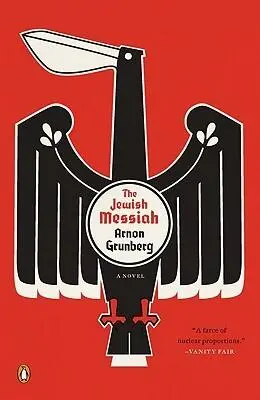
- Название:The Jewish Messiah
- Автор:
- Издательство:Penguin Group US
- Жанр:
- Год:2008
- ISBN:нет данных
- Рейтинг книги:4 / 5. Голосов: 1
-
Избранное:Добавить в избранное
- Отзывы:
-
Ваша оценка:
The Jewish Messiah: краткое содержание, описание и аннотация
Предлагаем к чтению аннотацию, описание, краткое содержание или предисловие (зависит от того, что написал сам автор книги «The Jewish Messiah»). Если вы не нашли необходимую информацию о книге — напишите в комментариях, мы постараемся отыскать её.
) Arnon Grunberg is one of the most subtly outrageous provocateurs in world literature.
, which chronicles the evolution of one Xavier Radek from malcontent grandson of a former SS officer, to Jewish convert, to co- translator of Hitler's
into Yiddish, to Israeli politician and Israel's most unlikely prime minister, is his most outrageous work yet. Taking on the most well-guarded pieties and taboos of our age,
is both a great love story and a grotesque farce that forces a profound reckoning with the limits of human guilt, cruelty, and suffering. It is without question Arnon Grunberg's masterpiece.
The Jewish Messiah — читать онлайн бесплатно полную книгу (весь текст) целиком
Ниже представлен текст книги, разбитый по страницам. Система сохранения места последней прочитанной страницы, позволяет с удобством читать онлайн бесплатно книгу «The Jewish Messiah», без необходимости каждый раз заново искать на чём Вы остановились. Поставьте закладку, и сможете в любой момент перейти на страницу, на которой закончили чтение.
Интервал:
Закладка:
He woke up in the middle of the night, having dreamed of Awromele. It had been a grim dream. “Where are you, Awromele?” he had felt like shouting. When he went to the bathroom for a drink of water, he heard sounds coming from downstairs. It might be a burglar, he thought, or a window his mother had forgotten to close. But the mother never forgot to close windows and doors.
Xavier went downstairs. He wasn’t afraid. Losing Awromele was the only thing he was afraid of. There were moments when he thought he had already lost him. Perhaps on the very first day they’d met, when he had been unable to come up with a dirty joke for Awromele to translate into Yiddish.
In the kitchen, Xavier did not find a burglar or an open window. Only the mother, standing in front of the dish rack, her pink pajama pants around her ankles, a bread knife in her right hand.
A little lamp was burning above the fridge; the mother didn’t need much light, she could find the wound by touch.
Blood was dripping from the mother’s thigh. Xavier looked at her without a word. She put the knife in the sink, pressed a dishtowel to the wound. “Sorry,” she said, “sorry.” She didn’t really know whom she was speaking to — maybe to herself, maybe to You-Know-Who, she wasn’t sure. She stood there as though this was where she belonged, as though this was her spot, as though she was predestined to this, to this forbidden love — for love it was — between her and the knife, which could no longer be denied.
Xavier was wearing only a T-shirt and underpants. He rubbed the back of his neck. What he felt like doing the most was running right back upstairs, going back to his dreams of Awromele, horrible as those dreams were. The most horrible dream about Awromele was better than this. But the mother had already seen him; he couldn’t run away. Now he had to stay in the kitchen, now he had to talk.
“Mama,” he said quietly. He didn’t want to wake Marc, especially not tonight. Marc had to remain asleep, deep and peaceful, dreaming about his great and naughty love. “What are you doing?” There was tenderness in his voice. Tenderness was something Xavier had a lot of.
The question was unnecessary. What she was doing was quite clear.
She looked at the boy. For the first time in years, she felt some compassion for her son. Not a lot, but enough, enough for a lifetime, as far as she was concerned. She would rather have had a daughter. Even more, she would rather have had nothing at all. But when she saw her son standing there in her kitchen, so shocked, so little and afraid — yes, she saw that, his fear, that he was afraid of her — then deep down inside she enjoyed it, for no one had ever been afraid of her. Then she loved him for a moment. Against her judgment, for she knew it wasn’t good for her. The way you might put food in your mouth even though you know you’re allergic to it.
“I’m living,” she said. “Can’t you see that? I’m living.”
She smiled magnanimously, the way a loser smiles when he receives halfhearted applause, and started washing off the knife. The dishtowel fell onto her pajama pants, which were still around her ankles. Xavier said, “But, Mama, it’s the middle of the night.” She had to lean against the counter to keep from fainting. Perhaps she had lost too much blood, perhaps she had done it too often, stabbed too often into that same wound. Or maybe it was seeing her son, that terrible and at the same time delicious feeling of being caught red-handed. Caught at last. When she was little, she had always wanted to catch her parents at it, but she had never been able. Now she wanted to be caught herself. “You need to get some sleep, Mama,” Xavier said. “It’s the middle of the night. You don’t have to apologize. But you do have to get some sleep.”
Xavier had seen something he was not supposed to see, something that would make him look at the mother differently from now on. He would see her with a knife in the kitchen, while the rest of the family was asleep, her pajamas down around her ankles. So that was living. You did it in the kitchen, you did it at night with a bread knife in your hand, and you had to apologize for it.
The mother sighed. She bent down to pick up the dishtowel and pressed it against the wound again.
“Has he been fiddling with you?” the mother asked as she put the knife in the dish rack, beside the teacups she had washed carefully that evening.
“Who?”
“My boyfriend. Has he been fiddling with you, the way he used to fiddle with me?”
“No, never,” Xavier said. “Really, never.”
The mother smiled magnanimously again, as though hearing lies that she, to keep the peace, had decided not to unmask any further. She seemed to be in a trance, yet in a completely different, impenetrable world.
“If he does,” she said, “I want you to let me know.”
“All right,” Xavier said, “I’ll let you know. But it’s not going to happen, Mama, really, it’s not going to happen.”
“He never fiddled with me much, either,” the mother said, adjusting the dishtowel slightly, because the blood had started to trickle through.
“Who?”
Xavier barely dared to look at his mother; he especially didn’t dare to look at the dishtowel. That bloody dishtowel at his mother’s thigh seemed to exercise on him an attraction almost as great as Awromele’s.
“My boyfriend, who else?” The mother stared at the sink, then wiped at it absentmindedly with a sponge. “That first night, and then two or three times after that, but no more. What about you? How often does he fiddle with you?” She squeezed the water out of the sponge.
“Never, Mama, really,” Xavier said. “Really, never. I swear.” He took a step towards her, but didn’t dare touch her. What he saw when he looked at her was mostly the dishtowel, which had turned a dark red in places. A neatly ironed dishtowel: she ironed everything, even the dishtowels.
“Do you want me to get you a bandage?”
“No,” the mother said, “no, absolutely not — a bandage. But maybe he can’t do it anymore.” She laughed as though this were a joke. The bandage, or his not being able to do it anymore, or maybe both.
“Can I do anything for you, Mama? Do you want me to take you upstairs? Shall we both go up and go to sleep?” Xavier asked. His vocal cords had started to hurt from talking so quietly. But he really wanted to do something for her.
“Your father didn’t, either,” the mother said quietly, still holding on to the counter. “Once every four or five months, and then in a very special way. Well, he was afraid of having children — that’s why he could only do it in that special way.”
“Oh, Mama,” Xavier said, “he’s dead anyway. It doesn’t matter anymore. He’s dead.”
“Yes,” she said, “he’s dead. He is, anyway.”
She pushed aside a bottle of liquid detergent. Her mouth was dry. Cutting into your own flesh dried you out, like walking in the desert. She had friends in her bridge club who were going to go walking in the desert two weeks from now, and then spend two weeks at the beach to recover from the desert. Lazy vacations were better when you had something to recover from. If you came out of a concentration camp, all life would probably be one long, lazy vacation.
“What can I do for you?” Xavier asked. “Please, tell me, aren’t you cold? Shall we have a cup of tea?”
He came another step closer; there was still half a yard between him and his mother. On the kitchen floor he saw a few drops of blood. Somewhere in the distance a dog barked.
“I want you to look at me,” the mother said. “I want you to take a good look at me, so you can paint me. Later on. Then I want you to paint me the way I am right now, in the kitchen. You mustn’t tell anyone — no one must know — I just want you to paint me.”
Читать дальшеИнтервал:
Закладка:
Похожие книги на «The Jewish Messiah»
Представляем Вашему вниманию похожие книги на «The Jewish Messiah» списком для выбора. Мы отобрали схожую по названию и смыслу литературу в надежде предоставить читателям больше вариантов отыскать новые, интересные, ещё непрочитанные произведения.







Обсуждение, отзывы о книге «The Jewish Messiah» и просто собственные мнения читателей. Оставьте ваши комментарии, напишите, что Вы думаете о произведении, его смысле или главных героях. Укажите что конкретно понравилось, а что нет, и почему Вы так считаете.