Albert Sanchez Pinol - Victus - The Fall of Barcelona
Здесь есть возможность читать онлайн «Albert Sanchez Pinol - Victus - The Fall of Barcelona» весь текст электронной книги совершенно бесплатно (целиком полную версию без сокращений). В некоторых случаях можно слушать аудио, скачать через торрент в формате fb2 и присутствует краткое содержание. Год выпуска: 2014, Издательство: Harper, Жанр: Современная проза, на английском языке. Описание произведения, (предисловие) а так же отзывы посетителей доступны на портале библиотеки ЛибКат.
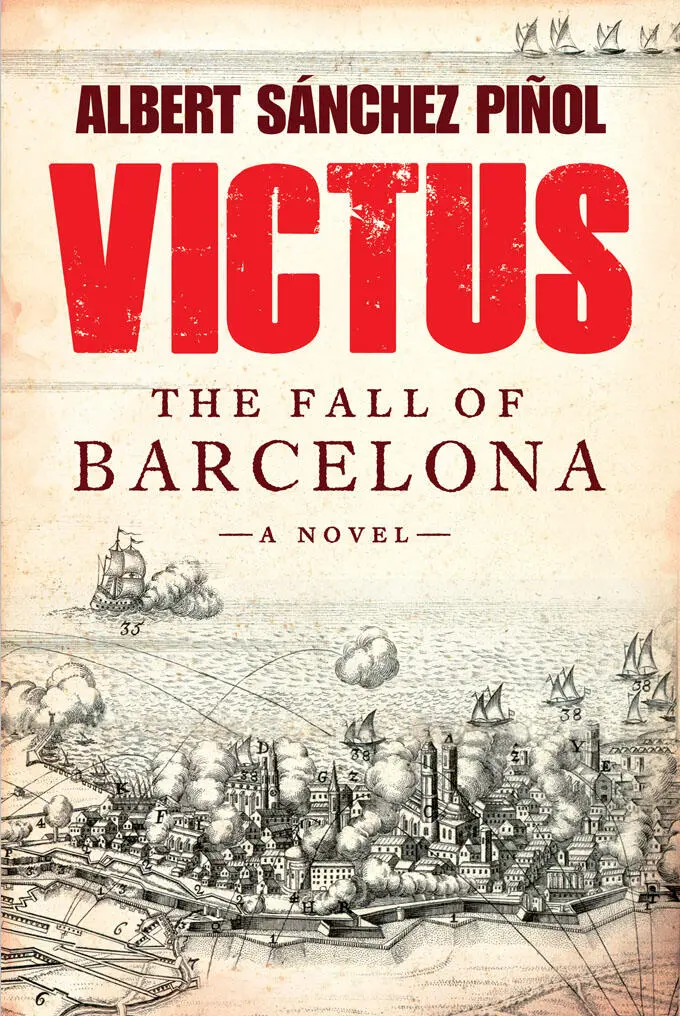
- Название:Victus: The Fall of Barcelona
- Автор:
- Издательство:Harper
- Жанр:
- Год:2014
- ISBN:нет данных
- Рейтинг книги:3 / 5. Голосов: 1
-
Избранное:Добавить в избранное
- Отзывы:
-
Ваша оценка:
Victus: The Fall of Barcelona: краткое содержание, описание и аннотация
Предлагаем к чтению аннотацию, описание, краткое содержание или предисловие (зависит от того, что написал сам автор книги «Victus: The Fall of Barcelona»). Если вы не нашли необходимую информацию о книге — напишите в комментариях, мы постараемся отыскать её.
Why do the weak fight against the strong? At 98, Martí Zuviría ponders this question as he begins to tell the extraordinary tale of Catalonia and its annexation in 1714. No one knows the truth of the story better, for Martí was the very villain who betrayed the city he was commended to keep.
The story of Catalonia and Barcelona is also Martí’s story. A prestigious military engineer in the early 1700s, he fought on both sides of the long War of the Spanish Succession between the Two Crowns — France and Spain — and aided an Allied enemy in resisting the consolidation of those two powers. Politically ambitious yet morally weak, Martí carefully navigates a sea of Machiavellian intrigue, eventually rising to a position of power that he will use for his own mercenary ends.
A sweeping tale of heroism, treason, war, love, pride, and regret that culminates in the tragic fall of a legendary city, illustrated with battle diagrams, portraits of political figures, and priceless maps of the old city of Barcelona, Victus is a magnificent literary achievement that is sure to be hailed as an instant classic.
Victus: The Fall of Barcelona — читать онлайн бесплатно полную книгу (весь текст) целиком
Ниже представлен текст книги, разбитый по страницам. Система сохранения места последней прочитанной страницы, позволяет с удобством читать онлайн бесплатно книгу «Victus: The Fall of Barcelona», без необходимости каждый раз заново искать на чём Вы остановились. Поставьте закладку, и сможете в любой момент перейти на страницу, на которой закончили чтение.
Интервал:
Закладка:
“Ballester!” cried Peret, terrified. “Ballester’s coming!”
Ballester! My old friend who had become one of the most notorious and cruel Miquelets — though I have already explained to you that in Catalonia, the word “Miquelet” could mean many things.
The chocolatada , as I have said, took place on a high plateau. I climbed up on a rocky promontory and could see what would soon be upon us: a group of light cavalry, still some distance away. To judge by the dust raised by their hooves, there must have been a good dozen of them.
Panic transforms people into a herd. Everybody was shouting and running. The wealthiest, who had come on their own horses, fled at a gallop, leaving their lovers behind (and most unscrupulously, indeed — ah, love!). The rest didn’t really know what to do; animal instinct sent them inside the abandoned masía . Nan and Anfán were running, holding Amelis’s hands. They, too, went into the masía , and I was right behind them.
Inside, people were crushed together like cattle, because even though it was a spacious place, the partition walls had fallen in long ago. The women wept and hugged one another, the men tore their hair. I shouted for silence.
“Anyone planning to do anything,” I yelled, “or should we just wait here to be sacrificed like little lambs?”
A gallant in his best glad rags stepped forward. “What are you saying?” he said. “You with your baby face, and the man who’s coming for us is Ballester!”
“I was pretty sure it wasn’t Saint Peter on horseback!” I replied, and turned to address the whole crowd: “So are we going to do something, or aren’t we?”
“Listen to the big captain here!” The gallant was mocking me again. “These people bugger little boys like you for breakfast!”
There was a rotten old table. I climbed up on it. “Listen to me, all of you: If you do everything I tell you, there’s a chance we might get out of this alive.”
But again the gallant spoke up: “The men coming this way are professional killers, and they have an arsenal. All we’ve got here are women, children, and doddering old men. The house is in ruins, and you mean to defend it.” He pointed at the entrance. “There isn’t even a door!”
Something flashed through my head. If I’d had the time to think, believe me, my answer would have been rather different. But the situation was so urgent, and at the same time so desperate, that I could not do it. Which was why I sighed and, emphasizing each word, said: “ We are the door.”
“They will slit our throats and rape the women!” the gallant insisted.
“That’s precisely why we mean to fight, you dolt!” I shouted. “When they see that they can get neither booty nor ransom, nor steal any horses, they will slit a few throats for their amusement and go riding on our women.” I pointed to Amelis. “That’s my woman, and I swear no one will touch her. They shall not!”
There are many different kinds of silence. The silence of desperation, the silence of reflection, the silence of peace: Every one is different, and that particular one reeked of doubt. Then somebody said, “They raped me once, a long time ago.”
It was a little old woman, the kind who still crackled with energy. She looked at the gallant while pointing a finger my way. “And on that day I would have liked to have a ‘little boy’ like this one around.” Then, looking at me, she said: “I’m just an old bag, but if you tell me to, I will stone anyone who sets foot through that door. What have I got to lose?”
Murmurs. That voice, humble but firm, was able to transform fear into anger. Peret came over to the table. He took hold of one of my ankles and said, petrified, “But Martí, lad, whatever do you think we poor wretches can possibly do?”
“First of all, pile up all the weapons we have, here on this table,” I replied.
I got down from the table, and the men who were carrying weapons brought them over. As usually happens, the most heavily armed are the most cowardly; the gallant took out two large pistols and a dagger. Altogether, we gathered six pistols and fifteen knives of varying sizes. The most pitiful of arsenals.
“Superb!” I cried, giving a sterling performance. “You see? With all this, we could defend Sagunto itself.”
As I’ve said, Catalan masías are designed like miniature fortresses, capable of repelling assaults from all four sides. Walls as thick as the ramparts of a city, windows as narrow as arrow-slits perpendicular to the ground, stone roofs that will not set fire: Even though it was falling into ruin, it remained a significant fortification.
I asked the women to pile up some good-sized stones. The roof had partly fallen in; using the rubble and the remains of the furniture, the men improvised a way up to the top. From there they could shoot, or at least throw stones, at anyone who approached. Others used the rubble to build a barricade — though a more symbolic barrier than an actual one — blocking the door. I told the children to go search in the corners. I squatted down beside Anfán. “Look underneath the floorboards; you’re sure to find something.”
And they did. Every masía has its own arsenal. In the floor of what must have been the main bedroom, Anfán and Nan found a dusty trapdoor. They opened it. Inside were four muskets. Rusty, two of them missing their stocks, but muskets all the same.
“What do you want us to do with this junk?” someone asked.
“Clean the barrels.”
“They’re here!” It was one of the lookouts; the only thing we weren’t short of was eyes.
For some time, the horsemen did not approach. They went round and round the masía , sniffing about, little more than that. I was running from one end to the other, asking the people stationed there: “What are they doing?”
“Nothing. Just loitering and looking.”
To the defenders, the time spent waiting for an attack is immeasurably worse than the attack itself; we needed to stop ourselves from imagining its horrors, at all costs. I decided to go outside. Amelis tried to hold me back.
“Who do you think should go and speak for us, then?” I said. “That gallant? Peret? You can be sure that Nan and Anfán won’t be leaving your side.”
“They’re bandits! They won’t be reasoned with.”
She was weeping tears of rage, furious with me, as though I had just confessed to her that I had a lover. She pummeled my chest with both fists. “They’ll kill you! They’ll kill you!” She turned and walked away.
You see? It is easier to reason with bandits than with women. And as for you, woman, don’t give me that look — just write down what I say.
We moved the fragile barricade from the doorway, and I stepped outside.
One of the bandits on horseback approached and then stopped about twenty feet away, scrutinizing me. I’d come up with no better idea than simply looking indifferent. I greeted him with a forced smile, touching the tip of my tricorn hat with my fingertips. He rode off. Then his boss appeared, escorted by four horsemen on either side. Ballester.
He had changed since we’d met in Beceite and at the inn. He’d aged; he seemed more used to that life of assault and flight. I could see that his eyes were sunken, as though their sockets were twice as deep as most people’s. He was not especially ugly, since ferocity can have its appeals. But with those sunken eyes, his eyebrows solid and dark like rope, and a thick, incredibly black beard, he had the look of a man who cared little for age or such things. He sported a pair of pistols either side of his upper torso; in a sticky situation, he could cross his arms and draw them in a flash.
I will always remember that look on Ballester’s face. His eyes had their own eloquence. And it was contradictory. They said, I’m going to kill you , and at the same time, they said, Let’s talk . Those who could not see the second fled.
Читать дальшеИнтервал:
Закладка:
Похожие книги на «Victus: The Fall of Barcelona»
Представляем Вашему вниманию похожие книги на «Victus: The Fall of Barcelona» списком для выбора. Мы отобрали схожую по названию и смыслу литературу в надежде предоставить читателям больше вариантов отыскать новые, интересные, ещё непрочитанные произведения.







Обсуждение, отзывы о книге «Victus: The Fall of Barcelona» и просто собственные мнения читателей. Оставьте ваши комментарии, напишите, что Вы думаете о произведении, его смысле или главных героях. Укажите что конкретно понравилось, а что нет, и почему Вы так считаете.