Pasha Malla - People Park
Здесь есть возможность читать онлайн «Pasha Malla - People Park» весь текст электронной книги совершенно бесплатно (целиком полную версию без сокращений). В некоторых случаях можно слушать аудио, скачать через торрент в формате fb2 и присутствует краткое содержание. Год выпуска: 2012, Издательство: House of Anansi Press, Жанр: Современная проза, на английском языке. Описание произведения, (предисловие) а так же отзывы посетителей доступны на портале библиотеки ЛибКат.
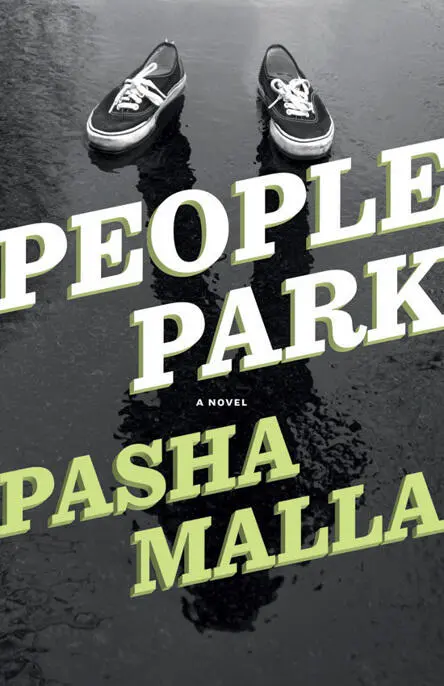
- Название:People Park
- Автор:
- Издательство:House of Anansi Press
- Жанр:
- Год:2012
- ISBN:нет данных
- Рейтинг книги:3 / 5. Голосов: 1
-
Избранное:Добавить в избранное
- Отзывы:
-
Ваша оценка:
People Park: краткое содержание, описание и аннотация
Предлагаем к чтению аннотацию, описание, краткое содержание или предисловие (зависит от того, что написал сам автор книги «People Park»). Если вы не нашли необходимую информацию о книге — напишите в комментариях, мы постараемся отыскать её.
People Park is a tour de force of eerily prescient, grotesque, and hilarious observation and a narrative of gripping, unrelenting suspense. Malla writes as if the twin demons of Stephen King and Flannery O'Connor were resting on his shoulders. You've never read anything quite like People Park.
People Park — читать онлайн бесплатно полную книгу (весь текст) целиком
Ниже представлен текст книги, разбитый по страницам. Система сохранения места последней прочитанной страницы, позволяет с удобством читать онлайн бесплатно книгу «People Park», без необходимости каждый раз заново искать на чём Вы остановились. Поставьте закладку, и сможете в любой момент перейти на страницу, на которой закончили чтение.
Интервал:
Закладка:
That’s a lot of responsibility, honey, for a boy your age, said Pearl, blew her nose, tucked the tissue into her sleeve. Stay close, we can barely see anything.
We’ll get your knapsack, Gibbles, don’t worry, said Kellogg, with Elsie-Anne wobbling atop his shoulders.
Gip kept talking, his voice trembling and delicate. Every sentence swung up into a wavering interrogative, questions that weren’t questions, questions that only demanded being heard. The boy had come to life a bit since breakfast, Kellogg thought, eyeing him warily, but still seemed less than himself.
The Pooles came out of Lakeview Campground at the Ferryport, no boats were running. A sinew of fog linked Perint’s Cove to the Islet, where it collected in a cataractal haze. Otherwise the view south was promise-clear to the horizon.
Beyond the roundabout where Lakeside Drive met Park Throughline lights stabbed through the mist in crimson spears.
Did someone crash? Kellogg said, and slid Elsie-Anne down to a piggyback.
The fog parted: one car sheared in half in the ditch, another upturned onto its roof. Around the accident gathered emergency vehicles, sirens flashed, pink flares sparkled, yet the scene was silent.
Good thing we walked, said Kellogg.
Except now my knee’s bugging me, said Pearl, reaching down to massage it.
Is it, Kellogg said vacantly, watching two paramedics haul a stretcher out of the ditch and slide the body-shaped figure upon it into a waiting ambulance.
Limping slightly, Pearl led the family up the Throughline. Traffic was stalled bumper to bumper in the northbound lanes. To every car and van and truck corresponded a family, some huddled for warmth inside, others had unloaded lawnchairs and gathered around little bonfires on the shoulder. Farther along there looked to have been an accident, a white coupe angled into the ditch. Engines idled, but no one was going anywhere. There was no way off the island.
What’s everyone waiting for, said Gip.
To go home, said Kellogg.
To escape, said Pearl.
But there’s no bridge, said Gip, and don’t you think I could save all these people, Mummy? We have to get my book, what if someone found it and they don’t know that I’m the one who’s supposed to finish the illustration?
Gip, said Pearl. We’ll get your book. But this has to stop.
Kellogg set Elsie-Anne down. Dad’s a bit tired, you mind walking?
It’s okay, she said, hugging her purse. Familiar can help.
At the edge of the poplars the Throughline ducked underground and ran beneath the common all the way to Topside Drive, where it surfaced again at the gates of Island Amusements. The Pooles skirted the line of cars disappearing into the tunnel, climbed up top, and looked down into the park. Nothing below, just a milky wash of fog, the closest poplars appeared as shipmasts in a misty harbour.
Wow, said Kellogg. Think we can find anything in that?
I’ll do it, said Pearl.
How’s that, Pearly?
I’ll go get his bag. If it’s not there I’ll find someone. Event staff or whoever. You take the kids to the Museum. We can meet back up later. Go to Island Amusements maybe.
Not a bad idea, said Kellogg, and pulled the CityGuide out of his backpocket. How about it, guys, want to see some exhibits? They’ve got a model of the city there, Gibbles — and hey look at this! Kellogg tore out a coupon. Two-for-one entry for kids! One of you guys gets in free!
Why does Mummy keep leaving us? said Elsie-Anne.
Leaving us? Ha, Annie, she’s not leaving us. Just knows the city, she’ll be back.
Will she? said Elsie-Anne. Familiar’s not sure.
Kellogg frowned. I’m beginning to have it up to here with Familiar.
Yeah, Dorkus, said Gip, Mummy’s our only hope of finding the Grammar .
That’s the spirit, said Kellogg, wrapping his kids under his arms. This is Mummy’s town! If anyone’s going to find your knapsack, it’s Mummy. Right, Mummy?
Let’s hope, said Pearl.

A REAL WRITER, Isa Lanyess repeatedly told her staff, was meant to have a voice. Yet Debbie’s writer’s voice always felt distant, a vague echo toward which she’d only ever leant, squinting, like a deaf person with an ear trumpet. The voice was faint, or a hallucination, or there was too much clutter, too many other voices from outside and within, a cacophony of selves all clamouring for attention. All she could ever make out was its timbre: meek, timid and doubtful and meek.
The night before, down in the belly of the city, she’d gotten the closest she’d ever been to this voice, or something like it, before the power had gone out. Now Debbie sat in the window nook in a square of limpid daylight, the streets clogged with fog, trying to summon it back. But worry muddied her thoughts: where was Adine, had Debbie driven her away, would she come back? Over and over she replayed their fight, felt stupid for fleeing it, she should have stayed, said something. .
Maybe things could still be fixed with words, thought Debbie, and she decided to write Adine a letter. She fetched her notebook and settled back into the window nook. But where to begin? What she wrote had to be genuine, from that essential part of herself she’d almost found in Whitehall, not as the cartoonish maudlin goof she’d come to play against Adine’s cold cynic. But with the pen hovering over the page as always she was a little lost. What to say? How to say it?
All she could come up with were memories of happier times. Look, she wanted to tell Adine, see when we were happy, see how happy we can be? Though what was wrong with happiness, she thought. Maybe what they needed was exactly that — a celebration and reminder. She settled on a story: their first kiss.
They’d gone to Budai Beach so Adine could show Debbie how erosion would have swallowed her Sand City. The night was moonless. They slipped out of their shoes and sat where the waves swished up onto the shore and withdrew fizzing into the lake. Adine’s leg brushed Debbie’s, retreated, then she reached over with her toes and playfully pinched Debbie’s calf, and Debbie yelped and Adine leaned down to press her lips to Debbie’s leg. When she came up her face was close. Neither of them said anything. Everything felt a little lost in the dark. Trembling, Debbie leaned in and — miracle! — Adine was doing the same. They kissed and Debbie thought, This is the most perfect kiss in the history of kisses. And after an instant or forever Adine pulled away and said, Fuggin finally , holy shet.
Debbie recalled a funny interpretation that had always batted mothlike around the fringes of this memory: When we first kissed , wrote Debbie, it was like two halves of the same strawberry pressed back together . Reading this over, her cheeks flushed. She could hear Adine’s laugh, a skewer that pricked and went sliding into her heart, pictured her puckering her lips and teasing, Don’t be shy, put my strawberry together. Don’t make fun of me! Debbie’d wail. You’re mean!
She dropped her pen. Here she was once again, performing herself in caricature. Always Debbie gushed and swooned, safely mawkish and too much, and Adine played the cruel realist, cutting her down with jokes. Though it felt good to make her laugh, and eventually Debbie would be laughing too. This dynamic preserved the illusion that they were still having fun — and it was, actually, fun. But also exhausting: fearing them corny Debbie buried her most heartfelt thoughts somewhere inaccessible even to herself. And Adine? She wondered if their theatrics had numbed Adine to her own heart entirely.
From the front door came a creaking sound.
Читать дальшеИнтервал:
Закладка:
Похожие книги на «People Park»
Представляем Вашему вниманию похожие книги на «People Park» списком для выбора. Мы отобрали схожую по названию и смыслу литературу в надежде предоставить читателям больше вариантов отыскать новые, интересные, ещё непрочитанные произведения.









Обсуждение, отзывы о книге «People Park» и просто собственные мнения читателей. Оставьте ваши комментарии, напишите, что Вы думаете о произведении, его смысле или главных героях. Укажите что конкретно понравилось, а что нет, и почему Вы так считаете.