Pasha Malla - People Park
Здесь есть возможность читать онлайн «Pasha Malla - People Park» весь текст электронной книги совершенно бесплатно (целиком полную версию без сокращений). В некоторых случаях можно слушать аудио, скачать через торрент в формате fb2 и присутствует краткое содержание. Год выпуска: 2012, Издательство: House of Anansi Press, Жанр: Современная проза, на английском языке. Описание произведения, (предисловие) а так же отзывы посетителей доступны на портале библиотеки ЛибКат.
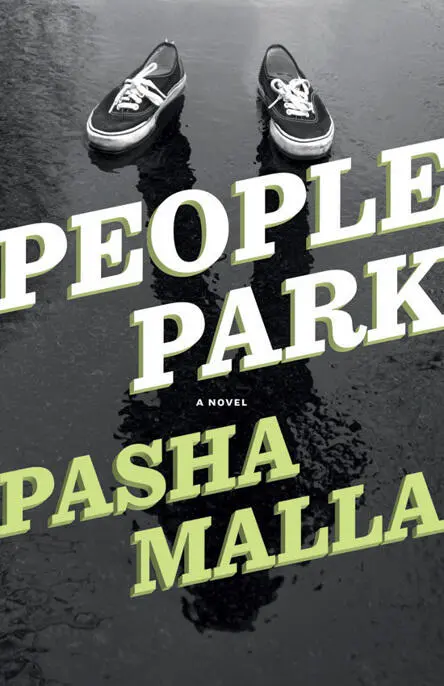
- Название:People Park
- Автор:
- Издательство:House of Anansi Press
- Жанр:
- Год:2012
- ISBN:нет данных
- Рейтинг книги:3 / 5. Голосов: 1
-
Избранное:Добавить в избранное
- Отзывы:
-
Ваша оценка:
People Park: краткое содержание, описание и аннотация
Предлагаем к чтению аннотацию, описание, краткое содержание или предисловие (зависит от того, что написал сам автор книги «People Park»). Если вы не нашли необходимую информацию о книге — напишите в комментариях, мы постараемся отыскать её.
People Park is a tour de force of eerily prescient, grotesque, and hilarious observation and a narrative of gripping, unrelenting suspense. Malla writes as if the twin demons of Stephen King and Flannery O'Connor were resting on his shoulders. You've never read anything quite like People Park.
People Park — читать онлайн бесплатно полную книгу (весь текст) целиком
Ниже представлен текст книги, разбитый по страницам. Система сохранения места последней прочитанной страницы, позволяет с удобством читать онлайн бесплатно книгу «People Park», без необходимости каждый раз заново искать на чём Вы остановились. Поставьте закладку, и сможете в любой момент перейти на страницу, на которой закончили чтение.
Интервал:
Закладка:
Adine shook her head. No, she said.
But, said the man, can you see?
Yes, she said. I can see.
He released her. Adine sensed him waiting. Out there was darkness, she knew. Though what was the difference between that and this private darkness? Her work seemed so vain now, so misguided and confused. Fug it, she said. And she took off the goggles. No light came searing in. The street was a sludge of dim, shuddery shapes — a crowd, she realized, squinting. People.
What a fantastic lightshow the NFLM are treating us to here tonight, said Wagstaffe. Truly a special night for the city, said Isa Lanyess, and a wonderful way to celebrate. And what an honour for us to share it with all of you, watching at home or in Cinecity.
Hello? said Sam again. No reply. Not even breathing. But the silence was that of a coma, secreting a dreamlife in another world.
The Helpers scooped up Gip and deposited him, squirming and reluctant, into his father’s arms. Wow, champ, said Kellogg, you were amazing. But the joy in the boy’s eyes had dimmed, replaced with a deadened gloss.
From the vacuum in Sam’s phone emerged a voice, echoey and faraway. Hello? it said. Sam’s breath caught in his throat. And the line went dead. Sam sat on his couch with the receiver in his lap. Slowly, he turned to look at the armoire, its doors barred and locked, and listened for any sound within. Nothing. Not yet.
Meanwhile as Adine joined the convoy trooping east from the Zone, and on the roof of the Temple Griggs and Noodles and Magurk cheersed schnappses to a job well done, and Cora dragged Rupe up the inoperative escalator into Blackacres Station, and in his cell in the Temple’s basement Pop hung his head as Havoc — Dack — told him, Enjoy your θtay! and Tragedy/Pea added, You dumb fug, and Olpert and Starx sat numbly watching the fireworks’ reflections shatter in Crocker Pond, and at last the hoodied mob disappeared — back underground? — and Debbie crawled out from the bushes, freed her face from the anorak’s hood, looked across the city and saw the sky was on fire —

ABOVE IT ALL SPUN the Mayor in her tower, around and around and around.
IX
 HAT IS WAKING, waking is being born. The sky is pale, not the sky of day or night or dusk or dawn, not clouds, but more a lack of sky. A sky that isn’t there. Or maybe this is what exists behind the sky, now Calum sees what has been there all along. Staggering to his feet he looks up and down the bridge, the road narrows to twin vanishing points in each direction, these distances feel infinite, the horizons look unattainable, as though they’d keep peeling back and away and on forever.
Calum goes to the railing, looks down. Below shrouded in mist might lie a river, if it is a river it disappears into thicker fog beneath the bridge. If it is a river then the river mirrors the sky, which is to say, colourless. If it is a river its surface is still. There is no current. Were Calum to fling his body off the bridge it would fall in silence and hitting the water not make a splash, if there is water, if not it would fall forever, tumbling end over end, a satellite dislodged from orbit in space.
So Calum steps back into the middle of the bridge.
And sits cross-legged on the yellow dividing line, and breathes short hollow breaths. And lays his hands on the knees of his jeans and looks at the palms of his hands, ridged with lines that mean, somehow, fate and love and health and life. He runs the fingers of one hand along the lines of the other. Squeezes the top knuckle of his right thumb. The flesh engorged with what should be blood does not swell purple, and when released no blood retreats, a rosy hue does not return.
Hello, Calum calls. The word disappears: no echo, no trace, it is as if another mouth has pressed to his mouth and eaten the word, swallowed the word.
Was there never a word?
Calum looks at the sky that isn’t quite sky, along the bridge that stretches forever, down at his hands, into the fog that hides what might not be a river.
Hello? says Calum or does he. Does he say then, Hello?
Does he say hello does he not say hello has he not then ever said: hello.
Saturday
What’s a city without its ghosts?
Unknown.
Unknown.
Unknown.
— Guy Maddin, My WinnipegI


 ERE WAS THE MORNING barely. Sometime in the waning hours of Friday night, those uncertain moments before dawn, the cloudcover sealed fontanelle-like over the island and snow began to fall. The temperature dropped and when the sun rose it did so with effort, struggling through fog thick as a pelt. Clouds drooped over the island, the sky nuzzled the ground, everything the same dirty white: the air, the thin crust of snow. Where did earth meet atmosphere, there was no telling.
It was this faint, hazy morning that greeted Kellogg. Waking felt akin to surfacing from the murky depths of a cave into an even murkier swamp. Outside hung that miasmic mist, and for a moment Kellogg had no idea where he was — and who were these people? and who was he ? It took a moment before he recognized the children in the backseat as his own. The woman asleep in the passenger seat was Pearl, his wife, and he was her husband, Kellogg. They were a family, the Pooles, together, on vacation.
From the huge and vexing and open, Kellogg nestled into the sanctuary of the familiar. He looked from one dreaming Poole to the next, peaceful and perfect. But something nagged at him, watching them sleep. Elsie-Anne, Gip, Pearl, their faces were masks. Who might he be in their dreams, what sort of figure, a hero or villain, triumphant or shamed?
Though Pearl claimed she didn’t dream, never had. But everyone dreams, Kellogg told her once, they’d had friends over for dinner, he looked wildly around the table for support. Not me, she’d said, and poured herself more wine. She could be lying: maybe her dreams were too weird to share. Or maybe she was oblivious to her own dreams, which was sad. Sadder: what sort of person had no dreams?
Watching Pearl sleep Kellogg wished for a device with which he could witness his wife’s dreams — and then he could tell her about them. But such a device did not exist. Kellogg looked past her, out the window, where snowflakes like little flames tumbled through the campsite’s lamplight, and replayed the final hours of the previous evening.
When the khaki-shirted men had escorted Gip back to his parents there’d been something almost apologetic in the way they handed him over — Sir, Ma’am. From that point things petered out: the last firework popped and splattered, the videoscreens shut down, an NFLM rep came onstage and offered a tepid, un-mic’d, Thanks for coming, have a great night, and ducked behind the curtains. The crowd lingered with collective, discomfited confusion — there was a sense of unfinished business. Kellogg, though, remained ecstatic. With deep booming pride he hugged his son. You were amazing, champ, he gushed. Wasn’t he, Pearly? Everyone was watching you. Everyone saw! But the boy seemed distant. He felt oddly limp in Kellogg’s arms. He’s tired, said Pearl, prying Gip away, petting his face. We’ve had a long day, let’s get everyone to bed.
Читать дальшеИнтервал:
Закладка:
Похожие книги на «People Park»
Представляем Вашему вниманию похожие книги на «People Park» списком для выбора. Мы отобрали схожую по названию и смыслу литературу в надежде предоставить читателям больше вариантов отыскать новые, интересные, ещё непрочитанные произведения.






Обсуждение, отзывы о книге «People Park» и просто собственные мнения читателей. Оставьте ваши комментарии, напишите, что Вы думаете о произведении, его смысле или главных героях. Укажите что конкретно понравилось, а что нет, и почему Вы так считаете.