Kathleen Spivack - Unspeakable Things
Здесь есть возможность читать онлайн «Kathleen Spivack - Unspeakable Things» весь текст электронной книги совершенно бесплатно (целиком полную версию без сокращений). В некоторых случаях можно слушать аудио, скачать через торрент в формате fb2 и присутствует краткое содержание. Год выпуска: 2016, Издательство: Knopf, Жанр: Современная проза, на английском языке. Описание произведения, (предисловие) а так же отзывы посетителей доступны на портале библиотеки ЛибКат.
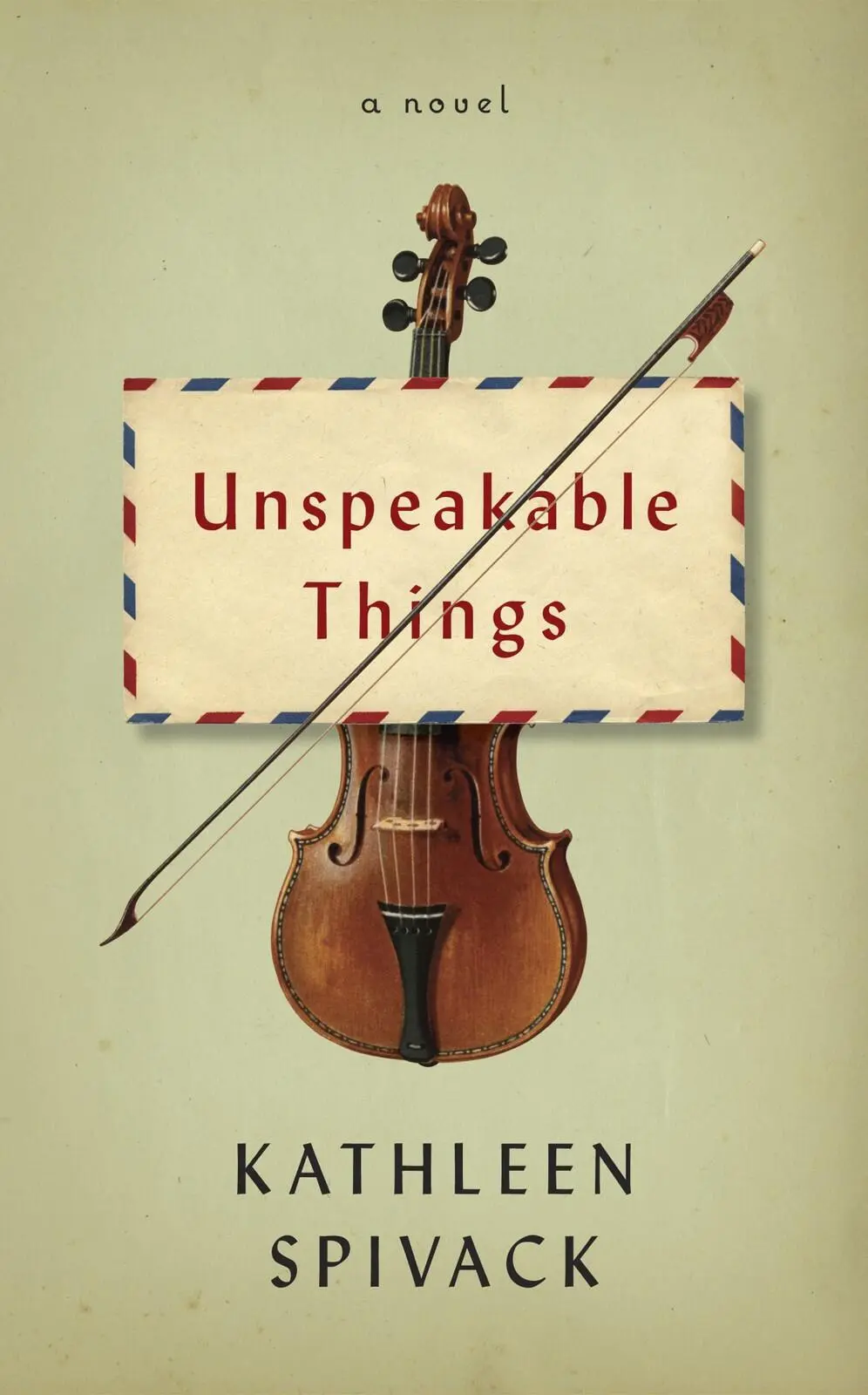
- Название:Unspeakable Things
- Автор:
- Издательство:Knopf
- Жанр:
- Год:2016
- ISBN:нет данных
- Рейтинг книги:4 / 5. Голосов: 1
-
Избранное:Добавить в избранное
- Отзывы:
-
Ваша оценка:
Unspeakable Things: краткое содержание, описание и аннотация
Предлагаем к чтению аннотацию, описание, краткое содержание или предисловие (зависит от того, что написал сам автор книги «Unspeakable Things»). Если вы не нашли необходимую информацию о книге — напишите в комментариях, мы постараемся отыскать её.
and
. A strange, haunting novel about survival and love in all its forms; about sexual awakenings and dark secrets; about European refugee intellectuals who have fled Hitler’s armies with their dreams intact and who have come to an elusive new (American) “can do, will do” world they cannot seem to find. A novel steeped in surreal storytelling and beautiful music that transports its half-broken souls — and us — to another realm of the senses.
The setting: the early 1940s, New York — city of refuge, city of hope, with the specter of a red-hot Europe at war.
At the novel’s center: Anna (known as the Rat), an exotic Hungarian countess with the face of an angel, beautiful eyes, and a seraphic smile, with a passionate intelligence, an exquisite ugliness, and the power to enchant. . Her second cousin Herbert, a former minor Austrian civil servant who believes in Esperanto and the international rights of man, wheeling and dealing in New York, powerful in the social sphere yet under the thumb of his wife, Adeline. . Michael, their missing homosexual son. . Felix, a German pediatrician who dabbles in genetic engineering, practicing from his Upper East Side office with his little dachshund, Schatzie, by his side. . The Tolstoi String Quartet, four men and their instruments, who for twenty years lived as one, playing the great concert halls of Europe, escaping to New York with their money sewn into the silk linings of their instrument cases. .
And watching them all: Herbert’s eight-year-old granddaughter, Maria, who understands from the furtive fear of her mother, and the huddled penury of their lives, and the sense of being in hiding, even in New York, that life is a test of courage and silence, Maria witnessing the family’s strange comings and goings, being regaled at night, when most are asleep, with the intoxicating, thrilling stories of their secret pasts. . of lives lived in Saint Petersburg. . of husbands being sent to the front and large, dangerous debts owed to the Tsar of imperial Russia, of late-night visits by coach to the palace of the Romanovs to beg for mercy and avoid execution. . and at the heart of the stories, told through the long nights with no dawn in sight, the strange, electrifying tale of a pact made in desperation with the private adviser to the Tsar and Tsarina — the mystic faith healer Grigory Rasputin (Russian for “debauched one”), a pact of “companionship” between Anna (the Rat) and the scheming Siberian peasant — turned — holy man, called the Devil by some, the self-proclaimed “only true Christ,” meeting night after night in Rasputin’s apartments, and the spellbinding, unspeakable things done there in the name of penance and pleasure. .
Unspeakable Things — читать онлайн бесплатно полную книгу (весь текст) целиком
Ниже представлен текст книги, разбитый по страницам. Система сохранения места последней прочитанной страницы, позволяет с удобством читать онлайн бесплатно книгу «Unspeakable Things», без необходимости каждый раз заново искать на чём Вы остановились. Поставьте закладку, и сможете в любой момент перейти на страницу, на которой закончили чтение.
Интервал:
Закладка:
The Quartet did not hear the genteel screams of dismay, did not see the hands clapped to ears, the hats pulled down. They did not notice the general stampede toward the large outward-swinging doors of the concert hall, the outrage as the Viennese rushed toward the exits and into the streets, running away from new music.
The four officers in the front row sprang to their feet. “Stop this,” commanded the senior one. “I command you to stop this noise immediately.”
The powdered faces of Gudrun, Inge, Ludmilla, and Olga cracked in dismay, and their lip rouge ran from the corners of their mouths. They looked haggard. “Stop,” whispered the women. But the Tolstoi Quartet played on. There was no stopping them. The officers took the women by their arms and firmly raised them to their feet. “Oh!” The four women’s mouths crumpled.
“Come, my dears.” They were dragged from their seats into the aisle, through the hall, and out the door. The women turned back in dismay, looking at the Tolstoi Quartet. But the musicians played, triumph and rebellion rising from the musical instruments that fiddled and scraped and scratched and twanged.
The Tolstoi Quartet played until finally, mercifully, a lone stagehand noticed that they were still there and lowered the tattered curtain. He clapped his hands over his ears as he did this. But it was too late. By the time the curtain, in shreds, was fully lowered, the man was deaf.
The Tolstoi Quartet played till the end of the final movement and put down their bows after the last flourish. They looked at one another, pleased. Alone on the darkened stage, they could still hear glass falling from shattered windows.
“Now, gentlemen,” the first violinist whispered in satisfaction, “it is time for an encore.”
Eine kleine Nachtmusik filled the now-empty concert hall, the notes falling like sunlight after a hurricane. The men played gravely; the notes were a poultice. They played in harmony, breathing as one man. Warm notes filled the cavities of their chests. The hall restored itself; even the draperies seemed to take on a new sheen. The instruments relaxed under the caressing hands of their owners. The strains of the Mozart soothed. And when it was finished, that music, the men looked deeply into one another’s eyes. “Oh, my friends,” they whispered in unison. “Oh, my children.” They kissed their instruments reverently.
They left the empty stage. The final notes of Mozart hung in the air and blessed them as they walked home.
“Don’t tell me any more,” Herbert said. He already knew the end of the story. The early-morning sunlight had given way to noon as light crept into the front section of the Automat on Forty-second Street, the usual bustle of day. Steam rose from the cafeteria, the yeasty smells of gravy and mashed potatoes. Herbert pulled his scarf closer to his body. Near the entry, Helen, the waitress, seemed to pause in her cleaning, and the counter boy and she stood silently together, wreathed in pale light. That winter New York noon light sang like an organ even within the dim cafeteria. The weak coffee had long ago grown cold. Herbert sighed. He looked at all four men, the question in his eyes. But perhaps it was no longer a question.
“Yes.” The four men looked down, cradling their hands in the folds of their coats. “Next morning they took our fingers,” said the second violinist.
“They wanted our hands,” the first violinist said. “They wanted to take our hands. The whole hand. The fingering hand. But at the last minute, our wives prevailed.”
The morning after the concert, a large black police van drove to the little flats of the Tolstoi Quartet. The musicians were allowed to take their musical instruments with them, but nothing else. The men were questioned gently, but there were no real questions, and no real answers to the questions. It was to be only a partial execution. Their hands were forced in front of them. At the last moment, a woman’s voice cried “No. Not the hand.”
“No!” said Olga, Gudrun, Ludmilla, and Inge with one voice.
“Fine,” said the chief officer. “Take only the little finger, then. Just do it.” He wanted to get it over quickly. “Just do it now.”
“But why?” asked Herbert. “Why the little finger?”
“Well, you see,” explained the first violinist. “The little finger, it is the revolutionary one. It is the one that stretches, that produces the most difficult sounds.”
“The pinkie,” explained the cellist, “whose reach exceeds the grasp.”
“The little one, he tries the hardest,” added the viola player. “He is the risk taker. He strives.”
“It is the little finger that played the high notes that drove them mad,” said the first violinist. “All this music, it cannot exist without him. When they took the little finger, they took the music, you see. They wanted to make sure we would never play such music again.” The men seemed in agreement about that.
Afterward, the men were — through the intervention of perhaps the wives, or was it the Ministry? — driven to the station, where, with instruments in hand, they were banished from Vienna forever while a military band played “Hänschen Klein” repetitively, out of tune. The four officers stood at attention as the train carrying the musicians pulled out of the main station. “Oompah, Oompah-pah,” went the gleaming tubas, thrusting the little song forward loudly, mockingly. At the last moment, the four wives ran out from behind the military guard, babushkas hastily tied around their curls, fur coats thrown in a panic about their bosoms. But they were thrust back again behind the watching crowd.
The members of the Tolstoi Quartet raised their bandaged left hands toward the women in a last, sad farewell gesture. The tubas yowled their sardonic notes as the train pulled out, carrying the men away forever.
Now the afternoon was darkening, and the Automat was empty after lunch save for a few lone men sitting morosely in the front, their hands cupped around warm mugs. A chill wind blew in the air.
“Ach.” Herbert sighed, pushing his chair from the table. He was preparing to leave.
“And so, our dear Herr Doktor, we come now to you.” The Quartet looked at him with mad, beseeching eyes. “To find our fingers.” The fingers, the Quartet knew, were still there somewhere, waiting for them in a dark box, waiting to be rejoined with their owners.
Herbert tightened his lips. His beaky shoulders hunched nearer the floor. The Quartet waited, but Herbert did not speak. He looked down at his own outspread fingers, which were resting quietly upon the table; his hands, gnarled, liver-spotted, stumpy. “Ah, my friends,” he said, as if half to himself. “Ah…”
“Please, Herr Professor, Herr Doktor. We implore you,” breathed the four men in counterpoint, and the instruments shivered next to them. Herbert could visualize the scene at the police station: the generals, the musicians’ wives, their sudden cry, and then the fingers. Those fingers, caught: did they still exist? Where?
“Gentlemen, forgive me. But I can do nothing for you.” Exhausted, Herbert longed to prepare his getaway.
“Aah Oh Eee Uuu.” The high ululating voice of a soprano practicing somewhere pierced the air. Did he imagine it or hear it? The voice rose and fell, wailing and climbing the scale, note by note, then rose another octave. “Aaa Eee Ooo Iiii Yyyy Uuuu.” It climbed upward confidently.
Herbert pushed his chair away. Already he was putting the Quartet’s story behind him, moving on to the next and then the next impossible plea.
Herbert listened as from the tombstone street a piano accompaniment began under the soprano’s voice. Somewhere roses opened in a sunny garden. A woman came to a balcony, watering pot in hand. The soprano voice rose and fell with pleasure. Herbert shivered. The notes of the piano anchored the voice firmly. “Aaahhhh…” The strains of a quartet tuning up before a performance could be heard. Adeline was putting on her best dress, and downstairs, maids were laying white linen upon the long table in preparation for the reception to follow.
Читать дальшеИнтервал:
Закладка:
Похожие книги на «Unspeakable Things»
Представляем Вашему вниманию похожие книги на «Unspeakable Things» списком для выбора. Мы отобрали схожую по названию и смыслу литературу в надежде предоставить читателям больше вариантов отыскать новые, интересные, ещё непрочитанные произведения.







Обсуждение, отзывы о книге «Unspeakable Things» и просто собственные мнения читателей. Оставьте ваши комментарии, напишите, что Вы думаете о произведении, его смысле или главных героях. Укажите что конкретно понравилось, а что нет, и почему Вы так считаете.